




As enterprises transition artificial intelligence strategies away from localized pilot projects and isolated experimental deployments toward fully realized, production-grade autonomous ecosystems, a striking operational bottleneck has come to light. According to the recently published 2026 State of Infrastructure in the Agentic AI Era report released by Google Cloud, a staggering 83% of surveyed organizations have realized that their current technology infrastructure is fundamentally inadequate to support autonomous agents at scale. This comprehensive study highlights an immense infrastructure gap that threatens to stall corporate digital transformation initiatives unless substantial capital investments and architectural overhauls are promptly executed.
The findings underscore a profound evolutionary shift within the enterprise technology sector. While initial generative AI deployments centered primarily on static prompt-and-response interactions, document summarization, and content generation, the next generation of artificial intelligence revolves around agentic workflows. Unlike their predecessors, agentic AI systems are designed to operate autonomously, executing complex, multi-step chains of logic, querying decentralized databases, navigating external software suites like Enterprise Resource Planning (ERP) and Customer Relationship Management (CRM) platforms, and maintaining contextual memory over extended periods. Consequently, the underlying hardware and software stacks must evolve rapidly to accommodate these persistent, stateful, and resource-intensive workloads.

The Evolution from Generative Experimentation to Autonomous Execution
To fully understand the gravity of the 2026 findings, it is helpful to examine the recent chronological progression of enterprise artificial intelligence adoption. Throughout 2023 and 2024, corporate boardrooms witnessed a massive influx of generative AI experimentation. Organizations rushed to establish proof-of-concept models, utilizing off-the-shelf application programming interfaces and basic cloud computing instances to test the viability of large language models. However, these early initiatives frequently operated in isolated sandboxes, far removed from core enterprise databases and mission-critical operational pipelines.
By 2025, the conversation within enterprise technology circles shifted toward the missing pieces in generalized generative AI strategies. Research conducted by Google Cloud during that period revealed near-universal experimentation, yet it simultaneously exposed critical vulnerabilities surrounding data governance, cross-platform integration, cost inefficiencies, and the complex requirements of hybrid cloud and edge deployments. Enterprises discovered that scaling generative AI required more than just powerful models; it demanded robust data pipelines and airtight security frameworks.
Now, entering 2026, the focus has transformed entirely. The industry is no longer talking about passive generative tools, but rather active, reasoning agents that continuously act across disparate enterprise systems. A single prompt issued to an advanced agentic system can effortlessly trigger hundreds of automated downstream operations. This level of autonomy requires a fundamental reimagining of cloud architectures, shifting the primary design requirements toward real-time telemetry, continuous inference tracking, high-speed inter-system communication, and advanced MLOps governance.
Breaking Down the Infrastructure Readiness Gap
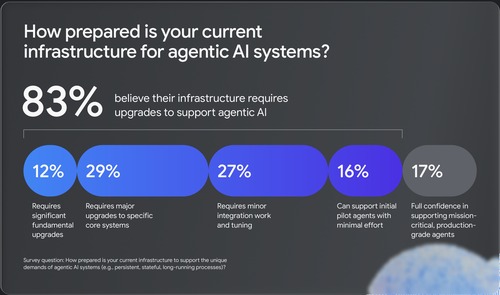
The scale of the enterprise infrastructure challenge is laid bare in the granular data provided by the Google Cloud study. The 83% readiness gap is not a monolith; rather, it is distributed across various degrees of required technical remediation, reflecting the diverse states of enterprise digital maturity.
When surveyed on their current operational capacity, only 17% of organizations reported absolute confidence in their infrastructure’s ability to support mission-critical, production-grade agentic agents without making substantial alterations. Conversely, the vast majority acknowledged varying degrees of structural deficit. Approximately 16% of respondents noted that their systems are currently capable of supporting initial pilot projects with minimal effort—a dangerously low threshold given the rapid pace of technological scaling.
More concerning are the figures pointing to deep systemic deficits. Twenty-seven percent of organizations stated that they require minor integration work and targeted tuning, while nearly a third—29%—indicated that major upgrades to specific core systems are mandatory before production rollout can safely occur. Most alarmingly, 12% of surveyed enterprises reported that their entire infrastructure requires significant, fundamental upgrades from the ground up. These organizations are essentially starting from square one when it comes to matching the rigorous networking, storage, and processing demands of autonomous software agents.

Why Agentic Workloads Break Traditional Architectures
Traditional enterprise application workloads were architected around deterministic logic, predictable user interactions, and centralized relational databases. In contrast, agentic AI introduces a dynamic, probabilistic operational model that fundamentally strains legacy IT environments.
Autonomous agents demand persistent statefulness. When an agent executes a multi-day workflow involving inventory forecasting, supply chain rerouting, and automated customer communication, it must maintain unbroken contextual awareness across each step. If the underlying data infrastructure suffers from latency or synchronization failures, the agent’s chain of reasoning can easily fracture, leading to erroneous business decisions or catastrophic system loops.
Furthermore, these systems require deep, bidirectional integration with legacy corporate architectures. Agents must securely read from and write to decades-old mainframe systems, modern cloud-native microservices, and third-party SaaS applications simultaneously. This creates unprecedented demands on API gateways, data lakes, and security perimeters. Ensuring that an autonomous agent does not inadvertently breach compliance mandates, leak sensitive personally identifiable information, or violate cross-border data residency laws requires sophisticated governance tools that many enterprise IT departments simply do not possess today.

Industry Leadership Perspectives and Strategic Implications
Commenting on the release of the comprehensive industry report, Nirav Mehta, Vice President of Product Management at Google Cloud, emphasized the transformative nature of the findings. "This report isn’t just a survey of the landscape; it’s a roadmap for establishing the new standard for production-grade autonomous systems," Mehta noted, signaling that infrastructure modernization must run parallel to algorithmic development if enterprises hope to extract genuine return on investment from their AI expenditures.
The implications of this infrastructure gap extend far beyond IT departments, touching upon executive strategy, financial planning, and organizational design. Chief Information Officers and Chief Technology Officers are now forced to reallocate capital budgets away from superficial software licensing toward foundational hardware, advanced orchestration platforms, and rigorous observability suites.
For developer and platform engineering teams, the mandate is clear. They must implement sophisticated orchestration tools capable of coordinating complex, multi-step agent workflows while retaining the ability to inject human intervention points into the loop. Without these supervisory frameworks, organizations risk losing control over automated processes operating at high velocity. Additionally, power consumption and hardware efficiency have emerged as critical decision-making factors in hardware selection, as the continuous inference demands of persistent agents drive data center energy requirements to historic highs.

Conclusion and Future Outlook for Enterprise AI
As the business world moves deeper into the agentic AI era, the division between organizations that successfully modernize their infrastructure and those that lag behind will define market leadership. The findings from the 2026 State of Infrastructure in the Agentic AI Era report serve as a definitive wake-up call. Bridging the 83% readiness gap will require disciplined investment, architectural foresight, and a willingness to dismantle outdated legacy paradigms. Enterprises that treat infrastructure as a strategic enabler rather than an afterthought will successfully harness the autonomous revolution, while those that fail to upgrade risk watching their ambitious AI initiatives collapse under the weight of their own operational limitations.