



The landscape of corporate strategy has undergone a seismic shift as artificial intelligence has effectively commoditized data analysis. For decades, the primary competitive edge for global enterprises was the ability to acquire and interpret proprietary information faster than market rivals. Today, however, high-level analytical capabilities are accessible to virtually any entity with an internet connection and a modest budget. As information access reaches parity across industries, the traditional sources of competitive advantage—such as superior data harvesting or rapid processing—have been neutralized. The focus for organizational leadership has consequently shifted from the acquisition of data to the development of human capabilities required to interpret that data effectively.
The Evolution of Information Commoditization
The trajectory of business intelligence over the last decade illustrates a rapid decline in the cost of insight. Historically, firms invested millions of dollars in data science teams, proprietary software, and expensive consultancies to gain a granular understanding of their customer base. The arrival of Large Language Models (LLMs) and generative AI platforms has compressed these costs. According to a 2023 report by the McKinsey Global Institute, generative AI could add between $2.6 trillion and $4.4 trillion annually to the global economy by automating tasks previously requiring human analytical effort.
This rapid democratization of intelligence means that no firm can rely on "having the right data" as a standalone strategy. When every competitor possesses the same analytical toolkit, the differentiation lies in the sophistication of the human layer overseeing those tools. The current business imperative is to transition from a culture of information consumption to one of institutional discernment.
A Framework for AI Integration: The Donorbox Case Study
Leadership teams across sectors are currently experimenting with frameworks to balance AI-driven efficiency with human oversight. At organizations like Donorbox, a leader in nonprofit fundraising infrastructure, the integration of AI has necessitated a structured, four-pillar approach to risk management and strategic execution.
1. The Principle of Data Governance and Discretion
The primary risk associated with AI adoption is the inadvertent exposure of proprietary or sensitive information. Because third-party AI models often ingest user inputs to refine their training sets, the risk of data leakage is significant. Industry standards for data protection now dictate that employees must exercise extreme discretion before interacting with external models.
Professional protocols require the scrubbing of datasets to remove Personally Identifiable Information (PII) before analysis. This includes the removal of email addresses, financial records, and unique identifiers. The implication for corporate policy is clear: companies must implement rigorous training programs to ensure junior analysts, who may be under pressure to deliver quick insights, do not compromise organizational security by inputting sensitive data into public or semi-public AI interfaces.
2. Building Context-Driven Workflows
AI operates within the constraints of the parameters provided, often exhibiting "hallucinations" or logical failures when context is missing. To mitigate this, organizations are adopting iterative workflows. This involves providing AI with specific business goals, screening the input data, and—critically—questioning the output.
Case analysis reveals that AI often segments markets or customer bases with high-level generalizations that fail to account for industry-specific nuances. For instance, while an AI might group all faith-based organizations into a single category, a seasoned professional understands that the operational needs of a church, a ministry, and a media publication differ vastly. The ability to push back, refine prompts, and demand multiple iterations is now a core job function that separates high-performing teams from those that rely blindly on automated outputs.
3. Transitioning to Continuous Learning and Agile Planning
The pace of AI development has rendered traditional, long-term strategic planning cycles increasingly obsolete. With tools evolving on a weekly basis, the capabilities of a firm are no longer static. A project that once required two fiscal quarters to complete may now be accomplished in a matter of weeks.
To keep pace, organizations are increasingly abandoning annual planning in favor of monthly goals and bi-weekly sprints. This agile approach allows for the rapid incorporation of new technologies as they emerge. By shortening operational timelines, leaders ensure that their teams are not working toward a version of the company that is already obsolete by the time the project reaches fruition. Continuous upskilling is no longer a luxury for elite firms; it is an operational requirement for survival.
4. The Institutionalization of Experience
Perhaps the most significant limitation of AI is its lack of "judgment"—a quality defined by the cumulative weight of past mistakes and nuanced professional experience. While an AI might suggest a marketing strategy based on prevailing trends—such as the popularity of a specific social media platform—it cannot account for the unique brand positioning, competitor history, or specific customer demographics that a veteran manager possesses.
Organizations that protect their employees from making decisions by over-relying on AI inadvertently stifle the development of this judgment. For a workforce to remain capable of overriding a flawed machine suggestion, they must be empowered to make decisions, observe the outcomes, and internalize the lessons from their failures.
Broader Economic and Workforce Implications
The shift toward human-centric AI integration is prompting a total re-evaluation of Learning and Development (L&D) budgets. As technical skills become increasingly automated, the "soft" skills of critical thinking, ethical reasoning, and cross-functional synthesis have gained premium status.
Industry analysts suggest that the next decade will define a divide between "AI-led" organizations—which treat AI as an autonomous operator—and "AI-augmented" organizations, which treat the machine as a junior contributor requiring constant management. The latter approach aligns with the consensus of human-capital experts who argue that the most successful firms will be those that teach employees to "think alongside" the technology rather than ceding control to it.
The Future of Strategic Decision-Making
The transition from a data-rich environment to an insight-rich one has fundamentally altered the power structure of the firm. Where once the gatekeepers of data held the most influence, the future belongs to the curators of logic and the practitioners of experience.
The implications for middle management are profound. Managers can no longer simply be conduits for data; they must act as editors and critics of AI-generated strategy. This requires a deeper understanding of the business’s core mechanics than was previously necessary. As the barriers to entry for data analysis continue to fall, the value of the "human in the loop" will only rise.
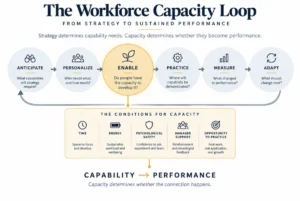
In conclusion, the competitive advantage in the current era is not the AI model itself, but the organizational capacity to harness it. Success will be determined by the rigor of governance, the agility of the planning process, and the commitment to fostering human judgment. Companies that successfully bridge the gap between machine efficiency and human intuition will be the ones that define the next generation of industrial leadership. As the technological tools evolve, the foundational requirement remains unchanged: the necessity for human leadership to provide the direction, the context, and the final word in the decision-making process.