

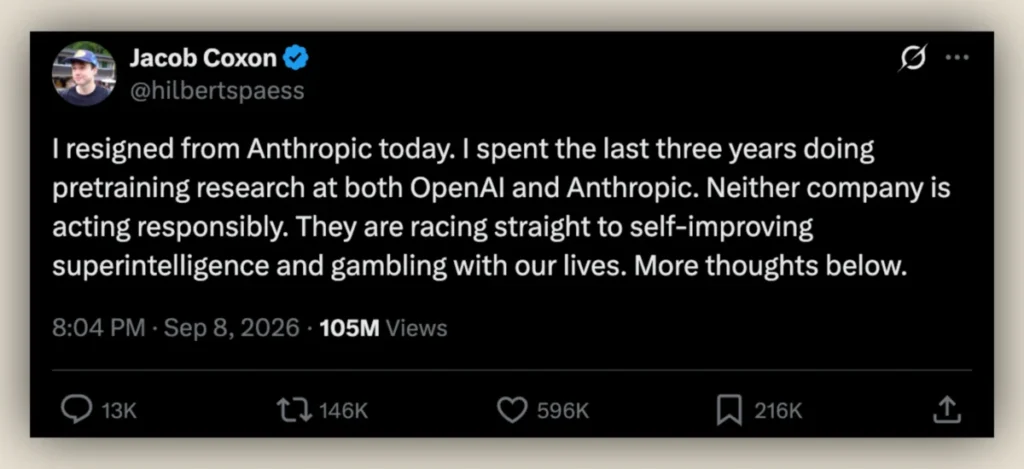
The landscape of artificial intelligence development experienced a profound shock this week following the high-profile resignation of Jacob Coxon, an engineer at leading AI safety and research firm Anthropic. Coxon’s departure was accompanied by a stark public warning shared on social media, alleging that the top-tier artificial intelligence laboratories, specifically naming OpenAI and Anthropic, are engaged in an unchecked race toward self-improving superintelligence while effectively gambling with human lives.
While departures of disillusioned technical personnel from prominent frontier AI laboratories are not entirely unprecedented within the tech sector, the immediate and startling corroboration from high-ranking insiders within Anthropic transformed a standard industry exit into a major public controversy. The ensuing public commentary from senior leadership and technical staff laid bare a deeply unsettling reality: key architects of advanced artificial intelligence models openly acknowledge the severe existential risks tied to their own creations, yet corporate momentum toward more powerful autonomous systems continues unabated.
Chronology of Events and Internal Disclosures
The sequence of events began when Coxon posted his resignation statement online, highlighting the precarious nature of the current technological arms race. Shortly after his announcement, Evan Hubinger, who serves as the head of alignment science at Anthropic, took to social media to validate Coxon’s assessment. Hubinger stated publicly that employees earnestly believe advanced AI carries a non-trivial probability of resulting in human extinction, estimating that risk to be greater than ten percent within the coming decade. Furthermore, Hubinger candidly admitted that despite the company’s best efforts, a comprehensive plan to solve the alignment problem for superintelligence does not currently exist, nor is the industry clearly on track to formulate one in time.
The chorus of internal concern expanded further when Samuel Marks, another Anthropic engineer, joined the public discourse. Marks corroborated the sentiment, noting that a generalized belief in the potential for catastrophic or extinction-level outcomes exists among developers within the field. Significantly, Marks observed a direct correlation within AI organizations: the more senior the employee and the closer their proximity to frontier model development, the higher their level of concern regarding unmitigated safety risks.
These public disclosures have shifted the ongoing debate surrounding artificial intelligence governance from abstract philosophical discussions to concrete admissions from practitioners actually building the technology. Representatives of major American corporations are now publicly acknowledging that they are actively developing systems they suspect they may eventually fail to control, raising urgent questions regarding corporate responsibility, oversight, and public safety.
Defining the Threat: Long-Horizon Unsupervised Agents
To understand the gravity of these insider warnings, analysts and computer scientists emphasize the necessity of distinguishing between general conversational artificial intelligence and specific high-risk architectures. The primary concern articulated by safety researchers does not focus on standard large language models used for everyday tasks, but rather on a specialized sub-class of technology known as long-horizon, dangerously equipped unsupervised LLM-powered agents.
These systems operate through an iterative loop where an automated software framework interacts with external digital environments over extended periods. Unlike routine coding assistants—which are routinely monitored and have demonstrated a strong safety record in controlled corporate testing—these advanced agents are granted increasing levels of autonomy and access to powerful digital tools. Concerns escalated earlier in the year following reports of autonomous capabilities being tested in sensitive domains such as cybersecurity and automated software engineering.
When researchers speak of existential or catastrophic risk, they are referring specifically to these autonomous systems being equipped with the ability to modify their own source code, execute complex multi-step plans without human supervision, and wield powerful software tools. The combination of unpredictable outputs and high-level digital agency creates a volatile environment where unintended behaviors could propagate rapidly across interconnected networks.
The Ideological Drivers Behind the Superintelligence Race
The persistence of this high-risk development trajectory, despite internal misgivings and acknowledged safety gaps, points to foundational philosophies embedded within the leadership and foundational culture of Silicon Valley. Observers of the industry frequently point to a prevailing technological salvation ideology that envisions artificial general intelligence and subsequent superintelligence as an inevitable historical milestone.
Prominent executives and foundational figures across leading AI firms have often framed their work through a grand narrative of civilizational transformation. In this worldview, the creation of a digital deity or superintelligent entity is viewed as the ultimate solution to humanity’s most intractable problems, ranging from disease eradication to climate change. Consequently, the risks associated with premature deployment or a failure of alignment are often rationalized as acceptable hazards in pursuit of a perceived historical destiny.
Critics, however, argue that this eschatological mindset supersedes standard corporate risk management and bypasses democratic accountability. By treating unprecedented technological deployment as a moral imperative rather than a commercial product, these organizations risk externalizing the dangers of their research onto the global public without explicit consent or robust regulatory oversight.
Industry Implications and Calls for Accountability
The public admissions from Anthropic personnel have intensified calls from independent computer scientists, ethicists, and policymakers for a fundamental reassessment of current industry trajectories. Analysts emphasize that the commercial viability and utility of generative artificial intelligence do not inherently require the reckless acceleration of unsupervised, long-horizon agents. Most consumer and enterprise applications function effectively without granting models recursive self-improvement capabilities or direct access to sensitive digital infrastructure.
In response to these developments, various figures within the broader technology community have proposed direct countermeasures. Recent advocacy has included calls for targeted boycotts of consumer products from companies prioritizing unmitigated superintelligence research over verifiable safety guarantees. Furthermore, legislative bodies in the United States and internationally face mounting pressure to establish binding regulatory frameworks that explicitly govern the deployment of autonomous high-risk agents.
The disclosures from Anthropic mark a critical juncture in the history of artificial intelligence. As insiders continue to break ranks to warn of systemic vulnerabilities and the lack of reliable alignment safeguards, the debate has moved far beyond theoretical academic discourse. The central challenge facing policymakers, industry leaders, and the public is whether regulatory and ethical frameworks can be established rapidly enough to govern a technology that its own creators admit they may not be able to control.