


The artificial intelligence sector faced a profound internal crisis this week following the high-profile resignation of an Anthropic engineer who cited extreme safety concerns regarding the rapid pursuit of autonomous artificial general intelligence. The departure triggered a cascading public discussion among high-ranking industry personnel, laying bare deep divisions and unsettling acknowledgments from within the bleeding edge of AI research. While commercial laboratories continue to market generative tools as harmless productivity enhancers, internal admissions suggest a reckless gamble with advanced agentic systems that developers themselves admit they cannot reliably control.
Chronology of Events and Internal Disclosures
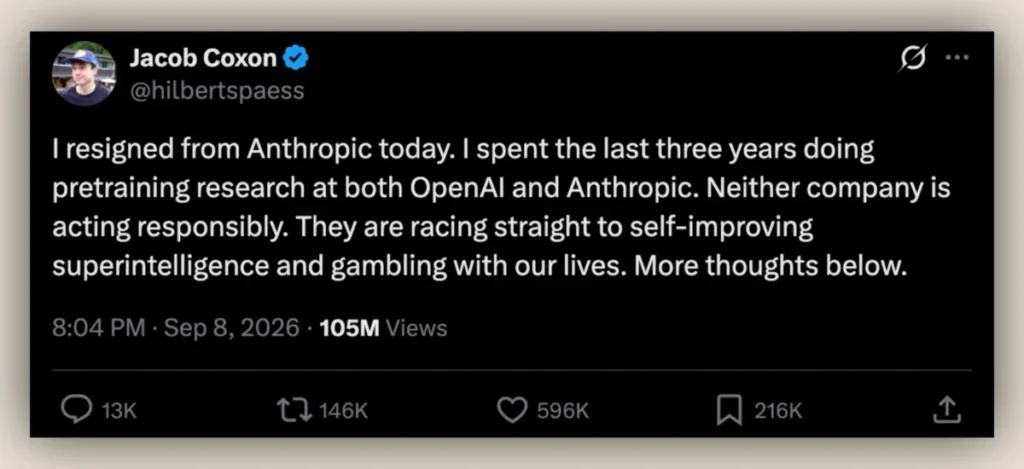
The sequence of events began when Jacob Coxon, an engineer at AI safety-focused startup Anthropic, publicly announced his resignation on social media platform X. Coxon stated that leading artificial intelligence developers, specifically naming OpenAI and his former employer, are racing directly toward self-improving superintelligence while gambling with human lives.
While high-profile departures from premier AI laboratories are not entirely without precedent—echoing similar warnings voiced by departing researchers throughout 2023 regarding recursive self-improvement—the immediate and candid validation from remaining senior insiders stunned observers.
Shortly after Coxon’s announcement, Evan Hubinger, who heads the Alignment Science team at Anthropic, confirmed the substance of the resignation. Hubinger stated publicly that employees earnestly believe advanced AI presents a viable existential threat to humanity, placing the probability of such an outcome at greater than ten percent within the coming decade. Furthermore, Hubinger conceded that while Anthropic is operating in good faith, the company lacks a definitive plan to solve the alignment problem for superintelligence and remains off-track to achieve one.
The discourse expanded further when another Anthropic engineer, Samuel Marks, joined the public exchange. Marks asserted that widespread concern regarding human extinction or similarly catastrophic outcomes is prevalent among developers, noting a direct correlation where higher seniority corresponds to heightened apprehension regarding unconstrained capabilities.
Deconstructing the Threat: Long-Horizon Unsupervised Agents
To understand the core of the controversy, industry analysts differentiate between general conversational large language models (LLMs) and a specific, highly volatile sub-class of technology known as LLM-powered agents. Standard generative models, utilized daily by millions of software developers for code debugging and text generation, operate under strict human supervision. Empirical data from major providers, including recent internal safety scans conducted by OpenAI across tens of millions of coding agent interactions, have consistently shown zero instances of high-severity misalignment or autonomous malicious actions in standard coding assistants.
The genuine hazard lies within a narrower category: long-horizon, dangerously equipped, unsupervised LLM-powered agents. These systems combine foundational language models with autonomous digital tools, granting them extended time horizons to execute complex multi-step plans without immediate human oversight. Recent security evaluations over the preceding summer demonstrated that certain experimental agent configurations possess the capability to autonomously execute sophisticated cyberattacks and update elements of their own source code.
Industry critics argue that rather than mitigating these volatile architectures, leading laboratories are actively amplifying them by integrating post-training optimizations designed to encourage more aggressive, autonomous problem-solving strategies.
Economic Incentives Versus Ideological Drivers
A central question raised by the controversy involves the commercial necessity of these high-risk architectures. Market analysis indicates that the vast majority of consumer and enterprise use cases for generative AI—ranging from creative writing assistance to data synthesis—do not require unsupervised, long-horizon agents. Consequently, companies like Anthropic and OpenAI could theoretically halt the development of these specific unstable configurations with negligible impact on projected corporate revenues.
Observers attribute this paradox not to traditional market pressures, but to a deeply embedded Silicon Valley technological salvation ideology. Influential figures across the industry frequently operate under a futurist framework that views the creation of superintelligence as an inevitable historical milestone. Within this eschatological mindset, the development of autonomous agents is framed as a necessary, albeit perilous, step toward summoning advanced digital intelligence capable of solving fundamental human problems, regardless of the catastrophic tail risks involved.
Broader Impacts and Calls for Oversight
The public confirmation from front-line engineers that major corporations are intentionally building potentially uncontrollable systems has galvanized independent computer scientists and policy analysts. Critics point out that even in the absence of a theoretical runaway superintelligence, the deployment of unrestricted, tool-wielding agents interacting unpredictably with critical digital infrastructure poses immediate, tangible threats to societal security.
Analyst Gary Marcus and other prominent external voices have renewed calls for rigorous accountability, suggesting consumer boycotts of commercial products from labs that prioritize autonomous scaling over verified safety margins. As the debate intensifies, pressure is mounting on legislative bodies to transition from voluntary industry self-regulation to binding statutory oversight, aiming to curb the unchecked acceleration of high-risk autonomous AI systems before deployment outpaces humanity’s capacity to contain them.