

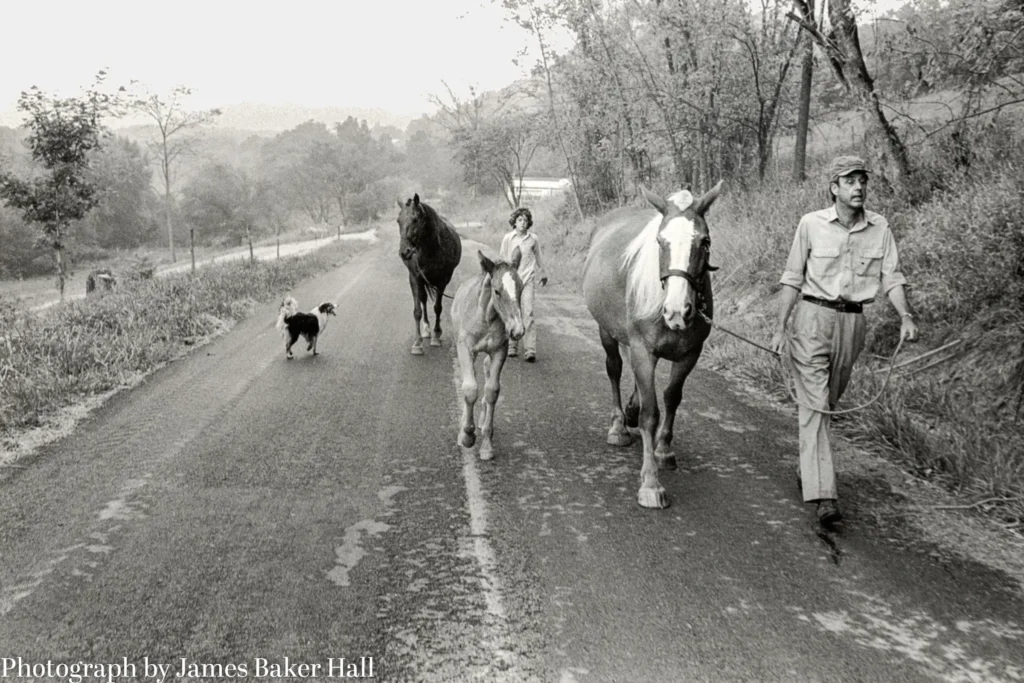
The passing of Wendell Berry at his Port Royal, Kentucky home at the age of 92 marks the conclusion of a life dedicated entirely to agrarian stewardship, environmental advocacy, and literary craftsmanship. Over a career spanning more than six decades, Berry established himself as one of the United States’ most formidable critics of industrial agriculture and technological detachment, choosing instead to farm his ancestral land with traditional techniques, write by hand, and live without the trappings of modern electricity. While his specific lifestyle—characterized by horse-drawn plows and writing in a secluded cabin—was uniquely his own, his broader legacy offers a profound template for intentional living in an increasingly automated and digital era.
Chronology of a Counter-Cultural Path
Berry’s journey to the rolling hills of Henry County, Kentucky, was neither direct nor provincial. Born in 1935, he initially pursued a conventional trajectory toward elite academic and literary success. He earned both his bachelor’s and master’s degrees from the University of Kentucky before heading west to Stanford University to study creative writing. Following his time in California, he received a prestigious Guggenheim Fellowship, which enabled him to spend formative months traveling and writing in Italy and France.
Upon returning to the United States, Berry accepted a faculty position as a professor of creative writing at New York University’s Bronx campus. By all standard academic metrics, he was on a swift upward trajectory toward institutional prestige in the heart of the American literary establishment. However, by 1964, at the age of 29, Berry made a radical pivot that baffled his colleagues and mentors. He resigned from his position at NYU, packed up his young family, and returned permanently to Henry County, Kentucky, where his ancestors had farmed for generations.
The decision was met with immediate skepticism from the academic hierarchy. As chronicled by writer David Demaree, Berry’s department supervisor called him into his office on the day of his resignation, attempting to dissuade him from discarding an extraordinary career. Invoking Thomas Wolfe’s famous dictum that "you can’t go home again," the senior faculty member warned Berry that retreating to Kentucky would amount to "intellectual death," cutting him off from the cultural epicenters of the metropolis. Unmoved, Berry maintained his course, driven by an unshakeable conviction that an authentic writer must be rooted in the specific geography and community they seek to portray.
Artistic Integrity and the Agrarian Ethos
Reflecting on that pivotal choice decades later in a 2018 interview with The New York Times, Berry explained the practical necessity of his geographical grounding. "The landscape was there to check me if I was wrong," he noted. "I could never go away and make up stuff at cocktail parties about the backwoods of Kentucky. I worked with people here in all walks of life and learned from them. It’s been a very rich experience."
This commitment to place formed the bedrock of Berry’s vast literary output, which includes dozens of volumes of poetry, fiction, and essays. Works such as The Unsettling of America: Culture and Agriculture (1977) served as foundational texts for the modern sustainable agriculture movement. Berry argued persuasively that the industrialization of farming was not merely an economic shift, but a moral catastrophe that severed humanity’s connection to the land and eroded rural communities. He championed local economies, familial stewardship of the soil, and the virtues of neighborly interdependence over corporate efficiency and globalized supply chains.
The Crisis of Modern Digital Disconnect
In the wake of Berry’s passing, cultural critics and sociologists have increasingly turned their attention to the contemporary relevance of his philosophy. The modern landscape stands in stark contrast to the rhythms of Henry County. Society is increasingly defined by digital intermediation, algorithmic optimization, and a pervasive sense of cognitive numbness.
As white-collar labor has migrated to digital platforms, millions of workers find themselves trapped in cycles of performative productivity—managing endless email chains, scheduling redundant video conferences, and generating corporate documentation that serves little functional purpose. Simultaneously, consumer technology and artificial intelligence are systematically engineered to eliminate friction, discomfort, and cognitive strain. Algorithms curate automated entertainment streams designed to placate anxious minds, while generative tools handle tasks that once required deep, focused thought.
Even civic engagement and political discourse have been compressed into digital theater. Social media platforms encourage users to adopt radical postures from the safety of remote screens, reducing complex societal challenges to performative tribalism. Berry recognized the nascent forms of these digital and industrial temptations during his lifetime, consistently warning that the systematic evasion of physical reality and hard labor would ultimately impoverish the human spirit.
Redefining Success in the Twenty-First Century
Berry’s life and philosophy challenge the fundamental metrics of success promoted by contemporary market economies. He demonstrated that hardship, physical strain, and intentional limitations are not obstacles to be engineered out of existence, but rather necessary components of a meaningful life. When an individual aligns their daily actions with a deeply considered set of values, the friction of physical existence ceases to be a burden and instead forms a resilient foundation capable of withstanding external turbulence.
While very few individuals possess the inclination or opportunity to abandon urban and suburban life to farm with draft animals, Berry’s core message transcends geography. His legacy invites a radical reassessment of how modern citizens allocate their attention, interact with their immediate physical communities, and navigate a culture dominated by screens and convenience.
Implications for the Future of Intentional Living
The death of Wendell Berry closes a significant chapter in American letters and environmental thought, prompting institutions and individuals alike to evaluate the trajectory of modern civilization. As society grapples with the psychological tolls of hyper-connectivity, ecological anxiety, and institutional alienation, Berry’s framework offers a compelling counter-narrative.
His rejection of the metropolitan literary machine in favor of obscurity and fidelity in Kentucky proves that purposeful limitations can yield profound cultural richness. By choosing to anchor his life to a specific landscape, a community, and a craft, Berry achieved a level of intellectual and artistic independence that few of his academic peers ever matched.
Ultimately, the lesson of Wendell Berry’s ninety-two years extends far beyond the borders of Port Royal. It is an enduring reminder that a deep, intentional life is built not by accumulating digital conveniences or chasing institutional prestige, but by cultivating what is near, honoring the responsibilities of place, and embracing the profound satisfactions of purposeful labor.