



When automotive engineers speak of high-performance luxury vehicles, the prevailing industry trend typically leans toward accumulation: heavier hybrid battery packs, more complex all-wheel-drive systems, and increasingly intricate digital interfaces. However, British luxury manufacturer Bentley Motors has charted a distinctly divergent path with its latest offering. The 2026 Bentley Continental GT Supersports challenges conventional engineering paradigms by demonstrating that profound capability can be achieved through rigorous weight reduction and mechanical simplification.
Priced with an official starting MSRP of $486,600 in the United States, the Supersports represents an extraordinary exercise in engineering focus. Despite its half-million-dollar price tag, the entire production run of 500 units has already been completely sold out. Every single vehicle has been heavily customized through Bentley’s bespoke Mulliner division, ensuring that no two examples leaving the Crewe factory will be identical. This exclusivity cements the Supersports not merely as a high-performance machine, but as a prized collector’s item from its moment of inception.
Genesis of the Supersports: A Radical Engineering Experiment
The genesis of the 2026 Bentley Continental GT Supersports lies within a clandestine "what-if" project conceived by the brand’s powertrain and vehicle dynamics engineers. Traditionally, the Continental GT family has relied heavily on sophisticated all-wheel-drive configurations to deliver year-round usability and high-speed stability. Furthermore, contemporary iterations have integrated hybrid-electric powertrains to meet stringent global emissions standards and provide silent urban transit.
While these technologies offer undeniable utility—such as secure traction during winter excursions to alpine resorts—they introduce a significant performance penalty on closed circuits. The hybrid-electric architecture and heavy all-wheel-drive hardware contribute substantial mass, which inevitably induces understeer and blunts razor-sharp track agility.
Intrigued by the untapped potential of the underlying chassis, the engineering team posed a fundamental question: What dynamic capabilities could be unlocked if the vehicle were stripped of its heavy hybrid-electric components and all-wheel-drive systems, resulting in a pure, combustion-powered, rear-wheel-drive track machine? The resulting vehicle, the Continental GT Supersports, provides a definitive answer, proving that a singular focus on weight reduction can radically transform a grand tourer’s personality.
An Aggressive Diet: Shedding 1,000 Pounds
The most remarkable achievement in the development of the Supersports is its extensive weight-loss regimen. By eliminating the heavy battery packs, electric drive motors, and front-axle drive shafts associated with the standard Continental GT, engineers managed to shed an astounding 1,000 pounds of mass compared to its electrified sibling.
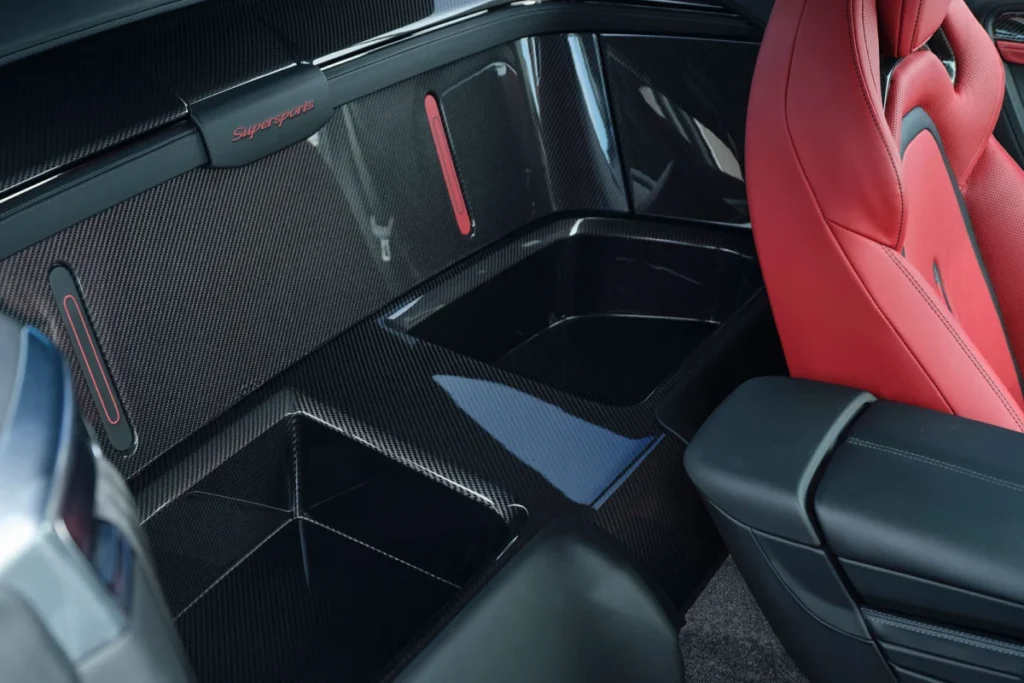
To achieve further reductions, the development team implemented a comprehensive lightweighting strategy. Carbon-fiber body panels replace traditional steel and aluminum structures where appropriate, while lightweight forged aluminum wheels reduce unsprung mass significantly. Additionally, a bespoke titanium exhaust system trims valuable pounds from the vehicle’s underside while altering its acoustic signature.
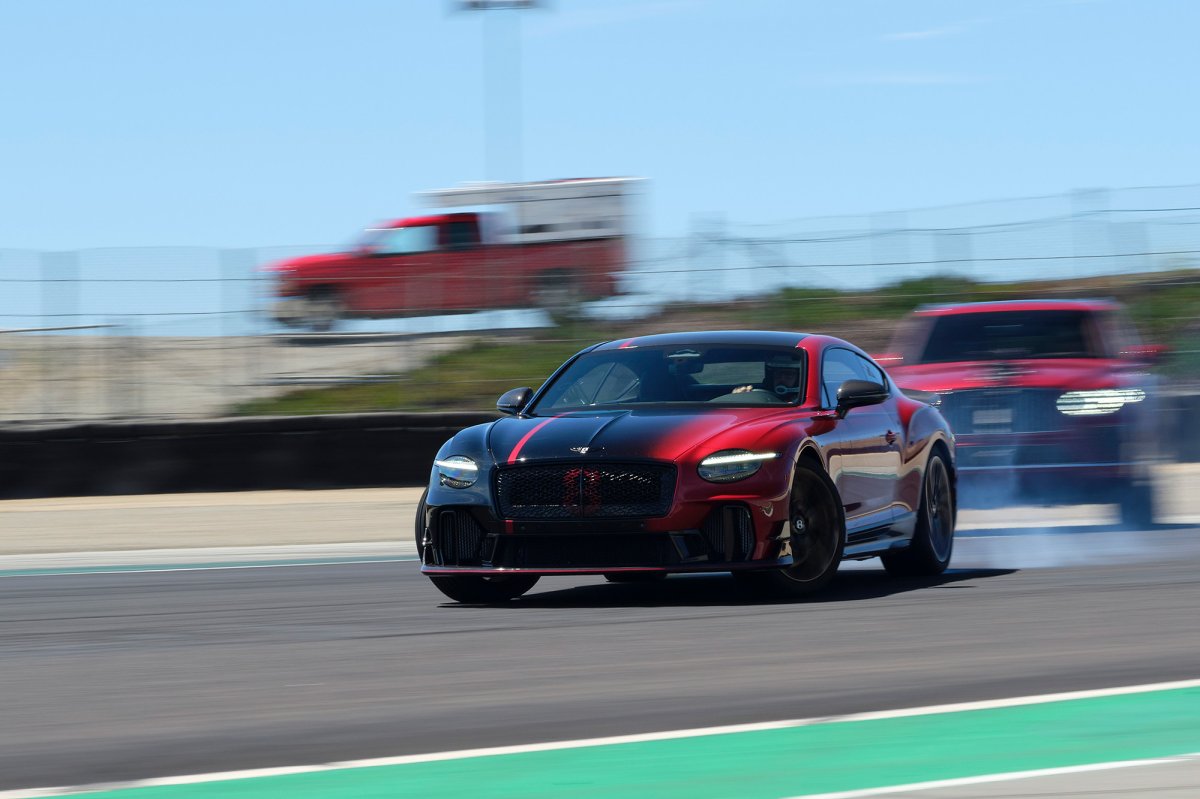
According to Bentley Americas President and CEO Mike Rocco, every aerodynamic addition serves a functional purpose. The visible carbon-fiber elements along the vehicle’s flanks are meticulously engineered to optimize downforce, manage airflow, and facilitate cooling for critical mechanical components under high-stress track conditions. Despite this rigorous dieting program, the Supersports remains a substantial grand tourer, tipping the scales at just over 4,400 pounds. Yet, its physical footprint is masked by advanced chassis technology and meticulously tuned suspension kinematics.
Powertrain Dynamics and Acoustic Engineering
At the heart of the 2026 Bentley Supersports is a heavily revised, non-hybridized version of the brand’s twin-turbocharged 4.0-liter V8 engine. Eschewing electrical assistance entirely, this internal combustion powerplant churns out an impressive 657 horsepower and 590 pound-feet of torque.
To achieve this power output reliably without the torque-filling assistance of an electric motor, engineers implemented several key hardware upgrades. The engine features larger-diameter single-scroll turbochargers designed to deliver sustained boost at high RPMs, alongside a robust dual-mass flywheel that helps manage the engine’s potent rotational forces.
The combustion symphony is projected through an Akrapovič titanium active exhaust system. This setup allows the driver to modulate the vehicle’s acoustic profile dynamically. On a closed circuit, the system opens up to deliver a resonant, energetic roar, while early morning departures from residential areas remain undisturbed due to adjustable valve control that softens the exhaust note.
Power is channeled to the rear wheels via a ZF-supplied eight-speed dual-clutch transmission. This gearbox executes instantaneous, seamless shifts, operating autonomously or via tactile steering-wheel-mounted shift paddles. During intensive testing sessions at WeatherTech Raceway Laguna Seca in Monterey, California, the transmission’s automated track programming demonstrated exceptional calibration, executing precise downshifts under heavy braking for the circuit’s infamous Corkscrew turn before ascending back toward the front straightaway.
Advanced Chassis Control and Handling Dynamics
Managing 590 pound-feet of torque exclusively through the rear wheels presents distinct dynamic challenges, particularly during aggressive acceleration out of slower corners. To mitigate unwanted wheelspin and oversteer, the Supersports is equipped with a torque-vectoring, electronically limited-slip differential.
This system works in tandem with an advanced electronic stability control architecture that permits a degree of slip without completely neutering power delivery. If a driver applies throttle with excessive aggression, the rear end will gracefully slither, offering immediate feedback regarding the limits of rear-wheel traction. When pointed in a straight line, the vehicle dispatches the sprint from zero to 60 miles per hour in just 3.4 seconds.
Despite its inherent heft, the Supersports exhibits remarkable agility through corners, courtesy of a sophisticated active suspension system. Traditional passive steel anti-roll bars have been replaced by twin-valve air springs paired with a 48-volt active anti-roll control system. This technology enables the vehicle’s suspension to adapt in real time to shifting road and track surfaces, ensuring high-speed stability without sacrificing low-speed compliance.
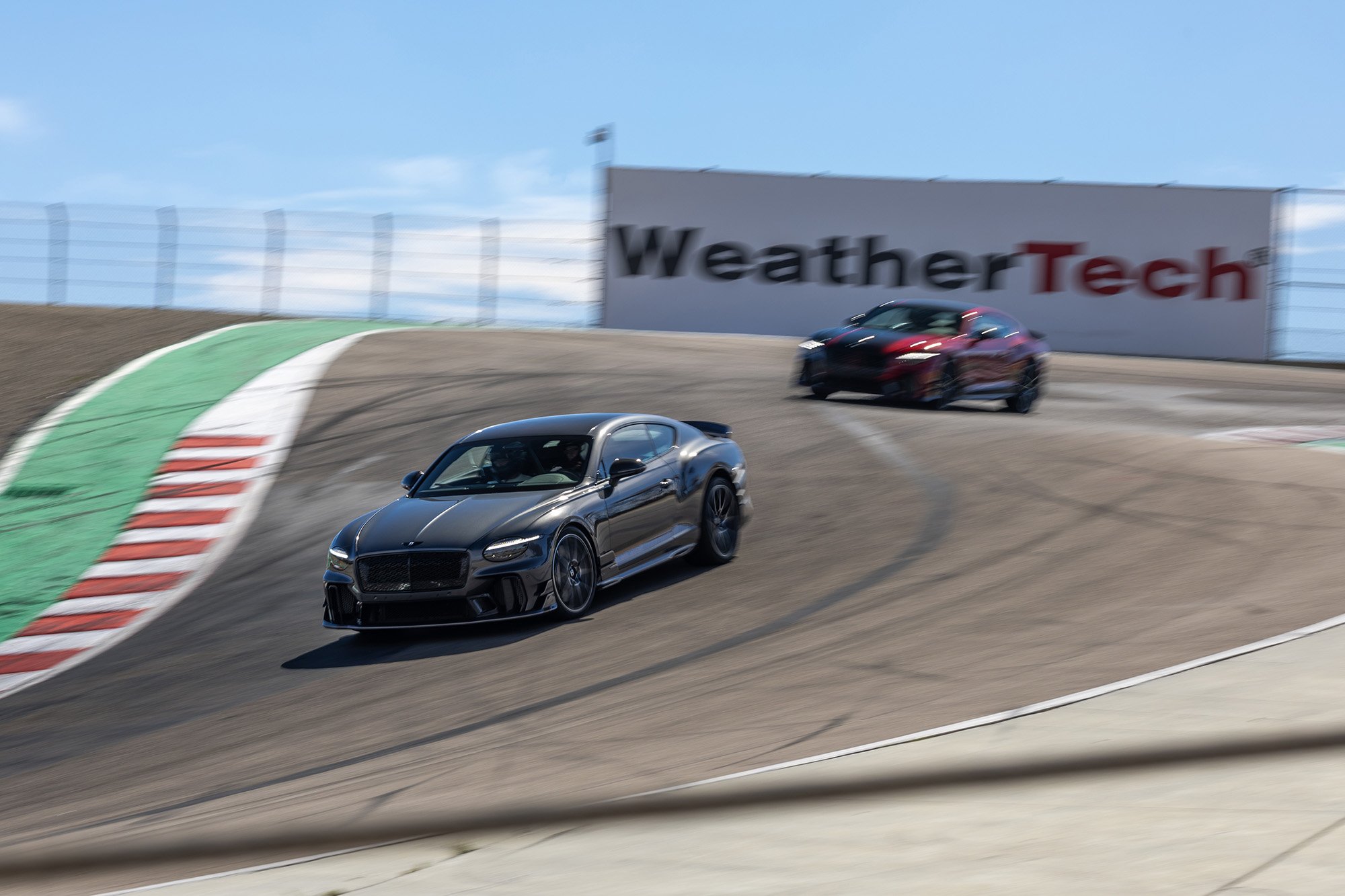
Deceleration duties are handled by massive carbon-silicon-carbide brake rotors measuring 17.3 inches up front, gripped by colossal 10-piston calipers. The rear setup utilizes 16.1-inch rotors paired with four-piston calipers. Unlike many high-performance carbon ceramic systems that suffer from annoying squeal during light street driving or exhibit wooden pedal feel, Bentley’s setup delivers progressive friction, linear feedback, and immense stopping power. The vehicle’s aerodynamic profile—comprising carbon-fiber splitters, diffusers, and dive planes—generates substantial high-speed downforce, which enhances braking efficiency as vehicle velocity increases. Contact with the pavement is maintained via sticky Pirelli P Zero Trofeo RS tires, sized 275/35 ZR22 in the front and 315/30 ZR22 in the rear, wrapped around 22-inch forged aluminum wheels.
Bespoke Craftsmanship and Mulliner Integration
While the Supersports is unapologetically engineered for track performance, it retains the bespoke craftsmanship that defines the Bentley marque. Because the entire production run of 500 units was spoken for prior to public delivery, every client engaged directly with Bentley’s internal personalization division, Mulliner, to co-create their vehicle.
This collaborative process ensures that each customer can tailor interior materials, exterior paint finishes, stitching patterns, and specialized track-focused accessories to their exact preferences. Mulliner’s involvement transforms the purchasing experience from a standard retail transaction into a bespoke design commission, reinforcing the vehicle’s status as a rare automotive artifact.
Broader Market Implications and Industry Outlook
The introduction of the 2026 Bentley Continental GT Supersports carries interesting implications for the ultra-luxury automotive sector. As global regulatory frameworks increasingly push manufacturers toward electrification, hybrids, and heavy battery-electric vehicles, the Supersports serves as a defiant reminder of the engaging qualities inherent in lightweight, internal-combustion engineering.
By proving that a traditional grand tourer platform can be dramatically re-engineered into a purist, rear-wheel-drive track weapon—and selling out its entire 500-unit production run instantaneously—Bentley has gathered valuable market intelligence. Industry analysts suggest that the commercial and critical success of the Supersports program may encourage corporate leadership to explore further niche, performance-oriented variants across the brand’s product portfolio.
Whether this experiment sparks a broader trend of lightweight, combustion-focused special editions within the ultra-luxury segment remains to be seen. However, for the fortunate 500 owners who secured an allocation, the 2026 Bentley Continental GT Supersports stands as a definitive engineering tour de force—proving unequivocally that sometimes, less truly is more.