

The Hellenic Republic remains one of the world’s most significant cultural and logistical hubs, drawing over 32.7 million international visitors in 2023 alone, according to data from the Hellenic Statistical Authority (ELSTAT). As the cradle of Western civilization, Greece offers a linguistic landscape that is both ancient and vibrantly modern. For the millions of travelers, expatriates, and digital nomads entering the country annually, the acquisition of foundational Greek phrases is no longer merely a courtesy but a strategic necessity for navigating the socio-economic fabric of the nation. Linguistic experts suggest that even a rudimentary command of the Greek language—an Indo-European language with a documented history spanning 3,400 years—can significantly alter the quality of interpersonal transactions and professional engagements within the region.
The Foundational Lexicon: Formalities and Social Lubricants
The initial phase of linguistic integration focuses on high-frequency "politeness markers." In the Greek context, these words serve as the primary tools for establishing rapport. Unlike English, Modern Greek maintains a strict distinction between formal and informal address, a feature that reflects the country’s deep-rooted respect for social hierarchy and age.
The term for "Hello," Yassas (Γεια σας), is employed in formal settings or when addressing multiple people. Conversely, Ya sou (Γεια σου) is reserved for peers, children, and informal acquaintances. This distinction extends to the inquiry "How are you?" where Ti kanete? (Τι κάνετε;) serves the formal/plural register, and Ti kanis? (Τι κάνεις;) serves the informal.
Supporting this framework are the essential monosyllables of daily life. Paradoxically for English speakers, the Greek word for "Yes" is Ne (Ναι), which phonetically resembles the English "Nay." The word for "No" is Ochi (Όχι). Mastering these, alongside Parakalo (Παρακαλώ) for "Please" and Efcharisto (Ευχαριστώ) for "Thank you," constitutes the minimum viable product for any visitor. The latter, Efcharisto, is often cited by linguists as a "shibboleth" for learners due to the "ch" sound (chi), which requires a soft, guttural expiration not present in standard English.
Chronology of Daily Interaction: Temporal Greetings
Social life in Greece is heavily dictated by the time of day, with specific greetings assigned to various windows of the 24-hour cycle. Understanding this chronology is vital for travelers interacting with hospitality staff and local residents.
- Kalimera (Καλημέρα): Used from sunrise until approximately 12:00 PM or 1:00 PM. It translates literally to "Good morning" and is arguably the most cheerful and widely used greeting in the Greek vocabulary.
- Kalo apogevma (Καλό απόγευμα): Translating to "Have a good afternoon," this is typically used as a parting wish during the late afternoon hours.
- Kalispera (Καλησπέρα): This greeting takes over from the late afternoon (post-4:00 PM) until the end of the day. In a journalistic or formal setting, using Kalispera prematurely is a common minor faux pas for foreigners.
- Kalinihta (Καληνύχτα): Reserved strictly for "Good night" when one is departing for sleep or leaving a social gathering late at night.
For departures that do not require a specific time marker, Adio (Αντίο) serves as a standard "Goodbye," while the colloquial Ta leme (Τα λέμε) functions as "See you later" or "Talk soon," signaling a continued social connection.
The Economic Impact: Survival Greek in the Tourism Sector
With tourism accounting for approximately 20% of Greece’s Gross Domestic Product (GDP), the ability to conduct basic transactions in the native tongue has measurable implications for service quality. While English proficiency is high in urban centers like Athens and Thessaloniki, as well as on popular islands like Mykonos and Santorini, the use of Greek in the "Plaka" or at a "Taverna" often results in more authentic interactions and, occasionally, preferential treatment.
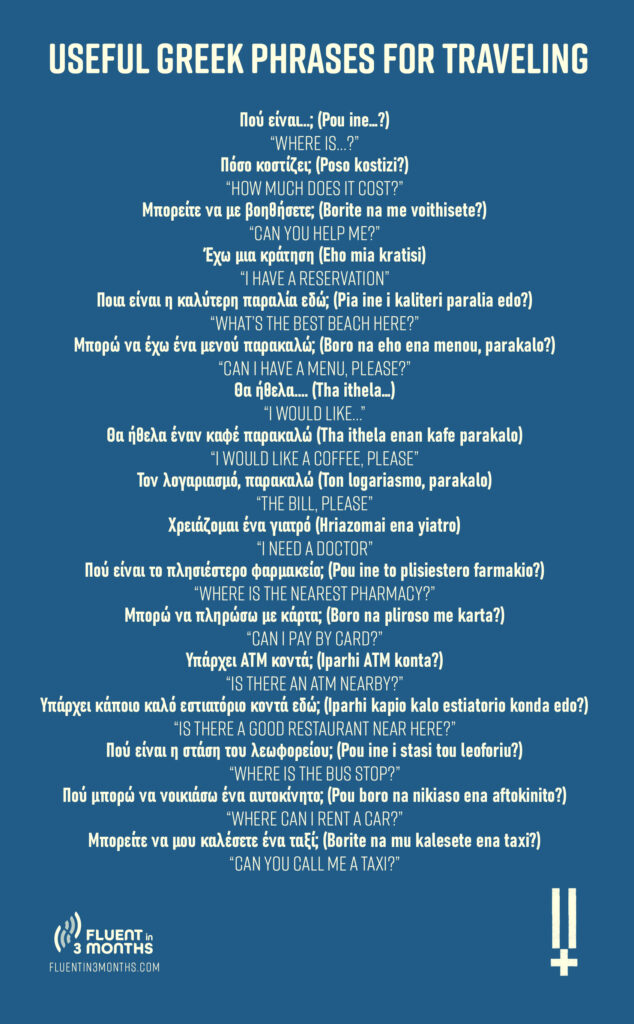
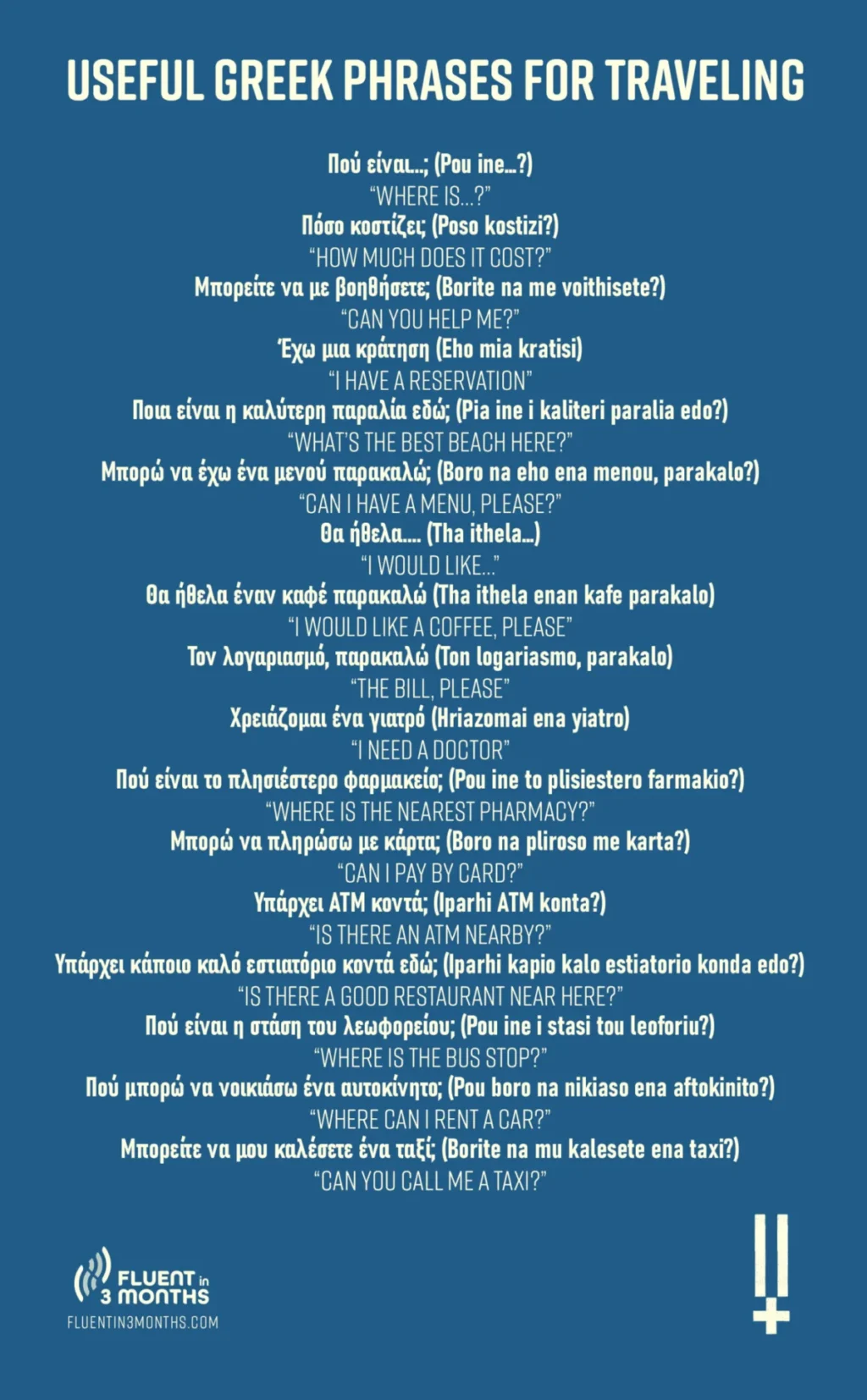
Key navigational phrases include Pou ine i tualeta? (Πού είναι η τουαλέτα; – Where is the bathroom?) and Poso kani? (Πόσο κάνει; – How much is it?). In a dining context, requesting the bill—Ton logariasmo, parakalo (Τον λογαριασμό, παρακαλώ)—is a fundamental requirement. Travelers are also encouraged to learn Kali orexi (Καλή όρεξη), the Greek equivalent of Bon appétit, and Yamas! (Γεια μας!), the ubiquitous toast meaning "To our health."
In more urgent scenarios, "Survival Greek" includes phrases such as Hriazomai ena yiatro (Χρειάζομαι ένα γιατρό – I need a doctor) and Pou ine to plisiestero farmakio? (Πού είναι το πλησιέστερο φαρμακείο; – Where is the nearest pharmacy?). Given that Greek pharmacies often serve as the first point of medical consultation for minor ailments, knowing this term is a critical safety measure for any traveler.
Professional and Personal Identification
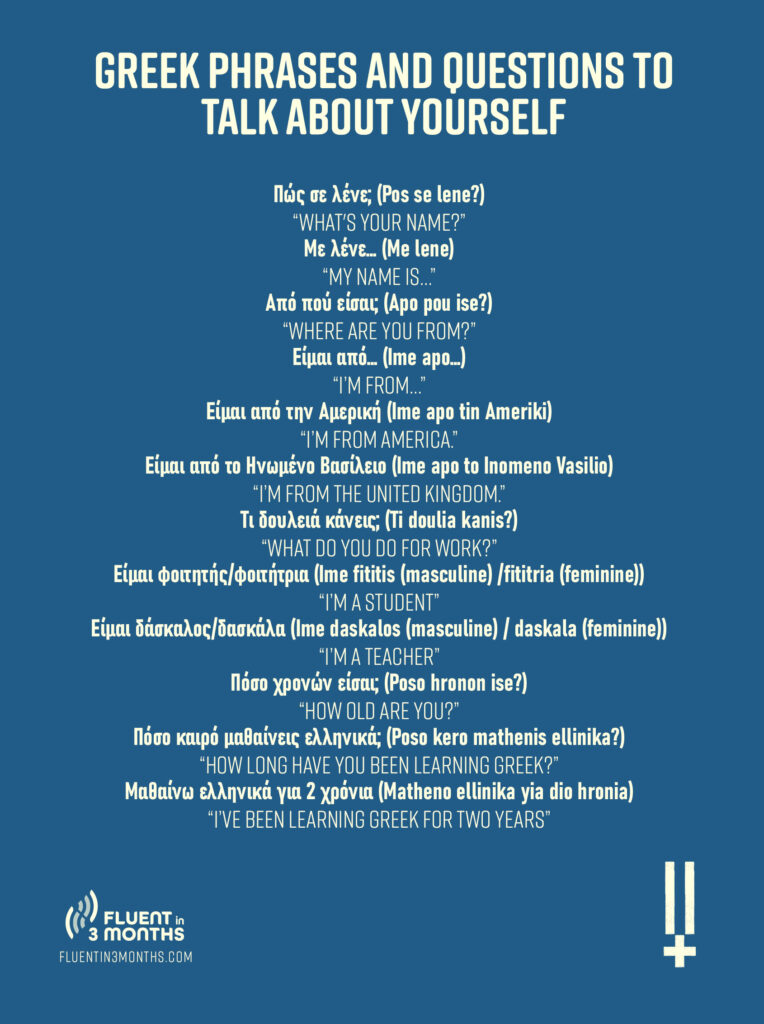
For the growing demographic of "digital nomads"—a sector the Greek government has actively incentivized through specialized visa programs—moving beyond basic greetings into personal introduction is the next logical step. The structure for self-identification is straightforward: Me lene… (Με λένε… – My name is…) and Ime apo… (Είμαι από… – I am from…).
When discussing professional backgrounds, the Greek language applies gender-specific suffixes to occupations. For instance, a male student is a fititis (φοιτητής), while a female student is a fititria (φοιτήτρια). Similarly, a male teacher is a daskalos (δάσκαλος) and a female teacher is a daskala (δασκάλα). This grammatical nuance is a gateway into the broader complexities of Greek declension and gendered nouns, which represent the primary hurdle for English-speaking students of the language.
Sociolinguistic Analysis: Slang and Informal Registers
To understand the modern Greek "street" or "parea" (social circle), one must acknowledge the role of informal registers and slang. Perhaps no word is more synonymous with Greek colloquialism than malaka (μαλάκα). While technically a vulgarity, its usage has evolved into a versatile contronym. Depending on the tone and context, it can be a harsh insult or a term of endearment between close male friends.
Other high-utility slang terms include:
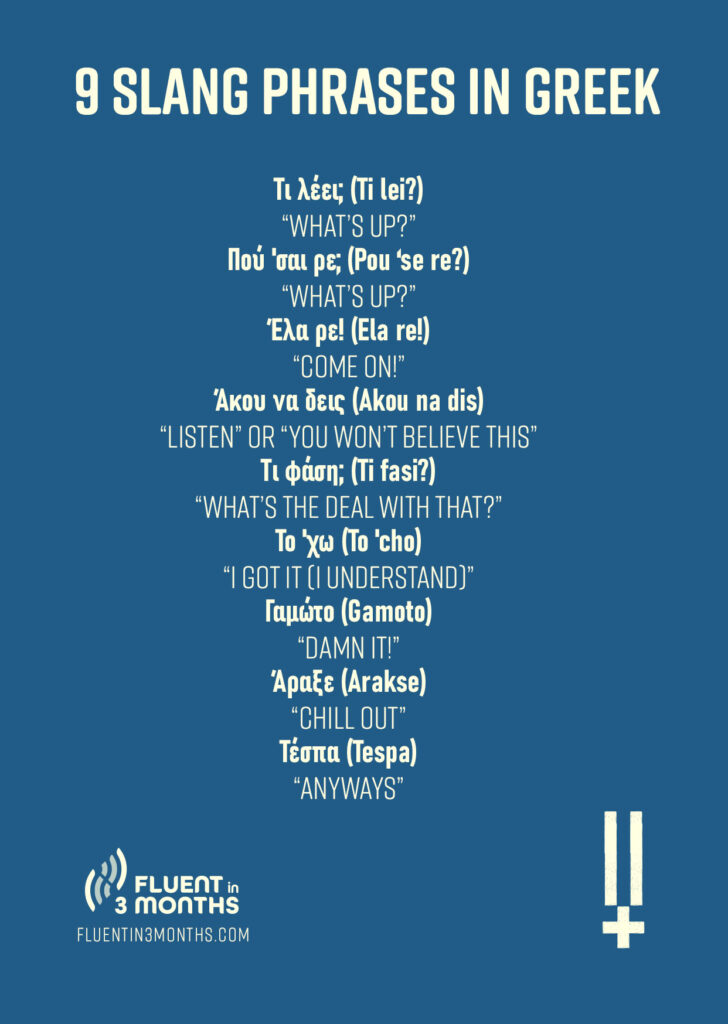
- Ti lei? (Τι λέει;): Literally "What does it say?", used as "What’s up?"
- Ela re! (Έλα ρε!): A versatile exclamation meaning "Come on!" or "No way!" The particle re is a ubiquitous filler in Greek speech, used to add emphasis or informal flair.
- Arakse (Άραξε): A command to "chill out" or "relax," reflecting the "siga-siga" (slowly-slowly) philosophy often associated with Greek island life.
- Tespa (Τέσπα): A shorthand for telos panton, meaning "anyways" or "whatever."
Journalistic observation of Greek youth culture suggests that these terms are essential for those seeking to move beyond the "tourist bubble" and achieve a level of social integration.
Philosophical Underpinnings: The Role of Proverbs
A language is a vessel for culture, and Greek proverbs provide a window into the Hellenic psyche—a blend of ancient wisdom, Mediterranean resilience, and a touch of fatalism. Analyzing these sayings offers deeper comprehension of the local mindset.
One common proverb, "Every obstacle is for a good reason" (Kathe empodio gia kalo), reflects a cultural stoicism in the face of bureaucracy or hardship. Another, "The many words are poverty" (Ta polla logia ine ftochia), suggests a preference for direct action over empty rhetoric—an interesting contrast to the stereotypical image of the talkative Greek. These idiomatic expressions are often used in editorial writing and political discourse in Greece to provide moral weight to contemporary arguments.
Broader Impact and Educational Implications
The global interest in learning Greek has seen a resurgence, fueled by digital platforms and language acquisition methodologies like "Fluent in 3 Months." Educational psychologists argue that learning a language with a different script, such as Greek, enhances cognitive flexibility and provides a unique "etymological map" for English speakers, given that an estimated 25% of the English vocabulary is derived from Greek roots.
From a diplomatic and economic perspective, the promotion of the Greek language is a key pillar of "soft power" for the Hellenic Republic. Official responses from the Ministry of Culture often emphasize that language is Greece’s most enduring export. By equipping themselves with these 50+ phrases, travelers do more than facilitate a transaction; they participate in a multi-millennial tradition of dialogue.
As the global travel industry shifts toward "experiential tourism," the value of linguistic preparation cannot be overstated. While digital translation tools are increasingly sophisticated, they cannot replicate the cultural resonance of a well-timed Kalimera or the shared laughter elicited by a clumsy but sincere Yamas. For the modern traveler, these words are the keys to a deeper, more meaningful engagement with one of the world’s most enduring cultures.