


In an era where artificial intelligence is rapidly redefining the global economic landscape, Microsoft has announced a sweeping new initiative titled Microsoft Elevate Washington. This homegrown commitment is designed to ensure that the benefits of technological advancement are distributed equitably across the company’s home state, providing hundreds of thousands of students and educators with free access to advanced AI tools, professional development, and technical support. The program represents a strategic effort to address a burgeoning "opportunity gap" between the state’s high-tech urban corridors and its rural communities.
For over a century, Washington state has served as a global epicenter for industrial and technological breakthroughs. From the early 20th-century aviation milestones of Boeing to the late-century rise of software and e-commerce giants, the region has consistently influenced the trajectory of global commerce. However, as the world enters the age of generative AI, new data suggests that the benefits of these innovations are not being felt equally across all zip codes. Microsoft’s new initiative seeks to rectify these disparities by integrating AI literacy into the fabric of the state’s public education system.
Quantifying the AI Divide: Data from the AI for Good Lab
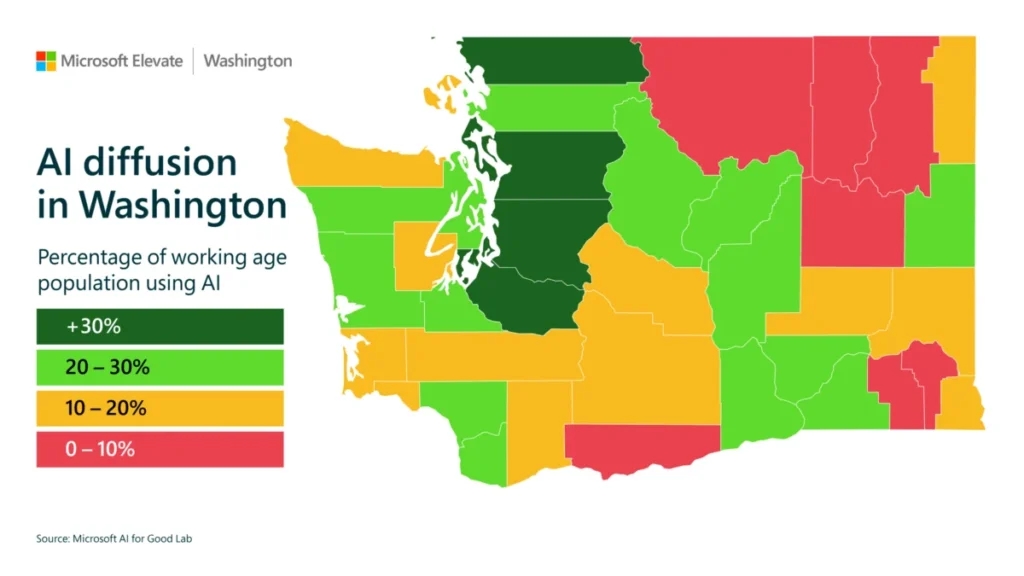
The impetus for Microsoft Elevate Washington stems from recent findings by Microsoft’s AI for Good Lab. In an analysis of internal data, researchers identified a significant geographical disparity in AI adoption rates throughout the state. The data reveals that while the Puget Sound region remains a global leader in AI engagement, rural areas are being left behind.
According to the report, counties with the highest concentration of technology professionals and infrastructure show robust AI usage. Snohomish County currently leads the state with a 35 percent AI adoption rate among the working-age population. King, Pierce, and Whatcom counties also show high engagement levels, with more than 30 percent of residents utilizing AI tools in their daily work or learning.
In contrast, the figures for eastern Washington tell a different story. In seven rural counties, AI usage remains below 10 percent. The disparity is most acute in Ferry County, where only 2.5 percent of residents are currently using AI—a tenfold gap compared to the most connected regions in the state. This "AI divide" mirrors previous challenges associated with broadband accessibility, which Microsoft has spent the last decade addressing through its Airband Initiative. The company argues that without intervention, this gap in digital literacy will translate into a long-term economic disadvantage for rural students and workers.
A Comprehensive Framework for High Schools and Community Colleges
Microsoft Elevate Washington is structured as a multi-tiered rollout intended to reach approximately 500,000 students and 100,000 educators. The program provides a suite of tools tailored to different educational levels and administrative needs, focusing on three primary pillars: students, educators, and institutional infrastructure.
Support for School Districts and Institutional Administration
Starting in January 2026, Microsoft will provide its Copilot Studio platform to all 295 public school districts and 34 community and technical colleges in Washington free of charge for a period of three years. Copilot Studio is a low-code platform that allows users to create custom AI agents designed to handle specific tasks.
For educational administrators, this technology is expected to streamline high-volume tasks such as class scheduling, data analysis for student performance, and school year planning. By automating administrative overhead, the initiative aims to allow educators to spend more time on direct student engagement. Furthermore, Microsoft will offer $25,000 in dedicated technology consulting to a select group of 10 school districts and 10 community colleges. These grants are intended to help institutions build bespoke AI solutions that can then serve as blueprints for other districts across the state.
Enhancing the High School Experience
The second phase of the rollout, beginning in July 2026, focuses on students in grades 9 through 12. These students will receive three years of free access to Copilot Chat, Microsoft 365 desktop applications, and Teams for Education.
Central to this offering are "Learning Accelerators," a category of AI-powered tools grounded in pedagogical research. These tools are designed to provide real-time, personalized feedback to students as they practice core skills. For example, reading accelerators can analyze a student’s pronunciation and fluency, providing tailored exercises to address specific weaknesses. The goal is to foster "information literacy"—the ability to critically evaluate and utilize AI-generated content—which is increasingly viewed as a fundamental skill for the 21st-century workforce.
Empowering Community College Students
Recognizing the immediate needs of those entering the workforce or pursuing vocational training, Microsoft is offering an immediate benefit to community college students. Effective through November 15, 2025, any community college student in Washington can access 12 months of Microsoft 365 Personal for free. This includes the integration of Copilot into standard applications like Word, Excel, and PowerPoint, as well as one terabyte of cloud storage and advanced security features via Microsoft Defender. This component of the program is designed to provide immediate digital skill-building opportunities for students who are often balancing education with full-time employment.

Professional Development and Strategic Partnerships
A technology rollout of this magnitude requires a prepared workforce of educators. Microsoft is collaborating with several key state and national organizations to ensure that teachers are not just recipients of technology, but masters of it.
The initiative involves a partnership with the Washington Office of Superintendent of Public Instruction (OSPI), the Washington Education Association (WEA), and the National Education Association (NEA). Together, these organizations will facilitate high-quality professional development for teachers and administrative staff. The training will focus on "Generative AI for Educators," a curriculum designed to help teachers use AI to generate lesson plans, differentiate instruction for diverse learners, and reduce the time spent on grading and paperwork.
A cornerstone of this effort will be the AI Innovation Summit, a collaborative conference hosted by K–12 agencies. This event is expected to bring together over 1,000 educators and administrators to discuss best practices for AI implementation in the classroom. Microsoft has also committed to providing cash grants to help schools integrate these new technologies into their existing instructional frameworks.
Background and Global Context: The $4 Billion Commitment
Microsoft Elevate Washington is the local manifestation of a broader global strategy. In July 2025, the company launched "Microsoft Elevate," a new global business unit dedicated to supporting the public sector, including schools, universities, and nonprofits.
The company has pledged more than $4 billion over the next five years in combined cash and cloud services to advance these missions worldwide. By prioritizing Washington as a primary site for this rollout, Microsoft is signaling its intent to use its home state as a "living laboratory" for AI-integrated education. This follows a trend of major tech firms investing in localized educational ecosystems to secure a future pipeline of tech-literate talent.
Broader Implications for the Future of Work
The implications of Microsoft Elevate Washington extend beyond the classroom. Economists and technology analysts suggest that the "AI gap" identified in the company’s data could lead to a two-tiered economy if left unaddressed. In the modern labor market, proficiency in AI is becoming a prerequisite for high-paying roles in finance, engineering, healthcare, and even creative industries.
By democratizing access to these tools, the program seeks to ensure that a student in Ferry County has the same technological advantages as a student in downtown Seattle. This geographical equity is seen as vital for the state’s long-term stability. Furthermore, the partnership with nonprofits like Code.org to bring the "Hour of AI" to schools statewide emphasizes the importance of early exposure to computational thinking.
Microsoft is also leveraging its own workforce to support the movement. More than 50,000 Microsoft employees based in Washington are being encouraged to participate in workshops and mentorship programs, showcasing real-world applications of AI to the next generation of innovators.
Chronology of the Microsoft Elevate Washington Rollout
To understand the scope of the initiative, it is helpful to view the planned timeline of implementation:
- July 2025: Global launch of the Microsoft Elevate business unit and the $4 billion commitment.
- November 15, 2025: Deadline for Washington community college students to claim 12 months of free Microsoft 365 Personal.
- January 2026: Launch of free Copilot Studio for all 295 Washington school districts and 34 community colleges. Commencement of technology consulting grants for 20 selected institutions.
- July 2026: Full rollout of Copilot Chat, Microsoft 365, and Learning Accelerators for high school students (Grades 9–12) across the state.
- Ongoing (2025–2028): Continuous professional development cycles in partnership with OSPI and the WEA, including the annual AI Innovation Summit.
A Vision for an AI-Literate Washington
The launch of Microsoft Elevate Washington marks a significant pivot in how private technology companies engage with public education. Rather than simply providing hardware or software, Microsoft is attempting to build a comprehensive ecosystem that includes funding, training, and long-term technical support.
As AI continues to evolve, the ability of a state to adapt its educational infrastructure will likely determine its economic resilience. For Washington, a state that has long prided itself on being at the "edge of the world" in terms of innovation, the Elevate initiative is a bid to maintain that leadership. By focusing on the people—the students and the educators—Microsoft is betting that the future of technology is not merely about the sophistication of the algorithms, but about the breadth of the population that can harness them.
The initiative concludes with an open call for innovators and community leaders to partner with educational institutions, signaling that while Microsoft is providing the tools, the ultimate success of the program will depend on a statewide movement of collaboration and adoption.