



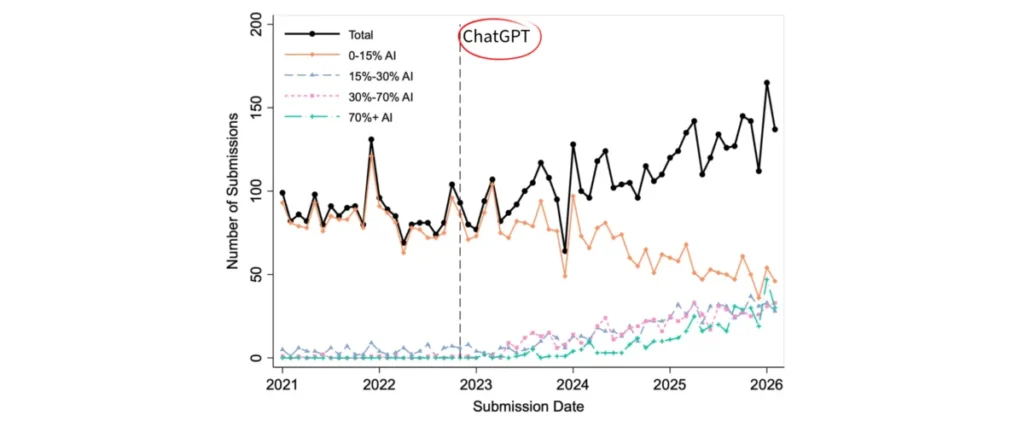
A critical shift is underway in the landscape of academic research, signaling profound implications for scholarly communication and the integrity of scientific output. An AI Task Force convened by the prestigious journal Organization Science has reported a dramatic increase in manuscript submissions since the widespread availability of generative artificial intelligence tools, concurrently observing a significant decline in readability and a troubling correlation with lower acceptance rates. This phenomenon, which began in earnest in 2023 following the public release of advanced AI models like ChatGPT, presents a sobering cautionary tale: the ease of generation does not equate to the quality of scholarship.
The Emergence of a New Challenge: AI’s Impact on Academic Submissions
The alarm bells first rang within the editorial offices of academic journals. Editors and reviewers, the gatekeepers of scholarly discourse, began to notice an inexplicable change in the nature of incoming manuscripts. As members of the Organization Science AI Task Force articulate, "Something is up in academic research." They describe a palpable shift: an increased volume of submissions possessing a "particular feel that is hard to pin down." While superficially resembling traditional academic papers, the writing often felt "weightless," lacking the precision, depth, and clarity expected from scholarly work. Reviewers frequently found themselves "scratching [their] head at the meaning the words are trying to convey," a stark contrast to the typically rigorous and dense prose of academic literature.
This anecdotal evidence prompted the Organization Science task force to undertake a quantitative investigation into the root cause. Their analysis unequivocally points to generative AI as the primary driver of this transformation. Starting in 2023, precisely when AI tools like ChatGPT became widely accessible to the public, the journal experienced a rapid surge in submission numbers. Simultaneously, the proportion of submissions classified as using "minimal AI" plummeted from nearly 100% to approximately 30%. This stark correlation indicates a swift and widespread adoption of AI assistance in academic writing, with significant consequences for submission quality.
Quantifying the Decline in Readability
One of the most concerning findings from the Organization Science study relates to the marked deterioration of manuscript readability. Utilizing a standard "reading ease" metric—a quantitative measure often based on algorithms like the Flesch-Kincaid reading ease test, which assesses text complexity by analyzing sentence length and the number of syllables per word—the task force observed a substantial decline. Between January 2021 and January 2026, the average reading ease score of submitted manuscripts fell by 1.28 standard deviations. This represents a statistically significant decrease, indicating that papers are becoming demonstrably harder for human readers to parse and absorb.
This finding challenges a common perception that AI-generated text is inherently cleaner or more polished. While AI can indeed improve surface-level grammar and syntax, the task force’s report highlights a deeper issue. "Submissions have become far harder to read," they stated, clarifying that "on the measures that capture whether a reader can actually parse and absorb the prose, AI writing is worse." The analysis revealed that AI-assisted papers tend to employ "longer words, more complex sentence structures, more jargon, and more nominalizations." These characteristics, while superficially appearing "academic," often obscure meaning and hinder comprehension, creating a barrier to effective scholarly communication. The sophisticated grammar often masks a lack of original thought, nuanced argument, or genuine intellectual contribution, leading to what editors describe as a "hollow" or "superficial" quality.
The Strain on Peer Review: Increased Submissions, Higher Rejection Rates
The proliferation of AI-assisted manuscripts has placed an unprecedented strain on the already overburdened peer review system, the cornerstone of academic quality control. The Organization Science data reveals a clear and concerning trend: papers making heavy use of AI are significantly more likely to be rejected.
The journal reported that nearly 70% of manuscripts identified as having "heavy AI use" were "desk-rejected." Desk rejection refers to the initial screening process where editors decline a paper without sending it for external peer review, often due to fundamental flaws, lack of fit, or low quality. In stark contrast, only 44% of papers written with "minimal AI" were desk-rejected. This difference of 26 percentage points underscores the editorial team’s assessment that AI-heavy submissions frequently fail to meet even the basic standards for consideration.
The disparity continues even for papers that proceed to full review. Ultimately, a mere 3.2% of high-AI papers were accepted for publication, compared to a substantially higher 12% of low-AI papers. This nearly four-fold difference in final acceptance rates serves as compelling evidence that AI-generated content, despite its superficial polish, largely fails to meet the rigorous intellectual and methodological standards required for publication in a reputable academic journal.
Crucially, these findings are based on retrospective analyses. The editors making the initial desk-rejection decisions and the peer reviewers evaluating the manuscripts were not aware of the level of AI involvement in the paper’s construction. This blind assessment strengthens the validity of the conclusions, indicating that the qualitative decline observed by human evaluators is objectively linked to AI usage, rather than a preconceived bias. The data thus provides an unfiltered look at how AI-generated academic writing performs under the scrutiny of the traditional peer review process.
Broader Context: The "Publish or Perish" Culture and AI’s Allure
The rapid adoption of generative AI tools in academia cannot be understood in isolation. It occurs within a broader context of intense pressure on researchers to publish. The "publish or perish" culture, driven by tenure requirements, grant funding considerations, and institutional prestige, incentivizes quantity over quality in many instances. For researchers grappling with heavy teaching loads, administrative duties, and the inherent challenges of complex academic writing, AI tools offer a seemingly irresistible shortcut.
Many researchers, particularly those for whom English is not their native language, or those struggling with writer’s block, might view AI as a valuable assistant for drafting, structuring, or refining their arguments. The promise of faster output, reduced writing effort, and a more "polished" linguistic presentation holds significant appeal. However, the Organization Science findings suggest that this perceived efficiency often comes at the cost of genuine intellectual contribution and effective communication. The tools, while making individual researchers’ lives "easier in the moment," are leading to "worse outcomes for the field as a whole," as they contribute to a flood of submissions that tax the time and patience of the academic community without advancing knowledge.
Reactions from the Academic Community and the Call for Guidelines
The revelations from Organization Science are not isolated; similar concerns are being voiced across various disciplines and publishing houses. While no official statements from all specific related parties are available, it is possible to infer plausible reactions and emerging trends within the academic ecosystem:
- Journal Editors and Publishers: Many editorial boards are grappling with the same challenges reported by Organization Science. Publishers like Springer Nature and Wiley have already begun to issue explicit guidelines on the use of generative AI in manuscript preparation, often requiring authors to disclose AI use and emphasizing that AI cannot be listed as an author. The overarching sentiment is one of caution and a firm stance on maintaining research integrity and quality. There’s a growing call for robust AI detection tools, though their efficacy remains a subject of ongoing debate.
- University Ethics Boards and Research Integrity Offices: Institutions are increasingly updating their policies on academic integrity to address AI use, focusing on issues of plagiarism, originality, and the appropriate attribution of intellectual work. The emphasis is on responsible AI use, ensuring that these tools serve as aids rather than substitutes for human thought and authorship.
- Researchers: The academic community itself is divided. Some researchers advocate for integrating AI tools strategically into their workflow, using them for tasks like grammar checking, summarizing literature, or brainstorming. Others express profound concern about the potential for deskilling, the erosion of critical thinking, and the ethical implications of presenting AI-generated content as original human scholarship. There is a broad consensus that while AI can be a powerful assistant, the ultimate intellectual responsibility and creative input must remain with the human author.
The Mechanics of "Weightless" Writing: Why AI Falls Short
The observed decline in readability and quality points to fundamental limitations in current generative AI models when applied to the nuanced demands of academic scholarship. While these models are adept at synthesizing vast amounts of text and generating grammatically correct sentences, they operate primarily on statistical patterns rather than genuine understanding or critical thought.
Academic writing requires:
- Original Argumentation: Developing novel theses and supporting them with unique evidence and logical reasoning.
- Nuance and Precision: Using language with exactitude to convey complex ideas and distinctions.
- Critical Analysis: Engaging deeply with existing literature, identifying gaps, and offering insightful critiques.
- Authorial Voice: Expressing ideas with clarity, authority, and a distinct perspective.
AI, in its current iteration, struggles with these elements. It tends to generate text that is:
- Formulaic: Relying on common academic phrases and structures, leading to a lack of originality.
- Generic: Lacking specific examples, deep insights, or genuine intellectual engagement with the subject matter.
- Superficially Complex: Using jargon and convoluted sentence structures without necessarily conveying deeper meaning.
- Syntactically Correct but Semantically Shallow: The words are arranged correctly, but the underlying message lacks depth, originality, or critical insight.
This creates the "weightless" feeling described by editors – text that appears to be academic but lacks the substance, rigor, and intellectual force that defines high-quality scholarship.
Implications for Research Integrity and the Future of Scholarly Communication
The findings from Organization Science have far-reaching implications for the entire ecosystem of scholarly communication:
- Erosion of Trust: If the academic landscape becomes saturated with AI-generated, low-quality papers, it could severely erode public trust in scientific research and the credibility of academic publications.
- Sustainability of Peer Review: The increased volume of poor-quality submissions places an unsustainable burden on volunteer editors and reviewers, leading to burnout and potentially compromising the thoroughness of reviews for genuinely valuable research.
- Deskilling of Researchers: An over-reliance on AI for writing tasks could hinder the development of essential critical thinking, analytical, and communication skills among future generations of scholars.
- Ethical Quandaries: The blurred lines of authorship and originality necessitate a re-evaluation of ethical guidelines in research.
- Resource Allocation: Time and resources spent reviewing and managing sub-par AI-generated content divert attention from truly innovative and impactful research.
Navigating the AI Frontier: A Call for Deliberation and Rigor
The challenge posed by generative AI is not to reject the technology outright, but to integrate it thoughtfully and responsibly. The Organization Science report serves as a powerful reminder that "making things faster or easier is not the same as making things better." The pursuit of knowledge, the development of original ideas, and the crafting of clear, impactful academic prose demand time, effort, and critical engagement.
Looking ahead, the academic community must:
- Develop Clear and Consistent Policies: Journals, universities, and funding bodies need to establish unambiguous guidelines for AI usage in research and publishing, focusing on transparency, attribution, and intellectual integrity.
- Educate Researchers: Provide training on responsible AI tools, emphasizing their role as assistants rather than replacements for human intellect.
- Reinforce Core Academic Values: Reiterate the importance of originality, critical thinking, methodological rigor, and clear communication as paramount to scholarly work.
- Innovate Peer Review: Explore new models of peer review that might be more resilient to the challenges posed by AI, potentially incorporating AI detection tools or novel review methodologies.
The current trend highlights a critical juncture for academic research. While AI offers tantalizing possibilities for enhancing various aspects of the research process, its application in core intellectual tasks like writing requires careful consideration. The findings from Organization Science underscore a fundamental truth: there is no shortcut to taking one’s time when it comes to producing meaningful and impactful scholarship. The future of academic integrity hinges on the collective commitment to quality, rigor, and genuine intellectual contribution, rather than succumbing to the allure of superficial efficiency.