



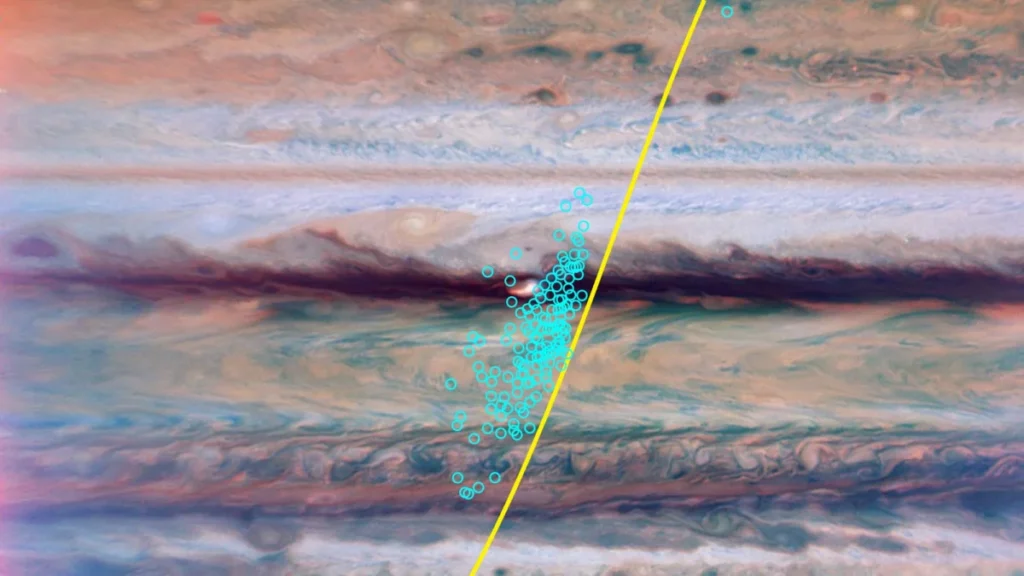
Recent astrophysical observations and data analysis from NASA’s Juno mission have revealed that the lightning occurring within the turbulent atmosphere of Jupiter is significantly more energetic than previously confirmed, with individual bolts discharging up to 100 times the power of those found on Earth. According to a comprehensive study published in the journal AGU Advances, these electrical phenomena, often originating from what researchers categorize as "stealth superstorms," represent some of the most violent meteorological events in the solar system. While Earth’s lightning is formidable enough to disrupt power grids and reshape landscapes, the Jovian counterparts operate on a scale that challenges our fundamental understanding of atmospheric electricity and convective dynamics in gas giants.
The Scale of Jovian Electrical Phenomena
On Earth, a typical lightning strike releases approximately one gigajoule of energy—enough to power a medium-sized American home for nearly nine days in a single millisecond. However, on Jupiter, the solar system’s largest planet, the scale of energy release is orders of magnitude higher. The study, led by Michael Wong of the University of California, Berkeley’s Space Sciences Laboratory, indicates that Jovian flashes regularly exceed Earth’s most powerful "superbolts."
Astronomers have known about lightning on Jupiter since the Voyager 1 flyby in 1979, but early observations were limited. Most historical data were captured on the planet’s night side, where the visual contrast allowed cameras to detect the bright flashes. Because these early detections focused on the most luminous events, scientists remained uncertain whether Jupiter also experienced a spectrum of weaker lightning strikes similar to Earth’s, or if the planet exclusively produced high-energy discharges. The recent findings from the Juno spacecraft, which has been in orbit around Jupiter since 2016, provide a more nuanced census of these events, revealing a diverse range of intensities that nonetheless dwarf terrestrial standards.
The Juno Mission and the Microwave Radiometer
The breakthrough in understanding Jupiter’s lightning is largely attributed to Juno’s Microwave Radiometer (MWR). Unlike traditional optical cameras that require clear lines of sight or darkness to function, the MWR can "see" through the thick layers of ammonia and hydrosulfide clouds that shroud the planet. It detects radio frequency emissions—specifically microwave static—generated by lightning discharges.
This instrument allows scientists to probe deep into the atmosphere, reaching depths where the pressure is significantly higher than at Earth’s sea level. By measuring the "sferics" (radio atmospheric signals) produced by lightning, Juno can quantify the energy of a strike regardless of whether it is visible to the naked eye. Between 2021 and 2022, Juno performed several close passes (perijoves) over Jupiter’s North Equatorial Belt, a region known for its cyclical weather patterns and intense storm activity.
Identifying the Stealth Superstorms of the North Equatorial Belt
The North Equatorial Belt (NEB) is one of the most prominent features of Jupiter, characterized by its deep reddish-brown hue and high-speed jet streams. Historically, this region is prone to "outbreaks" where bright, white clouds erupt and spread across the belt. However, the study focused on a period of relative "calm" in the NEB, which paradoxically allowed for more precise measurements.
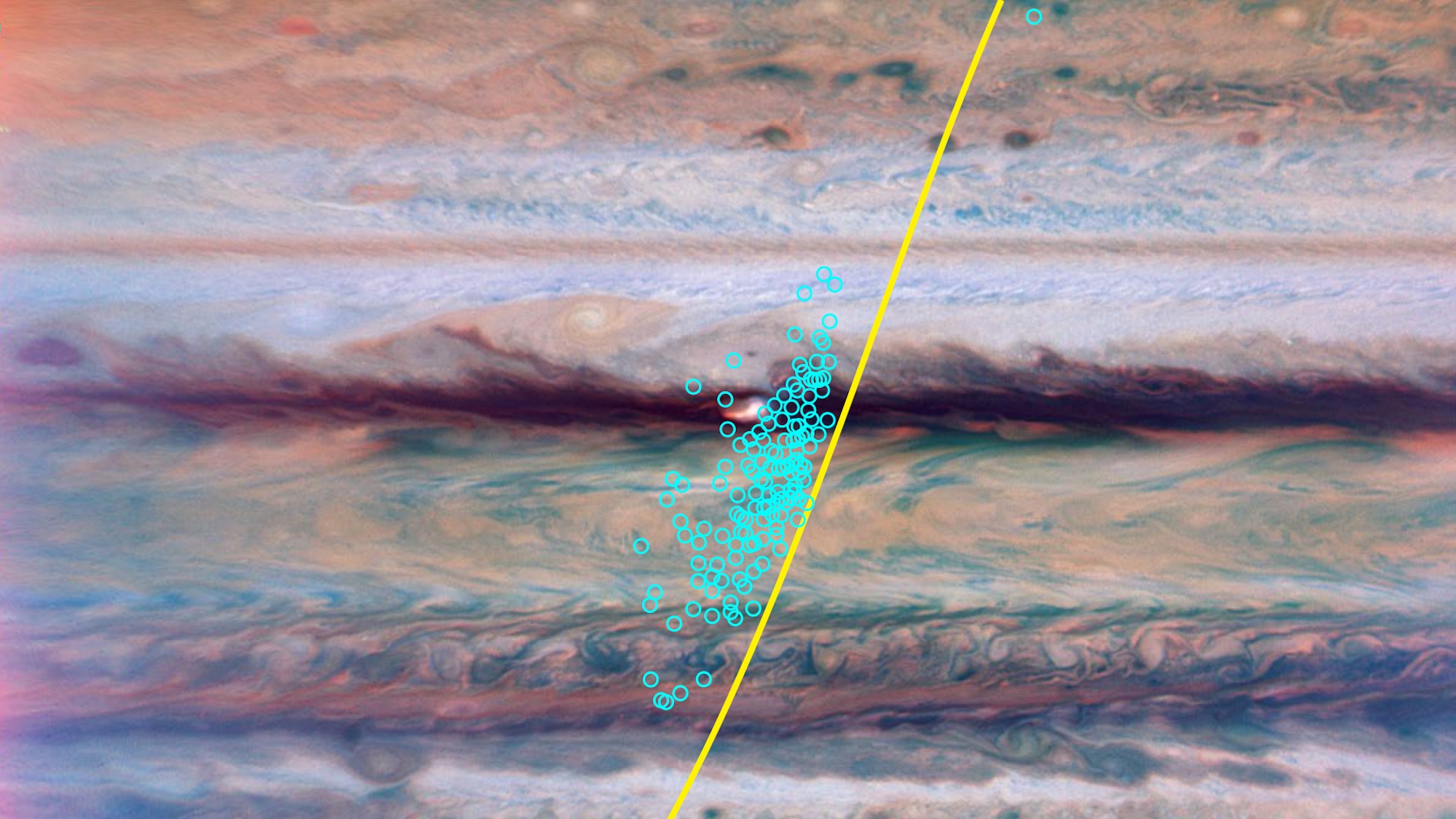
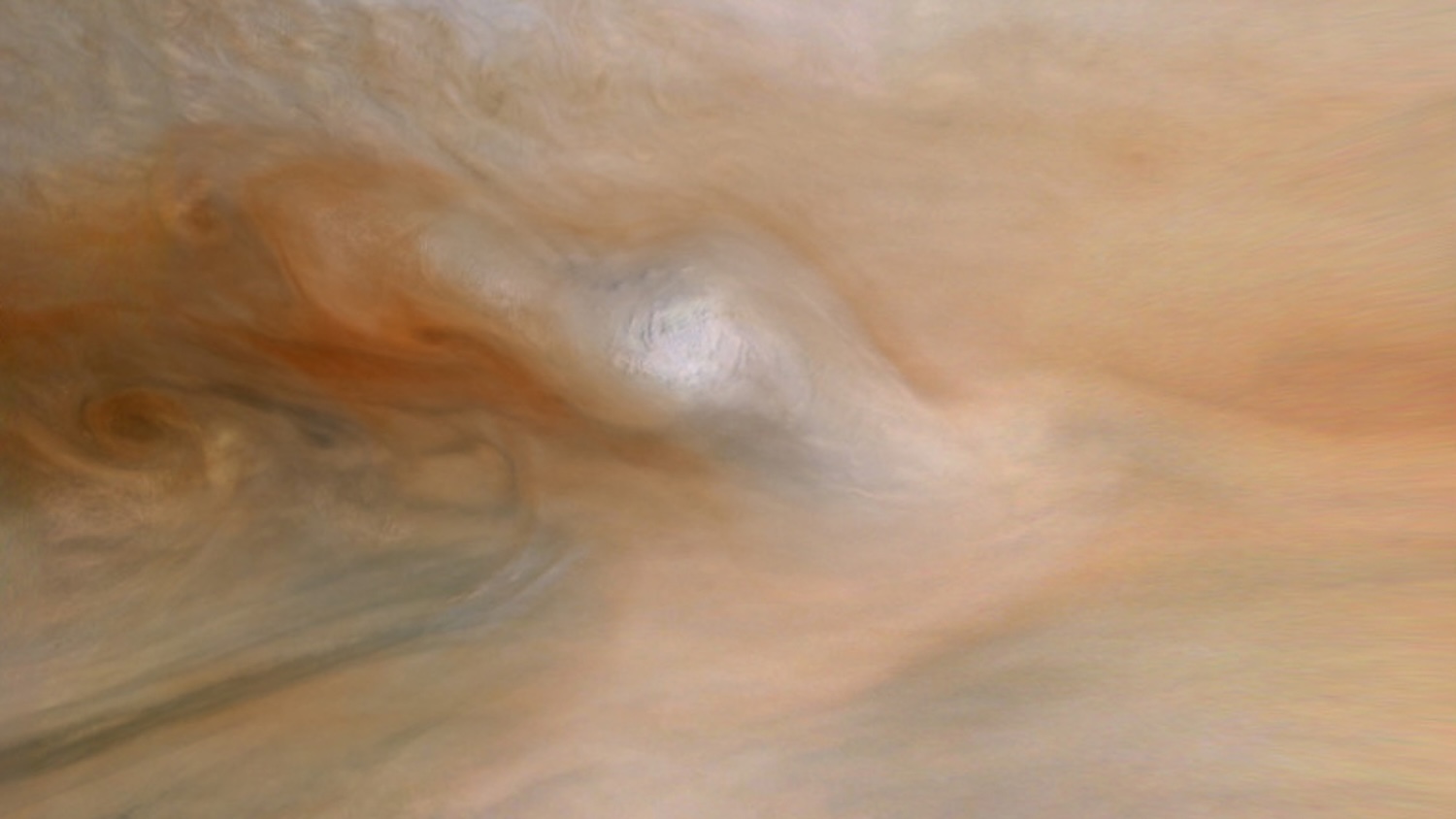
During this period, researchers identified what they termed "stealth superstorms." Unlike the massive, planet-circling disruptions that are easily visible from Earth-based telescopes, these stealth storms are more isolated and harder to detect through visual means alone. Using a combination of Juno’s MWR data and high-resolution imagery from the Hubble Space Telescope, the team was able to pinpoint the exact locations of these storms.
On August 17, 2022, Juno passed over a specific cluster of radio pulses. The data showed a high frequency of discharges—up to three pulses per second. In one particular pass, the spacecraft recorded 206 individual pulses from a single storm system. By correlating this with Hubble’s map, the researchers confirmed that the source was an isolated convective plume that appeared relatively unassuming in visible light but was electrically hyperactive beneath the cloud tops.
A Comparative Analysis of Atmospheric Composition
The disparity between Earth’s lightning and Jupiter’s lightning is rooted in the chemical and physical composition of their respective atmospheres. Earth’s atmosphere is predominantly nitrogen and oxygen, whereas Jupiter is composed mostly of hydrogen and helium. This difference in molecular weight and thermal properties has a profound impact on how storms develop.
In Earth’s atmosphere, moist air rises to form clouds through a process called convection. On Jupiter, the "moist" component is not just water vapor but also ammonia. Because hydrogen is much lighter than nitrogen, a parcel of "wet" air on Jupiter requires a much higher concentration of energy to achieve the buoyancy necessary to rise through the surrounding "dry" hydrogen-helium atmosphere.
Dr. Michael Wong noted that this higher threshold for convection means that when a storm finally does break through, it does so with explosive force. The "stealth superstorms" are essentially deep-seated convective engines. The moist air must travel much greater vertical distances—sometimes hundreds of miles—before it reaches the altitudes where electrical charging occurs. This extended vertical development allows for a massive buildup of static charge, resulting in discharges that are 500 to 10,000 times more energetic than the average terrestrial bolt when measured by total energy output.
Quantitative Findings from the AGU Advances Study
The research team analyzed a total of 613 microwave bursts captured during Juno’s mission. The statistical distribution of these bursts provided a clear picture of the Jovian electrical environment:
- Power Density: The power of the detected lightning ranged from levels comparable to Earth’s strongest strikes to "super-flashes" that were at least 100 times more powerful than the standard terrestrial emission.
- Frequency of Pulses: In active storm cells, Juno detected a rapid-fire succession of strikes, suggesting that the charging mechanism in Jovian clouds is incredibly efficient once the convective threshold is met.
- Energy Capacity: Calculations suggested that the most intense Jovian lightning contains energy levels that could theoretically disrupt planetary-scale communications if they occurred on Earth.
The study also highlighted the existence of "shallow lightning." While the superstorms originate deep in the atmosphere where water is liquid, Juno previously discovered flashes occurring much higher up, where temperatures are too cold for pure liquid water. These are believed to be caused by an "ammonia-water antifreeze" liquid, which creates a unique form of electrical discharge not seen on our home planet.
The Role of Multi-Instrument Synergy and Citizen Science
One of the most remarkable aspects of this discovery was the level of collaboration required to verify the data. Because Jupiter is a dynamic, fast-rotating planet, Juno’s "view" of any specific location is fleeting. To provide context for Juno’s microwave data, the team relied on the Hubble Space Telescope to provide global maps of the cloud decks.
Furthermore, the study benefited from the contributions of citizen scientists. Amateur astronomers around the world provide continuous monitoring of Jupiter, often capturing changes in the cloud belts that professional observatories might miss between scheduled sessions. This "ground-based" support allowed the UC Berkeley team to ensure that the "stealth superstorms" were indeed isolated events and not part of a larger, planet-wide upheaval.
"Because we had a precise location, we were able to just say, ‘OK, we know where it is. We’re directly measuring the power,’" Wong explained in a statement. This synergy between orbital probes, space telescopes, and amateur observers has become the modern gold standard for planetary science.
Broader Implications for Planetary Meteorology and Future Exploration
The findings have implications that extend far beyond the study of Jupiter. Understanding the lightning of a gas giant helps scientists refine models of atmospheric circulation and energy transfer that apply to exoplanets—planets orbiting other stars. Many of the exoplanets discovered to date are "Hot Jupiters" or gas giants similar in composition to our neighbor. By studying the electrical "fingerprints" of Jupiter, astronomers may eventually be able to remotely sense the weather patterns and atmospheric depths of worlds light-years away.
Furthermore, the data provides a cautionary tale for future robotic exploration. As space agencies consider "entry probes" that would descend into the atmospheres of the outer planets (similar to the Galileo probe of 1995), understanding the electrical environment is crucial for spacecraft hardening. A strike from a Jovian "stealth superstorm" would likely be fatal to any unshielded electronic equipment.
The study also raises new questions about the role of lightning in prebiotic chemistry. On Earth, lightning is thought to have played a role in "fixing" nitrogen and creating the building blocks of life. On Jupiter, the intense energy of these strikes continuously breaks down methane and other hydrocarbons, potentially creating a complex "smog" of organic molecules that contribute to the planet’s colorful hues.
Chronology of Recent Jovian Lightning Research
- 2011: NASA launches the Juno spacecraft with the Microwave Radiometer (MWR) on board.
- 2016: Juno enters orbit around Jupiter, beginning its mission to map the planet’s interior and atmosphere.
- 2020: Juno detects "shallow lightning" in the upper atmosphere, involving ammonia-water mixtures.
- 2021-2022: A period of relative calm in the North Equatorial Belt allows for the identification of isolated "stealth superstorms."
- August 17, 2022: A pivotal perijove pass allows Juno to record a cluster of 206 pulses from a single storm cell.
- 2025-2026: Data analysis concludes, and the Michael Wong et al. study is published in AGU Advances, confirming the 100x power differential.
As Juno continues its extended mission, which is currently slated to last until September 2025 (or until the spacecraft’s orbit decays), scientists hope to capture even more data from the polar regions. Unlike Earth, where lightning is most common near the equator, Jupiter’s lightning appears to be more frequent near its poles. Comparing the "stealth superstorms" of the equator with the polar discharges will be the next step in unravelling the mystery of the solar system’s most powerful electrical storms. For now, the message from the gas giant is clear: our biggest neighbor is a place of unimaginable power, where even a "stealthy" storm carries the energy of a hundred terrestrial tempests.