


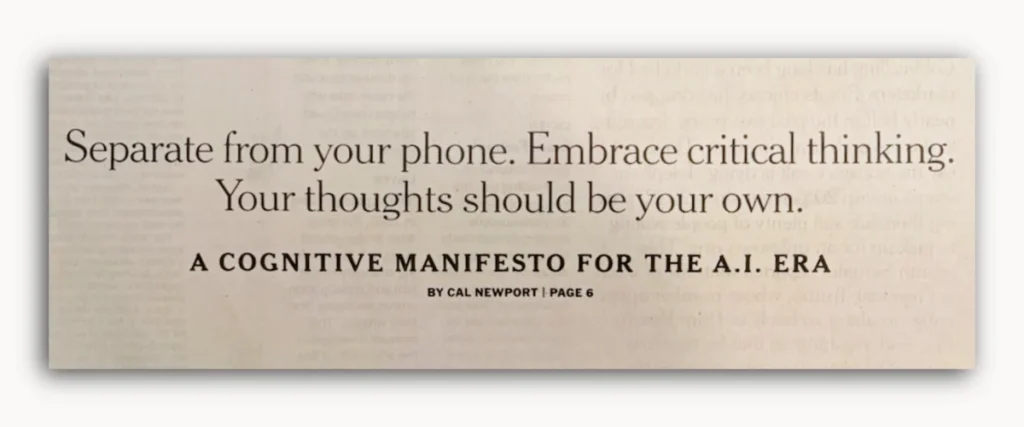
Ten years after the publication of his seminal work, Deep Work: Rules for Focused Success in a Distracted World, author and computer science professor Cal Newport has issued a stark warning regarding the accelerating erosion of sustained cognitive ability in modern society. Marking the anniversary, Newport reflected on the book’s unexpected success and, more critically, unveiled a somber assessment in a recent New York Times essay, contending that the problems he identified a decade ago have not merely persisted but have intensified, threatening humanity’s fundamental capacity for profound thought. His call is now for nothing less than a "revolution in defense of thinking."
The Genesis of Deep Work and its Unconventional Path
Published in 2016, Deep Work was Newport’s second mainstream hardcover "idea book," following So Good They Can’t Ignore You. Expectations for the follow-up were reportedly modest, as the preceding title had not achieved the commercial success hoped for by its publishers. This lower pressure, Newport suggests, afforded him the freedom to explore the conceptual edges of distraction and focus with an uncommon intellectual rigor, largely writing the book for his own intellectual satisfaction.
Newport’s fascination lay in the paradox of the knowledge economy: the systematic undervaluation of focused attention by organizations, despite its critical role in generating value. He articulated this insight as a "Moneyball for the cubicle class," suggesting that individuals and organizations willing to correct this systemic error could gain a significant competitive advantage. Beyond the economic calculus, Newport posited a philosophical cornerstone: the act of thinking itself as central to the post-Paleolithic human experience, the wellspring of our greatest ideas, satisfactions, and even moments of transcendence.
This fusion of economic pragmatism and profound philosophical inquiry distinguished Deep Work from the typical productivity literature of the era. Readers accustomed to breathless tales of overworked executives, regurgitated statistics on interruptions, and anodyne lists of "practical but not too challenging" tips presented in a conversational tone might have found Newport’s approach jarring. Instead, Deep Work delved into a rich tapestry of examples far removed from the corporate cubicle. Newport cited philosophers of religion, profiled a blacksmith forging swords with ancient techniques, explored the practices of memory champions, and discussed chavruta, the Jewish tradition of studying sacred texts in pairs. Rather than opening with a frustrated modern executive, the book commenced with Carl Jung’s struggles for intellectual autonomy from Sigmund Freud, setting a tone that was both academic and deeply personal. This idiosyncratic, intellectually rigorous approach, however, resonated powerfully with a growing audience grappling with the nascent stages of digital overload. The book ultimately became a global phenomenon, selling over two million copies and translated into more than forty-five languages. Its success also retroactively boosted So Good They Can’t Ignore You, which quietly surpassed half a million copies, offering a measure of vindication for Newport’s earlier work.
The Accelerating Erosion of Focus: 2016 to the Present
The decade since Deep Work‘s publication has witnessed a dramatic acceleration in the forces of digital distraction. In 2016, while email and nascent social media platforms already presented significant challenges to focus, the landscape was considerably different from today’s hyper-connected, notification-driven reality.
Workplace Communication Tools: The mid-2010s saw the widespread adoption and entrenchment of "hyperactive communication styles" in the workplace. Tools like Slack, launched in 2013 and rapidly gaining traction by 2016, along with Microsoft Teams (launched 2017) and the ubiquitous video conferencing platform Zoom (gaining prominence during the 2020 pandemic), transformed how knowledge workers interacted. These platforms, designed for instant messaging and low-friction digital meetings, fostered an environment of constant availability and rapid response. While lauded for improving collaboration and reducing email dependency, their widespread use has arguably fragmented attention into ever-smaller increments. Studies by organizations like the American Psychological Association and various workplace productivity consultancies have consistently highlighted the detrimental effects of constant interruptions, estimating that it can take an average of 23 minutes to regain focus after a significant distraction. The sheer volume of notifications, chat channels, and virtual meetings has created a perpetual state of context switching, making sustained, deep concentration an increasingly rare commodity.
The Social Media Tsunami: Outside the workplace, the evolution of social media has been equally profound and arguably more insidious. In 2016, platforms like Facebook, Instagram, and Twitter were still largely viewed through a lens of connecting people and sharing information. While concerns about screen time and engagement algorithms existed, they had not yet reached the critical mass of public discourse seen today. The subsequent rise of TikTok, launched internationally in 2017, marked a significant shift. Its highly optimized, short-form, algorithmic content feed has been described by Newport as an "addictive TikTok-ified slurry of optimized brain rot." This new generation of social media is explicitly designed to maximize engagement through hyper-personalized, dopamine-driven content loops, further conditioning users for fragmented attention and instant gratification. Research from institutions like the Pew Research Center consistently shows increasing social media usage across demographics, alongside growing concerns about its impact on mental health, attention spans, and critical thinking abilities.
The Advent of AI Shortcuts: The most recent addition to this complex landscape is the rapid emergence and widespread adoption of generative artificial intelligence (AI) tools, such as ChatGPT, which burst into public consciousness in late 2022. While offering unprecedented capabilities for automation, content generation, and information synthesis, Newport argues these tools present a new threat to cognitive depth. By providing "quick-fix short-cuts to whatever intellectually engaging work activities remain," AI could inadvertently diminish the incentive and perceived necessity for individuals to engage in the hard, often uncomfortable, work of deep thinking, original synthesis, and complex problem-solving. If AI can generate drafts, summarize complex texts, or even solve certain analytical problems, the human mind might increasingly outsource these functions, leading to a form of cognitive atrophy where the muscles of deep thought are simply not exercised.
The Deepening Crisis: A Decline in Cognitive Capacity
Newport’s central and most alarming assertion in his New York Times essay is that the problem has evolved from merely finding enough free time for deep work to a more fundamental crisis: "we’re rapidly losing the ability to think deeply at all, regardless of how much space we can find in our schedules for these efforts." This shift represents a profound and worrying implication for individual well-being, organizational innovation, and societal progress.
Cognitive science offers significant backing for this concern. Studies on attention, working memory, and cognitive load consistently demonstrate that the human brain is ill-equipped for constant multitasking and frequent context switching. Each interruption incurs a "switch cost," requiring mental effort to reorient and re-engage with the original task. Prolonged exposure to such environments can lead to reduced cognitive performance, increased stress, and diminished capacity for complex problem-solving. Neuroplasticity, the brain’s ability to adapt and change, suggests that consistently engaging in shallow, fragmented attention patterns can actually reshape neural pathways, making sustained focus more difficult over time.
For organizations, the systematic undervaluation of focus translates into tangible costs: reduced innovation, lower quality output, errors, and decreased employee engagement. While the immediate gains of hyper-connectivity might seem appealing for certain collaborative tasks, the long-term impact on strategic thinking, creative problem-solving, and the development of complex ideas can be severe. The economic reality Newport identified a decade ago – that focus is a massive opportunity – now appears even more critical as the default mode of operation drifts further into cognitive shallows.
The Call for a Revolution in Defense of Thinking
Confronted with this escalating crisis, Newport unequivocally states that merely buying copies of Deep Work or individually optimizing one’s schedule is no longer sufficient. He proposes a "louder response": a "revolution in defense of thinking." This is not a call for a retreat from technology, but a deliberate, systemic re-evaluation of our relationship with it, aimed at reclaiming our cognitive autonomy.
While the original prompt’s bullet points for concrete actions were empty, Newport’s broader work and public statements offer insights into the types of actions such a revolution might entail:
-
Individual Level:
- Digital Minimalism: Intentionally and aggressively reducing digital clutter and time spent on non-essential, distracting technologies. This involves curating digital tools for specific, high-value purposes rather than passively consuming whatever the algorithms present.
- Scheduled Deep Work Blocks: Dedicated, uninterrupted periods for demanding cognitive tasks, protected from notifications and interruptions. This requires proactive scheduling and adherence.
- Intentional Technology Use: Shifting from reactive engagement with technology to proactive, purpose-driven use. This could involve designating "check-in" times for email and messaging rather than constant monitoring.
- Cultivating Solitude and Reflection: Actively seeking out periods of quiet contemplation, free from external stimulation, to allow for unstructured thought and idea generation.
-
Organizational Level:
- Reforming Communication Norms: Implementing policies that reduce the expectation of instant responses, limit the use of internal messaging platforms for non-urgent communication, and encourage asynchronous work where appropriate.
- Designing for Focus: Rethinking workplace layouts and policies to support concentration, moving away from purely open-plan offices without designated quiet zones.
- Valuing Output Over Activity: Shifting organizational culture to reward meaningful contributions and deep work outcomes rather than merely visible activity, constant availability, or rapid response times.
- "No-Meeting" Days/Blocks: Designating specific periods or days where meetings are forbidden to allow for uninterrupted deep work.
-
Societal and Educational Level:
- Promoting Digital Literacy and Well-being: Educating individuals, particularly younger generations, on the psychological and cognitive impacts of excessive or unmanaged digital engagement.
- Re-emphasizing Sustained Attention in Education: Integrating practices that train and reward sustained focus, complex problem-solving, and critical thinking from early education onward.
- Public Discourse on Algorithmic Design: Fostering a broader societal conversation about the ethical implications of addictive algorithmic designs and the potential for regulatory oversight to prioritize user well-being over engagement metrics.
The "spirit of revolution" is paramount. As Newport concludes in his Times op-ed, it signifies a resolute refusal to "ced[e] my brain – the core of all that makes me who I am – to the financial interests of a small number of technology billionaires or the shortsighted conveniences of hyperactive communication styles." It is a call to move beyond passive "fretting" and to actively "do something about" the slide into cognitive shallows.
Broader Implications and Expert Perspectives
Newport’s call for a cognitive revolution resonates with a growing chorus of voices from various sectors.
Technology Industry Response: While many tech companies champion their products as tools for enhanced productivity and connectivity, some within the industry are beginning to acknowledge the potential downsides. There is a growing movement towards "ethical design" and features aimed at promoting digital well-being, such as screen time trackers, focus modes, and options to mute notifications. However, the fundamental business models of many platforms remain tied to maximizing user engagement, creating an inherent tension. Critics often point out that the financial incentives for addictive design are powerful, making true self-regulation challenging without external pressure.
Business and HR Leaders: Many organizations are caught in a dilemma. They have invested heavily in collaborative tools and agile methodologies, yet simultaneously recognize the growing challenges of employee burnout, reduced innovation, and a perceived decline in strategic thinking. HR departments and leadership development programs are increasingly exploring solutions to foster focus and mitigate digital overload. Some companies are experimenting with "focus Fridays," instituting "no email after hours" policies, or even designing specific "deep work" spaces within their offices. The challenge lies in cultural change, as deeply ingrained habits of constant connectivity are difficult to break.
Academic and Psychological Community: Researchers in cognitive psychology, neuroscience, and human-computer interaction have long documented the adverse effects of fragmented attention. There is a broad scientific consensus that sustained, focused attention is critical for learning, problem-solving, creativity, and emotional regulation. Newport’s work provides a compelling framework that bridges this academic understanding with practical implications for the modern knowledge worker. Psychologists emphasize that reclaiming focus is not merely about productivity but also about mental health and overall well-being.
Societal Impact: The implications of a widespread decline in cognitive depth extend far beyond individual productivity. A society less capable of sustained, nuanced thought risks diminished capacity for critical analysis, complex problem-solving, and informed democratic discourse. The ability to engage deeply with challenging ideas, to differentiate truth from misinformation, and to forge innovative solutions to global challenges all depend on a populace capable of profound cognition. Newport’s revolution is, therefore, not just about personal success, but about the future trajectory of human civilization.
Conclusion
A decade after Deep Work first illuminated the value of focused effort, Cal Newport’s latest analysis presents a sobering yet urgent mandate. The digital landscape has evolved rapidly, creating an environment where sustained attention is not just challenged but actively eroded by pervasive distractions and alluring technological shortcuts. His call for a "revolution in defense of thinking" is a powerful summons for individuals, organizations, and society at large to consciously and deliberately re-prioritize the human capacity for deep cognition. It is a recognition that without a concerted effort to reclaim our mental autonomy, the very essence of human intellectual achievement and satisfaction risks being irrevocably diminished, ushering in an era of cognitive shallowness with profound and far-reaching consequences. The moment, Newport asserts, has come to act.