
The advent of artificial intelligence is ushering in a profound transformation across the professional landscape, fundamentally altering the role of managers. While concerns about job displacement and hiring shifts are prevalent, a more optimistic outlook suggests a significant upside for mid- and senior-level leaders. This evolution, often overlooked, promises to redefine management, shifting its focus from task orchestration to human-centric coaching, development, and support, ultimately creating what are being termed "Supermanagers." This transition, driven by AI’s capacity to augment individual capabilities and foster the rise of the "Superworker," is not without its challenges, as employees grapple with increased productivity demands alongside heightened stress and uncertainty.
The Managerial Shift: From Player-Coach to Human-Centric Leader
Historically, many managers ascend to leadership positions not through dedicated training in people management, but due to their excellence in specific tasks. This often results in the classic "player-coach" dilemma, where excelling at individual contributions does not automatically translate into effective leadership of others. The integration of AI into the workplace exacerbates this challenge. AI is poised to augment individual capacity and capabilities, empowering employees to become more productive, higher-performing, and more adept at managing their own tasks, even their AI agents. This rise of the "Superworker" creates a dynamic where employees are increasingly autonomous, placing a new emphasis on the manager’s role.
However, these advancements are accompanied by a significant psychological toll. Workers are reporting record levels of fear, stress, and uncertainty as they navigate the rapidly changing impact of AI on their professional futures. In this evolving environment, the core function of a manager is fundamentally shifting. The emphasis is moving away from the granular orchestration of work and towards the cultivation of talent, fostering employee development, and providing robust support. These elements are the cornerstones of a more human-centric approach to leadership.
In this technologically driven future, management itself will increasingly be defined by its inherent humanity. Managers are expected to embrace and lead with AI, not as a replacement, but as a powerful tool to supercharge their own work and that of their teams. This will involve a seamless blending of human and technical capabilities, leading to multiplicative impacts. As AI takes over the more routine aspects of task orchestration, managers will be able to dedicate their efforts almost exclusively to coaching, individual development, employee well-being, skills recognition, and engagement. Currently, these HR-style responsibilities constitute only about 10 percent of a manager’s role. Projections suggest this share could dramatically increase to as much as 90 percent in the near future, signifying a radical reorientation of managerial duties.
AI-Driven Work Redesign: Rethinking Hierarchies and Skill Profiles
The integration of AI into daily workflows is already initiating a significant redesign of work processes. This raises critical questions about the future of managers who may lack strong interpersonal skills. The question of whether such individuals will remain in management roles or transition to other functions is a complex but necessary consideration. Given that strong people skills are often the most challenging to develop, the pervasive influence of AI in daily work will compel organizations to re-examine their hierarchical structures as part of broader AI-driven transformations and organizational redesigns.
Certain fields, such as software engineering, are poised to experience these changes acutely. Historically, identifying individuals who possess both exceptional technical acumen and effective people management skills has been a persistent challenge. With AI anticipated to automate a substantial portion of coding tasks, companies will need to fundamentally rethink skill profiles and redefine management responsibilities within these technical domains.
Despite these shifts, managers will retain a critical role in this AI-driven work design. Their expertise in the specific work performed within their domains will be invaluable in reinventing workflows and supporting the overall AI transformation. Furthermore, managers will lead by example, modeling the effective use of AI tools and championing new ways of working for their teams. This leadership by example will be crucial in fostering adoption and building confidence in AI-powered processes.
Managers as "Personalizers" of Employee Development: The Blurring Lines with HR
The evolving landscape of management also has significant implications for the Human Resources department. As HR functions have become more decentralized and employee experience has risen in priority, the lines between HR responsibilities and managerial duties have increasingly blurred. This shift is evident in the evolution of employee development and performance management practices.
For instance, the traditional model of managers rating employee performance on an annual or semi-annual basis under HR oversight has given way to a more continuous approach. This now involves ongoing coaching and feedback, regular career development conversations, and comprehensive support for employee growth. Data indicates that managers have a far greater influence over the employee experience than HR departments do, underscoring the pivotal role they play in shaping workplace satisfaction and engagement.
However, a persistent gap remains. While leadership may prioritize people outcomes, managers are often still primarily rewarded for achieving business results. This can create a tension between these shifting priorities and existing performance metrics, making it challenging for managers to fully embrace their evolving people-centric responsibilities.
The emergence of AI in learning and development (L&D) promises to address some of these challenges. The phenomenon, termed the "L&D AI revolution," leverages AI to provide personalized learning experiences and coaching. This raises the question of whether AI will supplement or replace the manager’s role in development. The prevailing sentiment is that AI will perform both functions, making the often-tricky but essential work of people management more accessible and effective for both managers and their teams.
Harnessing AI to Address Complex People Challenges
AI is poised to offer significant support to managers who find people management particularly challenging. In organizations that are early adopters of AI in HR, employees have expressed a preference for receiving constructive feedback from AI. This preference stems from the perception that AI feedback is less personal and therefore easier to digest.
Managers often express reluctance in delivering difficult feedback. AI can depersonalize this process and provide guided support, offering tactical recommendations for thoughtful and consistent people management. AI tools can furnish conversation guides, performance insights, and coaching tips, thereby making the ambiguous and often stressful components of management far more approachable, even for individuals who do not naturally excel in soft-skills tasks.
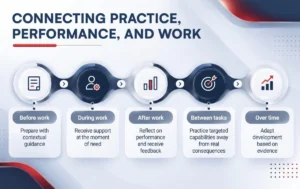
In practical terms, the traditional managerial reluctance to engage with HR systems like Workday, SAP, or Oracle – often viewing these as burdensome extra work on top of their primary responsibilities like sales targets or product launches – is being addressed. AI interfaces are now capable of handling up to half of these HR-related tasks. These functionalities can be integrated directly into everyday workflows within platforms like Microsoft Teams or Slack. Instead of requiring managers to log into separate Human Capital Management (HCM) systems, prompts can be delivered contextually. For example, a manager might receive a prompt such as, "Write three sentences about Jim’s performance," with suggested content grounded in Jim’s actual performance and productivity metrics. The manager can then review, validate, and expand upon this AI-generated input.
AI HR: A Reality Redefining Managerial Support
The emergence of responsive AI HR systems signifies a new era where text can be automatically pulled into HCM systems. These systems can then generate development conversation guides, offering managers tips, best practices, and relevant HR policies to ensure successful interactions for both parties. Furthermore, AI can even automate the scheduling of these development meetings.
The benefits of this AI integration are manifold. Managers are likely to become more productive as their administrative managerial tasks are streamlined and presented within their natural workflow. Their approach to management will become more personalized, facilitated by improved access to relevant information. Overall, their management skills are expected to improve, with AI acting as a constant "co-pilot coach."
The strategic integration of AI into the workplace is not merely about automation; it is about augmentation. It’s about equipping managers with tools that enhance their ability to lead, develop, and support their teams. The transition may initially introduce change and uncertainty, but the future promises a workplace where managers, much like their AI-augmented junior colleagues, are seamlessly supported in ways that deliver tangible value, potentially beyond our current imagination.
The ultimate takeaway is that the path to becoming an AI-empowered "Supermanager" lies in embracing both the human element and the technological advancements that enable exponential outcomes for individuals and their teams. This proactive embrace of AI will be the defining characteristic of effective leadership in the coming years, fostering environments where human potential is amplified and organizational goals are achieved with unprecedented efficiency and impact. The evolution of management is not a threat to human leadership, but rather an opportunity to elevate it.