


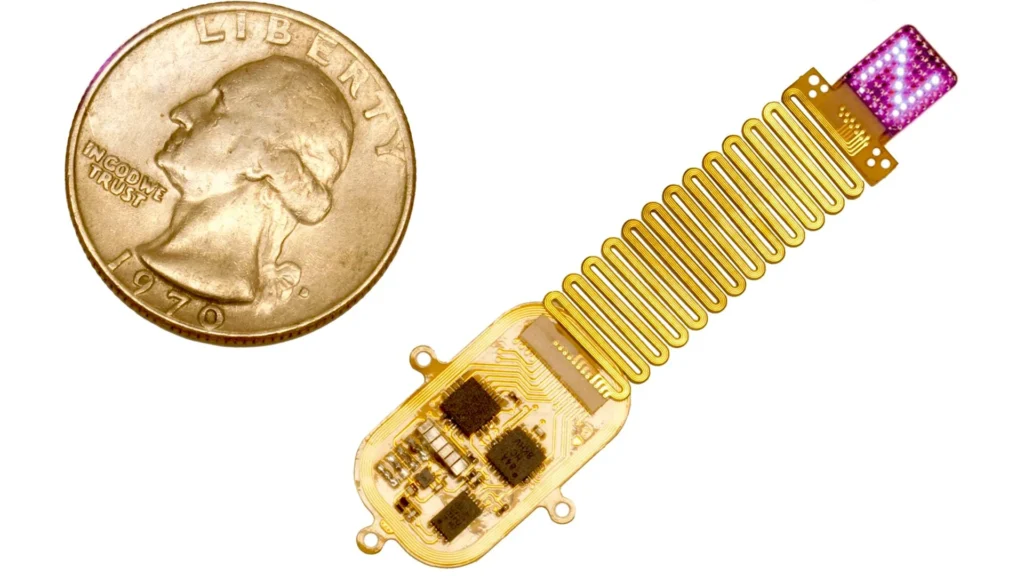
In a monumental leap forward for neurobiology and the burgeoning field of bioelectronics, scientists at Northwestern University have engineered a groundbreaking wireless device capable of transmitting information directly into the brain using precisely controlled patterns of light. This innovative technology fundamentally bypasses the body’s traditional sensory pathways, such as sight, sound, or touch, instead delivering signals straight to neurons within the cerebral cortex, heralding a new era for brain-computer interfaces and the restoration of lost sensory functions. The device, characterized by its soft and flexible form factor, is designed to fit discreetly beneath the scalp, resting gently on the skull, from which vantage point it projects its carefully modulated light patterns through the cranial bone to activate specific groups of neurons.
A New Paradigm in Brain-Computer Interface Technology
This breakthrough represents a significant departure from conventional brain-interfacing technologies, which often rely on invasive probes or bulky external hardware connected by wires. The Northwestern team’s creation ushers in an era of more seamless and less obtrusive interaction with the brain, leveraging the power of light to communicate directly with neural circuits. During extensive testing, researchers meticulously deployed tiny, precisely timed bursts of light to stimulate targeted populations of neurons deep within the brains of specially engineered mouse models. These particular neurons had been genetically modified to exhibit photostimulation properties, meaning they respond actively to light, a technique known as optogenetics. Remarkably, the mice swiftly demonstrated an ability to interpret specific light patterns as meaningful cues, making accurate decisions and successfully completing complex behavioral tasks even in the complete absence of auditory, visual, or tactile stimuli.
The profound implications of this technology for future medical applications are vast and far-reaching. Envisioned uses span a wide spectrum, including providing sophisticated sensory feedback for advanced prosthetic limbs, delivering artificial inputs for next-generation hearing or vision prostheses, enabling intuitive control over robotic limbs, significantly enhancing rehabilitation outcomes for individuals recovering from injuries or strokes, and even modifying pain perception without the need for pharmacological interventions. The seminal work detailing this innovation was recently published in the prestigious journal Nature Neuroscience, underscor confirming its significance within the scientific community.
The Genesis of Direct Neural Communication: A Timeline of Innovation
The development of this advanced device is not an isolated event but rather the culmination of years of dedicated research and incremental breakthroughs in the fields of bioelectronics and neurobiology. To fully appreciate the magnitude of Northwestern’s latest achievement, it is essential to contextualize it within the broader history of brain-computer interfaces (BCIs) and the revolutionary advent of optogenetics.
Brain-computer interfaces, broadly defined, are systems that translate neural activity into commands for external devices or, conversely, introduce information directly into the brain. The concept has been a staple of science fiction for decades, but its practical realization began in earnest with early efforts in the 1970s and gained significant momentum in the late 20th and early 21st centuries. Initial BCIs often involved invasive electrodes implanted directly into brain tissue, a procedure fraught with risks and limitations, including signal degradation over time and the potential for infection. Non-invasive methods, such as electroencephalography (EEG), offered safety but lacked the precision and bandwidth for high-fidelity communication.
The landscape dramatically shifted with the emergence of optogenetics in the early 2000s. Pioneered by scientists like Karl Deisseroth and Gero Miesenböck, optogenetics involves genetically engineering specific neurons to express light-sensitive proteins called opsins. These opsins act as molecular switches, allowing researchers to precisely turn neurons on or off with flashes of light. This technique revolutionized neuroscience by providing an unprecedented level of control over neural circuits, enabling scientists to dissect the brain’s complex functions with unparalleled precision. However, early optogenetic applications typically required the insertion of fiber optic cables directly into the brain, physically tethering the subject and severely restricting natural behavior, especially in animal models.
Northwestern University’s Querrey Simpson Institute for Bioelectronics, a powerhouse of interdisciplinary research, has been at the forefront of addressing these limitations. In 2021, the same research team made a significant stride by reporting the creation of the first fully implantable, programmable, wireless, and battery-free device capable of controlling neurons with light. That earlier system utilized a single micro-LED probe to influence social behavior in mice, marking a critical step beyond traditional optogenetics by allowing mice to behave naturally in their social environments without cumbersome wires. This foundational work laid the essential groundwork for the current, more sophisticated iteration.
Creating New Brain Signals with Advanced Micro-LED Technology
The new device represents a substantial evolution of its predecessor, extending its capabilities for more complex and nuanced communication with the brain. Instead of a single point of stimulation, the updated system incorporates an array of up to 64 independently programmable micro-LEDs, each no larger than a single strand of human hair. This array allows researchers to deliver intricate sequences of light patterns that closely mimic the distributed activity patterns naturally produced by the brain during genuine sensory experiences. "Our brains are constantly turning electrical activity into experiences, and this technology gives us a way to tap into that process directly," explained Northwestern neurobiologist Yevgenia Kozorovitskiy, who expertly spearheaded the experimental portion of the study. "This platform lets us create entirely new signals and see how the brain learns to use them. It brings us just a little bit closer to restoring lost senses after injuries or disease while offering a window into the basic principles that allow us to perceive the world."
John A. Rogers, a globally recognized leader in bioelectronics and the visionary head of the technology development, elaborated on the engineering marvel. "Developing this device required rethinking how to deliver patterned stimulation to the brain in a format that is both minimally invasive and fully implantable," Rogers stated. "By integrating a soft, conformable array of micro-LEDs — each as small as a single strand of human hair — with a wirelessly powered control module, we created a system that can be programmed in real time while remaining completely beneath the skin, without any measurable effect on natural behaviors of the animals. It represents a significant step forward in building devices that can interface with the brain without the need for burdensome wires or bulky external hardware. It’s valuable both in the immediate term for basic neuroscience research and in the longer term for addressing health challenges in humans."
The multidisciplinary nature of this research is reflected in the affiliations of its key contributors. Kozorovitskiy holds the prestigious Irving M. Klotz Professorship of Neurobiology in Northwestern’s Weinberg College of Arts and Sciences and is an active member of the Chemistry of Life Processes Institute. Rogers holds multiple appointments across materials science and engineering, biomedical engineering, and neurological surgery, in addition to directing the Querrey Simpson Institute for Bioelectronics. The study’s first author, postdoctoral researcher Mingzheng Wu, played a pivotal role in the experimental design and execution.
A Soft, Less Invasive Design for Enhanced Brain Engagement
Despite its significantly enhanced capability, the device maintains an impressively compact footprint, roughly the size of a postage stamp and thinner than a standard credit card. A key advancement in its design is its minimally invasive approach: rather than requiring a probe to be inserted directly into the delicate brain tissue, this new version gently conforms to the skull surface. From this position, it transmits light through the cranial bone to activate the underlying neurons. "Red light penetrates tissues quite well," Kozorovitskiy clarified. "It reaches deep enough to activate neurons through the skull." This transcranial delivery method significantly reduces the risks associated with traditional invasive brain surgeries, making the technology more viable for broader application.
Wu further elaborated on the progression from their earlier work: "In the first paper, we used a single micro-LED. Now we’re using an array of 64 micro-LEDs to control the pattern of cortical activity. The number of patterns we can generate with various combinations of LEDs — frequency, intensity, and temporal sequence — is nearly infinite." This exponential increase in signal complexity is crucial, as real-world sensations activate broad, interconnected neural networks rather than isolated neurons. The multi-site approach of the new device therefore more accurately mirrors how the cerebral cortex naturally functions, allowing for the generation of more realistic and interpretable artificial perceptions.
Training the Brain to Recognize Synthetic Patterns: Experimental Validation
To rigorously evaluate the system’s efficacy, the research team conducted a series of sophisticated experiments using the aforementioned genetically engineered mouse models, whose cortical neurons were primed to respond to light. The animals underwent a specialized training regimen designed to associate a particular pattern of light stimulation with a tangible reward, typically located at a specific port within a controlled testing chamber.
During these meticulously structured experiments, the implanted device delivered a predefined pattern across four distinct cortical regions, effectively acting like a coded message tapped directly into the brain. The mice were then tasked with identifying this target pattern amidst a series of alternative, distracting light stimulations. Demonstrating remarkable cognitive flexibility and learning capacity, the animals consistently learned to identify the correct artificial signal. Upon detecting the accurate pattern, they would reliably navigate to the appropriate port within the chamber to receive their reward, typically a small amount of water or food. "By consistently selecting the correct port, the animal showed that it received the message," Wu affirmed. "They can’t use language to tell us what they sense, so they communicate through their behavior." This behavioral evidence provided irrefutable proof that the mice not only perceived the light-based signals but also interpreted them as meaningful information to guide their actions.
Broader Impact and Future Trajectories: Expanding the Horizons of Neurotechnology
The successful demonstration that the brain can interpret complex patterned light stimulation as meaningful information opens vast avenues for future research and development. The team’s immediate next steps involve testing even more sophisticated patterns and precisely determining the maximum number of distinct signals the brain can reliably learn and differentiate. Future iterations of the device are envisioned to incorporate an even greater density of LEDs, with smaller spacing between them to achieve higher spatial resolution. Plans also include developing larger arrays to cover more extensive regions of the cortex and exploring different wavelengths of light that can penetrate even deeper into brain tissue, potentially reaching subcortical structures.
The long-term implications of this technology extend far beyond basic neuroscience research. For instance, in the realm of prosthetics, this device could enable users of advanced robotic limbs to experience tactile sensations – feeling the texture of an object, perceiving its temperature, or judging the pressure exerted. For individuals with profound hearing or vision loss, the technology could bypass damaged sensory organs entirely, delivering artificial signals directly to the brain’s auditory or visual cortices, potentially restoring a form of perception that current prostheses cannot offer. In rehabilitation, it could provide novel pathways for communication and motor control for stroke survivors or those with spinal cord injuries, potentially retraining neural circuits or bypassing damaged ones. The prospect of non-pharmacological pain management, by directly modulating neural pathways involved in pain perception, holds immense promise for millions suffering from chronic pain, offering an alternative to addictive opioids.
While the immediate focus is on medical applications and basic research, the broader impact on human understanding of consciousness and perception cannot be overstated. By directly inserting "synthetic" experiences into the brain, scientists gain an unprecedented tool to probe how the brain constructs reality, learns new information, and adapts to novel sensory inputs. This could unlock fundamental insights into neural plasticity, memory formation, and decision-making processes.
However, as with all groundbreaking neurotechnologies, ethical considerations will become increasingly pertinent as the capabilities of such devices grow. Questions surrounding data privacy, the potential for cognitive enhancement, and the definition of personal identity in the context of direct brain interfaces will require careful societal dialogue and robust ethical frameworks to ensure responsible development and deployment.
This pioneering study, titled "Patterned wireless transcranial optogenetics generates artificial perception," received substantial support from a consortium of prestigious institutions and awards, underscoring its recognized importance. These include the Querrey Simpson Institute for Bioelectronics, the NINDS/BRAIN Initiative, the National Institute of Mental Health, the One Mind Nick LeDeit Rising Star Research Award, the Kavli Exploration Award, the Shaw Family Pioneer Award, the Simons Foundation, the Alfred P. Sloan Foundation, and the Christina Enroth-Cugell and David Cugell Fellowship. Such collaborative funding highlights the collective scientific community’s investment in advancing the frontiers of neurotechnology and its potential to profoundly improve human health and understanding.