


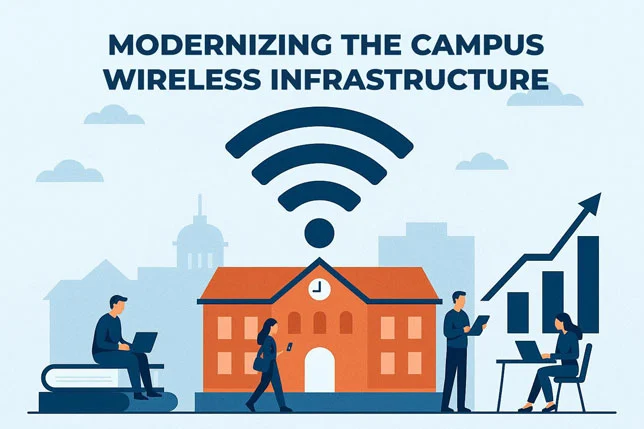
For colleges and universities today, updating the campus wireless infrastructure transcends mere technical upgrades; it represents a fundamental overhaul crucial for delivering on the promise of emerging technologies and meeting the evolving operational expectations of a modern university constituency. Forward-looking IT leaders are now engaged in comprehensive plans to modernize their networks – from the ground up, and for the future – understanding that piecemeal solutions are no longer sufficient to address the complex demands of contemporary higher education.
Institutions are embarking on multi-year, full modernizations of their campus wireless infrastructure. These ambitious plans are designed not only to integrate the speed and capabilities of the latest Wi-Fi standards but also to establish a future-ready state capable of swiftly adapting to a burgeoning wave of AI-driven applications, the relentless proliferation of new Bring Your Own Device (BYOD) endpoints that saturate bandwidth, and the explosive growth of data repositories generated by novel research programs. The imperative is clear: universities aim to position themselves to transform new technologies and practices into opportunities for innovation, ultimately securing a robust return on investment (ROI) from their significant commitments to wireless infrastructure.
The Paradigm Shift: From Upgrades to Comprehensive Modernization
The conversation around campus connectivity has fundamentally shifted. Historically, network upgrades often focused on increasing bandwidth or updating access points to the next Wi-Fi standard. While necessary, these incremental improvements are now recognized as inadequate for the scale and complexity of demands placed on modern academic environments. The current emphasis is on a holistic network modernization that considers every layer of the infrastructure, from physical cabling to software-defined networking (SDN) and advanced security protocols. This comprehensive approach is driven by several interconnected factors, including the dramatic acceleration of digital transformation spurred by the recent global pandemic, the widespread adoption of hybrid learning models, and the increasing sophistication of educational technology tools that demand ultra-low latency and high reliability.
According to a recent industry report, average device density on university campuses has surged by over 40% in the past five years, with students often carrying 3-5 Wi-Fi enabled devices. This includes laptops, smartphones, tablets, smartwatches, and a growing array of Internet of Things (IoT) devices, from smart dorm appliances to research sensors. This density, combined with the bandwidth-intensive nature of modern applications like high-definition video conferencing, virtual reality (VR) simulations, and cloud-based collaborative platforms, necessitates a network far more robust and intelligent than those of previous generations.
Driving Forces: Hybrid Learning, AI, and Device Proliferation
The landscape of higher education has been profoundly reshaped by hybrid learning, which blends synchronous and asynchronous online instruction with traditional in-person classroom experiences. This model places unprecedented demands on wireless networks, requiring seamless connectivity and consistent performance across lecture halls, dormitories, libraries, and remote learning environments. Students and faculty expect to transition effortlessly between physical and virtual spaces, engaging with rich media content, participating in interactive online discussions, and accessing vast digital resources without interruption.
Simultaneously, the rise of artificial intelligence (AI) is poised to revolutionize pedagogy, research, and administrative functions. From AI-powered tutoring systems and personalized learning platforms to advanced data analytics for institutional planning and sophisticated AI models used in scientific research, these applications require immense computational power and, crucially, a highly responsive and low-latency network to facilitate real-time data exchange and processing. The growth of AI in research, particularly in fields like bioinformatics, material science, and climate modeling, generates petabytes of data that must be rapidly collected, transmitted, and analyzed, stressing network capabilities far beyond conventional limits.
The sheer volume and diversity of BYOD devices continue to challenge campus IT departments. Beyond traditional laptops and smartphones, the network must now accommodate smart laboratory equipment, augmented reality (AR) devices for experiential learning, wearable health monitors, and a myriad of other IoT sensors deployed across the campus for everything from energy management to security. Each device presents unique connectivity and security requirements, demanding a network infrastructure that is not only fast but also highly secure, scalable, and manageable.
The Cisco Perspective: Insights from "The State of Wireless"
In April 2026, Cisco released its inaugural report, "The State of Wireless," offering critical insights into these evolving dynamics. Gary DePreta, Cisco’s senior vice president of U.S. public sector, highlighted the urgency and significance of this research during a recent discussion. "We’ve just published our inaugural report on The State of Wireless," DePreta stated, emphasizing its role in helping strategists understand the profound impacts of radical changes within the wireless ecosystem.
DePreta elaborated on the core findings, noting, "We all see a lot of dynamics around wireless infrastructure for education, but the key thing schools are realizing now is to respond to this not as another technology upgrade, but as a true network modernization for the entire campus. That’s the mindset that’s going to deliver ROI, ultimately." This distinction between a mere upgrade and a comprehensive modernization is central to Cisco’s message, advocating for a strategic, future-proof investment rather than tactical, short-term fixes.
Beyond Speed: The Quest for an Enhanced User Experience
While technological advancements in speed and capacity are fundamental, both Cisco and university IT leaders stress that the ultimate goal of modernization is to deliver a superior user experience. "Colleges and universities have upgraded their networks throughout the years," Mary Grush noted during the interview, "but it sounds like today it’s different. New opportunities and escalating demands point to comprehensive change."
DePreta affirmed this, adding a crucial human element: "Yes. But keep in mind that even with the full-scale modernizations that would solve some of these issues and support many innovations technically, it’s important to understand that at the end of the day, we want to deliver a super-positive experience for students, faculty, administrators, and researchers. It’s not about the technology or tools; it’s about delivering the best experience possible." This user-centric philosophy underscores that technology serves as an enabler for learning, research, and administrative efficiency, with the seamless and reliable connectivity being a prerequisite for effective engagement.

Technical Underpinnings of a Future-Ready Network
Achieving a future-ready state involves deploying cutting-edge wireless standards like Wi-Fi 6 (802.11ax), Wi-Fi 6E, and preparing for the imminent arrival of Wi-Fi 7 (802.11be). Wi-Fi 6 and 6E, in particular, offer significant improvements in capacity, efficiency, and performance in dense environments by leveraging technologies like OFDMA (Orthogonal Frequency Division Multiple Access) and MU-MIMO (Multi-User, Multiple-Input, Multiple-Output). Wi-Fi 6E extends operations into the 6 GHz band, providing wider channels and reduced interference, which is critical for high-bandwidth applications. Wi-Fi 7 promises even greater throughput and lower latency, ideal for real-time applications and massive data transfers.
Beyond the access points, modernization entails a robust wired backbone, often incorporating 10 Gigabit Ethernet (10GbE) and even 100 Gigabit Ethernet (100GbE) to handle the aggregate traffic from hundreds or thousands of wireless devices. Network segmentation, using Virtual Local Area Networks (VLANs) or more advanced software-defined segmentation, is essential for isolating different types of traffic (e.g., academic, administrative, guest, IoT) to enhance security and performance. Power over Ethernet (PoE) technology is also vital, simplifying the deployment of access points and other network devices by delivering both power and data over a single cable.
Crucially, robust cybersecurity measures must be intrinsically woven into the network architecture. With an expanding attack surface due to the proliferation of devices and data, advanced threat detection, intrusion prevention systems, and granular access control are paramount. This includes implementing Zero Trust network principles, where no user or device is inherently trusted, regardless of their location on the network.
Strategic Investment and Return on Investment (ROI)

Investing in a full-scale network modernization represents a substantial financial commitment for universities. However, IT leaders increasingly view this as a strategic necessity rather than a discretionary expense. The ROI extends beyond mere technical performance. A state-of-the-art wireless infrastructure can significantly enhance a university’s attractiveness to prospective students and faculty, who increasingly prioritize digital resources and seamless connectivity. It empowers innovative pedagogical approaches, fosters cutting-edge research, and streamlines administrative processes, leading to greater operational efficiency.
Moreover, a resilient and high-performing network can reduce help desk calls related to connectivity issues, freeing up IT staff to focus on more strategic initiatives. It also supports institutional goals related to sustainability through optimized energy management for connected devices and smart campus initiatives. Failure to modernize, conversely, can lead to competitive disadvantages, hindering academic progress and impacting student satisfaction and retention rates.
Challenges and Considerations in Implementation
Despite the clear benefits, the path to full wireless modernization is not without its challenges. Funding remains a primary concern, requiring careful budget allocation and often multi-year financial planning. Legacy infrastructure, common in older campus buildings, can present physical and technical hurdles, demanding creative solutions for cabling and equipment placement. The availability of skilled IT personnel to design, deploy, and manage these complex, modern networks is another critical factor. Universities must invest in training existing staff or recruit new talent with expertise in advanced networking, cybersecurity, and cloud integration.
Ensuring backward compatibility with older devices while optimizing for new standards is a balancing act. Furthermore, the inherent security risks associated with a highly connected environment necessitate continuous vigilance, regular audits, and proactive threat intelligence.

A Chronology of Campus Connectivity Evolution
The journey of campus wireless connectivity has evolved significantly over the decades:
- 1990s: Early adoption of rudimentary Wi-Fi (802.11b) in select areas, primarily for faculty and staff, offering basic internet access. Coverage was sparse, and speeds were low.
- Early 2000s: Expansion of Wi-Fi (802.11g) to more academic buildings and libraries. The rise of laptops drove increased demand, but networks were often congested and unreliable, especially in high-density areas.
- Late 2000s – Early 2010s: Introduction of 802.11n (Wi-Fi 4) brought faster speeds and dual-band operation (2.4 GHz and 5 GHz). Student BYOD started to become a major factor, with smartphones and tablets joining laptops. Campuses began to plan for denser deployments.
- Mid-2010s: Adoption of 802.11ac (Wi-Fi 5) significantly boosted speeds in the 5 GHz band. This era saw the proliferation of streaming video, cloud-based applications, and an exponential increase in device count, leading to initial discussions about "high-density Wi-Fi."
- Late 2010s – Early 2020s: The advent of 802.11ax (Wi-Fi 6) marked a shift from purely speed-focused upgrades to efficiency and capacity in congested environments. The pandemic dramatically accelerated the need for robust, ubiquitous wireless to support remote and hybrid learning.
- Mid-2020s (Current Focus): Transition to Wi-Fi 6E and strategic planning for Wi-Fi 7. The focus is on holistic network modernization to support AI, advanced research, IoT, and an increasingly digital-first campus experience, as highlighted by Cisco’s "The State of Wireless" report in April 2026. This period emphasizes security, scalability, and intelligence within the network architecture.
Voices from the Campus: CIO Perspectives
University IT leaders underscore the strategic importance of this modernization. Dr. Eleanor Vance, CIO of a major research university, commented on the shift: "We’ve moved past merely providing internet access. Our network is now the central nervous system of our institution, directly impacting everything from student success and research breakthroughs to operational efficiency. It’s not just about speed; it’s about intelligent, secure, and reliable connectivity that anticipates future needs."
Similarly, Marcus Chen, Director of Network Services at a liberal arts college, emphasized the user experience: "Our students and faculty expect the same seamless, high-performance connectivity on campus as they do at home or in modern workplaces. Anything less is a disservice and can impact our ability to attract and retain top talent. This modernization is about empowering their work and lives."
Broader Implications for Higher Education
The implications of a robust, modernized wireless infrastructure extend far beyond technical specifications. For teaching and learning, it enables immersive educational experiences, access to rich digital content, and seamless collaboration regardless of physical location. For research, it supports data-intensive computations, real-time sensor networks, and global collaborations, accelerating discovery. Administratively, it underpins smart campus initiatives, optimizes facility management, and enhances security systems, leading to more efficient and safer environments.
Competitively, universities that invest proactively in their digital infrastructure will be better positioned to attract and retain students and faculty who increasingly view technology as a critical component of their academic and professional lives. It signals an institution’s commitment to innovation and its readiness to embrace the future of education.
Looking Ahead: The Continuously Evolving Wireless Landscape
As technology continues its relentless march forward, wireless infrastructure modernization will remain an ongoing process. The next wave of innovations, including advancements in 5G private networks, even more sophisticated AI integration, and the expansion of edge computing, will undoubtedly place new demands on campus networks. Universities that adopt a strategic, forward-looking mindset, viewing their wireless infrastructure as a dynamic asset rather than a static utility, will be best equipped to navigate this evolving landscape. By prioritizing comprehensive modernization, fostering a user-centric approach, and investing in both technology and talent, campuses can ensure they are not just ready for the future, but actively shaping it.