

In a strategic move to solidify Washington state’s position as a global epicenter for technological innovation, Microsoft has unveiled "Microsoft Elevate Washington," a comprehensive initiative designed to democratize access to artificial intelligence (AI) across all 39 counties. The program represents a multi-year commitment to provide the state’s students and educators with the tools, training, and financial resources necessary to navigate an economy increasingly defined by generative AI. By offering high-level software and professional development free of charge, the Redmond-based tech giant aims to dismantle a growing "AI divide" that threatens to leave rural and underserved communities behind in the next industrial revolution.
The initiative comes at a pivotal moment for Washington, a state that has historically served as the birthplace of industry-defining companies in aerospace, retail, and cloud computing. However, internal research from Microsoft’s AI for Good Lab has identified a stark disparity in how these technologies are being adopted. While the Puget Sound region remains a global leader in AI integration, many rural districts face significant barriers to entry, ranging from limited infrastructure to a lack of specialized training for staff. Microsoft Elevate Washington seeks to bridge this gap by treating AI literacy not as a luxury for the tech elite, but as a foundational skill for every student from the Olympic Peninsula to the Palouse.
Quantifying the AI Divide: A Tale of Two Washingtons
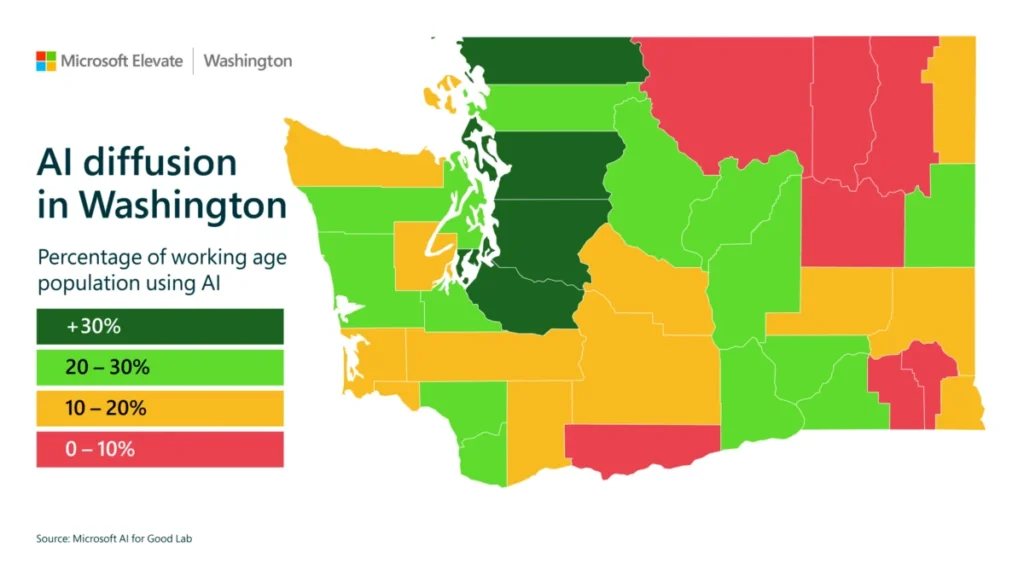
Data released alongside the announcement highlights a troubling trend in AI diffusion across the state. According to Microsoft’s analysis, AI usage is heavily concentrated in the urban and suburban corridors of Western Washington. In Snohomish County, approximately 35 percent of the working-age population is already utilizing AI tools in their daily lives or professional tasks. Similar figures are seen in King, Pierce, and Whatcom counties, where usage rates consistently exceed 30 percent.
In contrast, seven rural counties in Eastern Washington report usage rates below 10 percent. The most extreme disparity is found in Ferry County, where only 2.5 percent of residents are currently engaged with AI technologies. This tenfold gap between the most and least connected regions suggests that without intervention, the "opportunity gap" that has historically plagued rural education could widen into an insurmountable chasm. Microsoft’s leadership argues that because future labor markets will prioritize AI-fluent candidates, ensuring equitable access today is a prerequisite for statewide economic stability tomorrow.
Strategic Rollout and Chronology of Implementation
Microsoft Elevate Washington is structured as a phased rollout, beginning with institutional support and moving toward direct student access over the next two years. The timeline is designed to allow educational institutions to build the necessary administrative infrastructure before the tools are fully integrated into the student experience.
Phase One: Institutional Empowerment (January 2026)
Starting in January 2026, Microsoft will provide Copilot Studio free of charge for up to three years to Washington’s 295 public school districts and 34 community and technical colleges. Copilot Studio is a "low-code" platform that allows organizations to build custom AI agents tailored to specific administrative or pedagogical needs. This phase focuses on operational efficiency, allowing districts to use AI for complex scheduling, data-driven school year planning, and reducing the administrative burden on educators.
To ensure successful implementation, Microsoft is offering $25,000 technology consulting grants to 10 selected school districts and 10 community colleges. These "early adopter" institutions will work directly with Microsoft consultants to develop best practices for AI deployment, which will then be shared as a blueprint for the rest of the state.
Phase Two: Community College Integration (Current – November 2025)
In an immediate effort to support higher education, Microsoft is offering all community college students in the state 12 months of free access to Microsoft 365 Personal. This package includes Copilot integration across standard applications like Word, Excel, and PowerPoint, as well as one terabyte of cloud storage. This offer is available through November 15, 2025, providing a bridge for current students to build digital skills before the broader K-12 rollout begins.
Phase Three: K-12 Student Access (July 2026)
The most expansive part of the initiative begins in the summer of 2026. Approximately 500,000 high school students (grades 9–12) will receive free access to Copilot Chat, Microsoft 365 desktop apps, and specialized "Learning Accelerators." These tools are grounded in learning science and are designed to improve reading fluency, information literacy, and critical thinking. By providing these tools at no cost for three years, Microsoft aims to ensure that every high school graduate in Washington enters the workforce or higher education with a sophisticated understanding of AI applications.
Empowering the Frontline: Professional Development for Educators
A central pillar of the initiative is the recognition that technology is only as effective as the educators who implement it. Microsoft has partnered with the Washington Office of Superintendent of Public Instruction (OSPI), the Washington Education Association (WEA), and the National Education Association (NEA) to launch a statewide professional development program.

This effort will provide AI training to 100,000 educators, instructional assistants, and administrative staff. The curriculum focuses on two primary areas: enhancing classroom instruction through AI-powered personalized learning and streamlining "back-office" tasks to allow teachers more time for direct student engagement. Microsoft will also support the state’s AI Innovation Summit, a collaborative conference intended to bring together over 1,000 educational leaders to share insights on ethical AI adoption and policy.
To further incentivize innovation, Microsoft is providing cash grants directly to K-12 schools and community colleges. These funds are earmarked for "AI-ready" instruction, allowing schools to purchase hardware or develop localized curricula that integrate generative AI into core subjects like math, science, and the humanities.
Broadening the Movement through Public-Private Partnerships
Microsoft Elevate Washington is not intended to be a solo venture. The company is leveraging its existing workforce of over 50,000 employees in the state to foster a "statewide movement" for AI literacy. A key component of this community outreach is a partnership with the nonprofit Code.org to bring the "Hour of AI" to students across the state. This program will feature workshops led by Microsoft employees, showcasing real-world applications of AI and encouraging student-led innovation.
Furthermore, the initiative extends support to the broader educational ecosystem, including youth development workers and career navigators. These community leaders will receive tailored generative AI training to help them better serve their local populations, particularly in regions where traditional educational resources may be scarce.
Microsoft has also issued an "open call for innovators," inviting developers and educators to collaborate on scalable AI-enabled solutions. This crowdsourcing of ideas is intended to ensure that the tools provided remain relevant to the specific needs of Washington’s diverse student body, from urban tech hubs to agricultural communities.
Economic Analysis and Long-term Implications
From a journalistic and economic perspective, Microsoft’s investment in its "backyard" is both a philanthropic gesture and a strategic safeguard for the state’s talent pipeline. Washington’s economy is heavily reliant on high-tech sectors that are currently being disrupted by AI. By ensuring that the local workforce is the most "AI-ready" in the nation, Microsoft is effectively future-proofing the state’s economy.
Industry analysts suggest that this model—providing free enterprise-grade tools to public institutions—could serve as a national blueprint. However, the success of the program will likely depend on addressing the underlying infrastructure issues that Microsoft has acknowledged through its decade-long work on rural broadband. AI tools require robust internet connectivity; without continued progress in rural fiber-optic and 5G deployment, the software provided by Elevate Washington may remain out of reach for the very students it intends to help.
The initiative also signals a shift in the corporate responsibility landscape. By committing more than $4 billion globally over the next five years to its "Elevate" business unit—of which the Washington program is a flagship component—Microsoft is positioning itself as a central player in the global educational infrastructure.
Conclusion: A Promise to the Future
Microsoft Elevate Washington is more than a software giveaway; it is a calculated attempt to align the state’s educational output with the demands of a new technological era. By focusing on "people, creativity, and problem-solving," the initiative seeks to move the conversation away from AI as a threat to labor and toward AI as a tool for human empowerment.
As the program moves toward its 2026 milestones, the eyes of the nation will likely be on Washington to see if a private-sector giant can successfully close the digital divide in its home state. For the students in Ferry County and the educators in Snohomish County alike, the promise of Elevate Washington is the same: the opportunity to not only participate in the future of technology but to lead it.