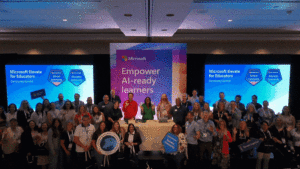




Microsoft has officially announced the induction of more than 43,000 educators into the Microsoft Innovative Educator (MIE) Expert program and the designation of 900 Microsoft Showcase Schools for the 2025–2026 academic year. This latest cohort represents a significant expansion of a global community dedicated to the integration of advanced technology in the classroom, with a specific and timely focus on artificial intelligence (AI) literacy and visionary leadership. As educational institutions worldwide grapple with the rapid evolution of generative AI, these selected experts and schools are positioned as the vanguard of a movement to reimagine pedagogical frameworks for a digital-first future.
The 2025–2026 cycle arrives at a critical juncture for global education. According to data from LinkedIn’s 2025 report on AI and the Global Economy, approximately 70% of the skills required for the majority of professional roles are expected to undergo significant changes by 2030. In response to this shifting labor landscape, Microsoft’s education programs are prioritizing the development of future-ready skills, ensuring that students are not merely consumers of technology but proficient navigators of an AI-augmented world. The MIE Expert and Showcase School programs serve as the primary vehicles for this mission, providing a structured environment for peer-to-peer learning, professional development, and institutional transformation.
The Evolution of Microsoft’s Educational Ecosystem
The Microsoft Innovative Educator program has evolved over the last decade from a focus on basic digital literacy and software proficiency to a comprehensive ecosystem centered on "people-centered AI innovation." This evolution is now anchored by Microsoft Elevate, a strategic initiative designed to empower educators, nonprofit organizations, and workforce partners with high-level AI capabilities. By aligning the MIE Expert and Showcase School programs with the Elevate initiative, Microsoft aims to ensure that the human element remains central to technological progress.
The Microsoft Elevate framework provides participants with exclusive access to advanced resources, including specialized coaching and leadership opportunities. This initiative is built on the premise that while AI can automate tasks and personalize content, the educator’s role as a mentor and facilitator is more vital than ever. The integration of Elevate into the 2025–2026 program cycle marks a deeper commitment to providing educators with the tools necessary to bridge the gap between current curricula and the demands of the future workforce.
A Chronology of the 2025–2026 Selection Process
The path to becoming an MIE Expert or a Showcase School is a rigorous, multi-stage journey that reflects a long-term commitment to professional growth. The selection process for the 2025–2026 cohort began several months prior to the academic year, involving a series of prerequisites designed to test both technical proficiency and innovative mindset.
Educators seeking the MIE Expert designation were required to complete specific professional learning paths on the Microsoft Learn Educator Center. these paths cover a range of topics, from the fundamentals of Microsoft 365 to specialized modules on inclusive classroom tools and AI integration. Following the completion of these modules, candidates submitted self-nominations detailing their impact on student learning and their efforts to mentor colleagues.
For institutions, the journey to becoming a Microsoft Showcase School typically begins on the "Incubator" path. During this phase, school leadership teams work closely with Microsoft to develop a transformation plan based on the Education Transformation Framework (ETF). Schools must demonstrate a commitment to equity, inclusion, and the purposeful use of technology to improve student outcomes. Only after meeting these stringent criteria can an Incubator school apply for full Showcase School status, a title that recognizes them as global models of innovation.
Data-Driven Justification for AI Integration
The surge in AI adoption within educational settings is supported by internal Microsoft research and external labor market data. The "AI in Education Report," released in August 2025, highlights a dramatic increase in the use of generative AI tools by both students and teachers to streamline administrative tasks and create personalized learning experiences.
The necessity of this shift is underscored by the economic reality of the 21st century. With 70% of job skills predicted to change within the next five years, the traditional model of rote memorization is being replaced by a focus on critical thinking, AI ethics, and prompt engineering. MIE Experts are tasked with translating these global trends into classroom realities. By utilizing tools such as Microsoft Copilot and Learning Accelerators, these educators are able to provide real-time feedback and data-driven interventions, particularly in core areas like literacy and mathematics.

Leadership and Mentorship: The Role of MIE Fellows
A distinct tier within this global community is the MIE Fellows. These individuals are distinguished leaders who have been personally nominated by Microsoft team members for their exceptional contributions to the program. MIE Fellows are not only practitioners of technology but are also advocates and mentors who share their expertise on a global stage.
In the 2025–2026 academic year, MIE Fellows will take on expanded leadership roles within their respective regions. They are responsible for providing professional learning opportunities to other educators, presenting at international conferences, and working directly with the Microsoft Elevate team to refine the program’s impact. Their role is essential for maintaining the scalability of the MIE Expert program, ensuring that the knowledge generated by top-tier innovators is disseminated throughout the broader educational community.
Perspectives from the Frontlines of Innovation
The sentiment among the new cohort is one of cautious optimism and a sense of historical responsibility. Eleanor Jenkins, a prominent Microsoft Innovative Educator Expert, emphasized the urgency of the mission during the launch of Microsoft Elevate. Jenkins noted that many of the careers students will enter in the coming decade do not yet exist, requiring educators to "define the way the world works and the way the world is going to change."
This perspective is echoed by school leaders within the Showcase School network. These administrators argue that the integration of AI is not merely about efficiency but about equity. By leveraging AI-driven accessibility tools, schools can better support students with diverse learning needs, ensuring that the digital divide does not widen as technology advances. The consensus among participants is that the 2025–2026 academic year will be a "defining moment" for the role of technology in human development.
Broader Implications for Global Education Systems
The announcement of the 43,000 MIE Experts and 900 Showcase Schools has implications that extend far beyond the individual participants. It signals a broader shift in how global technology companies interact with public and private education systems. Rather than simply providing hardware and software, Microsoft is increasingly acting as a partner in professional development and systemic reform.
The success of the MIE Expert and Showcase School programs suggests that the future of educational reform will be decentralized and practitioner-led. By empowering a massive network of educators to experiment with AI and share their findings, Microsoft is fostering an organic, bottom-up approach to innovation. This model allows for more rapid adaptation to technological changes than traditional, top-down policy mandates.
Furthermore, the focus on "inclusive, student-centered learning environments" addresses a critical need in modern education: the demand for personalization. As AI tools become more sophisticated, the ability to tailor educational content to the specific pace and style of each learner becomes a reality. The 2025–2026 cohort will be the primary testers of these personalized models, providing the data and case studies that will likely inform educational policy for years to come.
Conclusion and Future Outlook
As the 2025–2026 academic year commences, the Microsoft education community stands as a testament to the power of collaborative innovation. The 43,000 MIE Experts and 900 Showcase Schools are embarking on a year that will likely be characterized by rapid experimentation and the setting of new standards for AI in the classroom.
For those looking to join this movement, the path remains open. Microsoft continues to encourage educators and school leaders to engage with the Microsoft Learn Educator Center and the Showcase School Incubator path. The goal remains a shared vision: to elevate education through purpose-driven technology, ensuring that every student is equipped with the skills, literacy, and mindset necessary to thrive in an increasingly complex and automated world. Through the combined efforts of Microsoft Elevate and this global network of changemakers, the future of learning is being redefined in real-time.