




Despite nominal increases in average teacher salaries nationwide, inflation continues to significantly diminish the purchasing power of educators’ earnings, according to a comprehensive new report released by the National Education Association (NEA) on Monday, April 28, 2026. The findings paint a stark picture of an ongoing struggle for teachers to maintain economic stability, even as policy discussions around compensation gain traction.
The NEA report, which analyzes educator pay and student spending across states, indicates that while the average national teacher salary has seen an upward trend in recent years, this growth is largely overshadowed by the persistent rise in the cost of living. This reality is forcing many dedicated professionals to grapple with financial strain, impacting their ability to remain in a profession they are passionate about.
The Inflationary Squeeze on Educator Pay
The report highlights that for the 2024-25 school year, the average national teacher salary stood at $74,495. This represents a modest increase of 3.5% from the previous academic year’s average of $71,985. While these figures might appear positive on the surface, a deeper analysis reveals a concerning trend when adjusted for inflation. Over the past decade, when accounting for the escalating costs of goods and services, the real value of teacher pay has actually declined by 5%. This means that despite earning more dollars, educators are able to afford less than they could ten years ago.
This persistent erosion of purchasing power is a critical factor contributing to teacher dissatisfaction and attrition. Many educators find themselves working second jobs or making significant financial sacrifices to make ends meet, a situation that is increasingly unsustainable and detrimental to the profession’s long-term health.
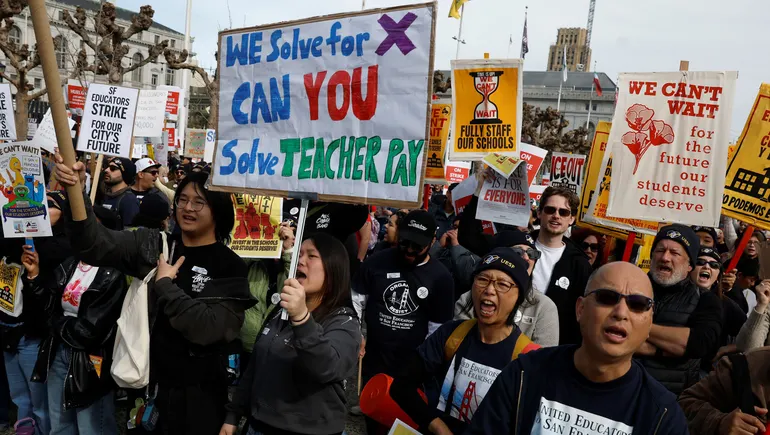
Collective Bargaining: A Differentiator in Teacher Compensation
A significant finding from the NEA report underscores the impact of collective bargaining on teacher salaries. Educators in states with strong collective bargaining laws earn, on average, a substantial 24% more than their counterparts in states where such protections are absent. For the 2024-25 school year, teachers in collective bargaining states saw an average salary of $80,176, a marked contrast to the $64,500 average for teachers in non-collective bargaining states.
This disparity suggests that organized labor plays a crucial role in advocating for and securing more competitive compensation for teachers. The ability of unions to negotiate contracts that reflect the cost of living and the value of the profession appears to be a key driver in ensuring better financial outcomes for educators.
Legislative Efforts and Budgetary Pressures
The issue of teacher pay is not going unnoticed by policymakers. The report indicates that as of April 2026, 22 states have introduced at least 64 bills aimed at increasing teacher salaries. This legislative activity reflects a growing awareness of the need to address compensation challenges. Data from FutureEd, a think tank at Georgetown University’s McCourt School of Public Policy that monitors such initiatives, confirms this trend.
However, these legislative efforts are occurring against a backdrop of complex fiscal challenges. State policymakers and K-12 leaders are navigating difficult budget decisions, often influenced by declining public school enrollment in some regions and the uncertainty surrounding federal funding streams. These financial constraints can limit the scope and effectiveness of proposed salary increases, creating a tension between the stated desire to improve teacher pay and the practical realities of public finance.

The Recruitment and Retention Crisis
The financial realities faced by teachers have direct implications for the critical issues of recruitment and retention within the K-12 education system. Many school districts are already struggling to attract and retain qualified, certified teachers. When combined with stagnant or declining real wages, the teaching profession becomes less appealing to new entrants and less tenable for experienced educators contemplating their future.
NEA President Becky Pringle articulated this sentiment forcefully in a statement accompanying the report’s release. "Educators are struggling to stay in the profession they love," Pringle stated. She attributed the persistent gap between teacher pay and inflation to "elected officials’ policy choices" rather than inherent economic limitations. Pringle further elaborated, "Leaders have tolerated widening income inequality, allowing CEO compensation to climb dramatically while educators struggle to maintain their spending power." This perspective highlights a systemic issue where the value placed on the teaching profession, as reflected in compensation, lags behind that of other sectors.
Key Figures from the NEA Report: A Statistical Snapshot
The NEA’s comprehensive report offers a detailed statistical breakdown of teacher compensation across the nation, providing a granular view of the trends and disparities. Here are some of the standout figures from the 2024-25 school year:
- Average National Teacher Salary: $74,495
- Year-over-Year Increase in Average Salary: 3.5% (from $71,985 in 2023-24)
- Real Decline in Average Salary Over 10 Years (Adjusted for Inflation): 5%
- National Average Starting Teacher Salary: $48,112
- Year-over-Year Growth in Beginning Teacher Salary: 3.4%
- Average Salary for Teachers in Collective Bargaining States: $80,176
- Average Salary for Teachers in Non-Collective Bargaining States: $64,500
- Percentage Premium for Teachers in Collective Bargaining States: 24%
- Number of States with an Average Starting Teacher Salary of at Least $50,000: 15
- Percentage of School Districts Offering a Maximum Teacher Salary of at Least $96,000: 31%
- Percentage of School Districts Offering a Maximum Teacher Salary Less Than $60,000 (Regardless of Experience/Education): 7%
- Highest Average Statewide Teacher Salary (California): $103,552
- Lowest Average Statewide Teacher Salary (Mississippi): $54,975
Implications for the Future of Education

The data presented by the NEA carries significant implications for the future of the education system. A profession that struggles to offer competitive compensation, especially when adjusted for the rising cost of living, is likely to face ongoing challenges in attracting and retaining high-quality educators. This can lead to larger class sizes, increased reliance on underqualified instructors, and a potential decline in the overall quality of education delivered to students.
The report also implicitly raises questions about how societal priorities are reflected in compensation structures. When professions vital to the nation’s future, such as teaching, are unable to keep pace with economic realities, it suggests a broader societal conversation is needed about the value placed on public service and the necessary investments to support it.
The disparity between states with and without collective bargaining further suggests that policy frameworks can have a tangible impact on educator well-being and, by extension, on the stability of the teaching workforce. As states continue to grapple with teacher shortages and the need for educational excellence, the findings of this NEA report serve as a critical reminder of the economic factors that underpin these complex challenges. The continued erosion of teacher purchasing power, despite nominal salary increases, necessitates a more robust and sustained approach to ensuring educators are fairly compensated for their invaluable contributions.