The Turkish language, a primary branch of the Turkic language family, serves as a vital linguistic bridge between Europe, the Middle East, and Central Asia, spoken by approximately 80 million native speakers globally. For those entering the sphere of Turkish commerce, tourism, or diplomacy, the path to proficiency is increasingly viewed through the lens of the Pareto Principle, which suggests that a significant majority of daily communication—roughly 80%—is derived from a mere 20% of the total vocabulary. By focusing on high-frequency nouns, verbs, and social markers, learners can achieve functional literacy and conversational competence with a streamlined investment of time.
The Strategic Importance of High-Frequency Vocabulary
Linguistic researchers and the Turkish Language Association (Türk Dil Kurumu – TDK) emphasize that the mastery of core "building block" words is the most efficient method for navigating the agglutinative nature of the Turkish language. Unlike Indo-European languages, Turkish relies heavily on suffixes to convey grammatical relationships, meaning that a single root word can be expanded into an entire sentence. However, before a learner can master complex morphology, they must first secure a foundation of common nouns and verbs.
Statistical data from the Foreign Service Institute (FSI) categorizes Turkish as a Category III language, meaning it is "hard" for native English speakers due to significant linguistic and cultural differences. Despite this, experts note that Turkish is remarkably logical and phonetic. Following the 1928 Alphabet Reform led by Mustafa Kemal Atatürk, the language transitioned from the Arabic script to a modified Latin alphabet, making the initial stages of vocabulary acquisition significantly more accessible to Western learners.
A Chronology of Linguistic Socialization: Greetings and Politeness
The first stage of integrating into Turkish society involves mastering the nuanced hierarchy of greetings. Turkish culture places a high premium on hospitality and social etiquette, often reflected in the formal and informal distinctions of its address.
Essential Greetings and Social Markers
In Turkish social circles, the transition from "Merhaba" (Hello) to "Selam" (Hi) marks a shift in familiarity. Formal situations require the use of the plural or formal second person, as seen in "Hoş geldiniz" (Welcome) and "Nasılsınız?" (How are you?).
| English | Turkish | Usage Context |
|---|---|---|
| Hello | Merhaba | Standard formal/neutral |
| Good morning | Günaydın | Early day greeting |
| Good evening | İyi akşamlar | Used both as greeting and parting |
| See you later | Görüşürüz | Common informal parting |
| I’m fine | İyiyim | Standard response to wellness queries |
Beyond basic greetings, "Polite Words" act as social lubricants. Phrases such as "Geçmiş olsun" (Get well soon) and "Afiyet olsun" (Enjoy your meal) are not merely suggestions but cultural requirements in daily interactions. A unique aspect of Turkish is the phrase "Elinize sağlık" (Health to your hands), used to thank a cook or artisan, reflecting the deep-seated value placed on manual labor and hospitality. Similarly, "Kolay gelsin" (May it come easy) is a ubiquitous acknowledgement of anyone currently working, from a bank teller to a street sweeper.
Navigating the Physical World: Nouns of Sustenance and Place
Once social rapport is established, functional communication shifts to the identification of objects and locations. In urban environments like Istanbul or Ankara, the ability to identify "Banka" (Bank), "Hastane" (Hospital), and "Eczane" (Pharmacy) is essential for safety and logistics.
Food, Drinks, and the "False Friend" Phenomenon
Turkish cuisine is a central pillar of the nation’s identity. Beginners must distinguish between "Yemek" (Food/To eat) and "İçecek" (Drink). A critical linguistic trap for English speakers is the word "Pasta." While in many languages this refers to noodles, in Turkish, "Pasta" exclusively means "Cake." The correct term for noodles or pasta is "Makarna."
| English | Turkish | English | Turkish |
|---|---|---|---|
| Water | Su | Meat | Et |
| Tea | Çay | Fish | Balık |
| Coffee | Kahve | Bread | Ekmek |
| Cheese | Peynir | Milk | Süt |
The Domestic Sphere: Complexities of Family
The Turkish language provides an intricate map of family relations, reflecting a traditional social structure that distinguishes between maternal and paternal lineages. For example, a paternal uncle is "Amca," while a maternal uncle is "Dayı." Similarly, an "Abla" (older sister) and "Abi" (older brother) are titles of respect used even for non-relatives to acknowledge seniority.
The Architectural Logic of Turkish Verbs
The most significant hurdle for learners is the Turkish verb system. Turkish follows a Subject-Object-Verb (SOV) sentence structure, placing the action at the very end. For example, "I am learning Turkish" translates to "Ben Türkçe öğreniyorum" (I Turkish learn-am).
High-Frequency Verbs
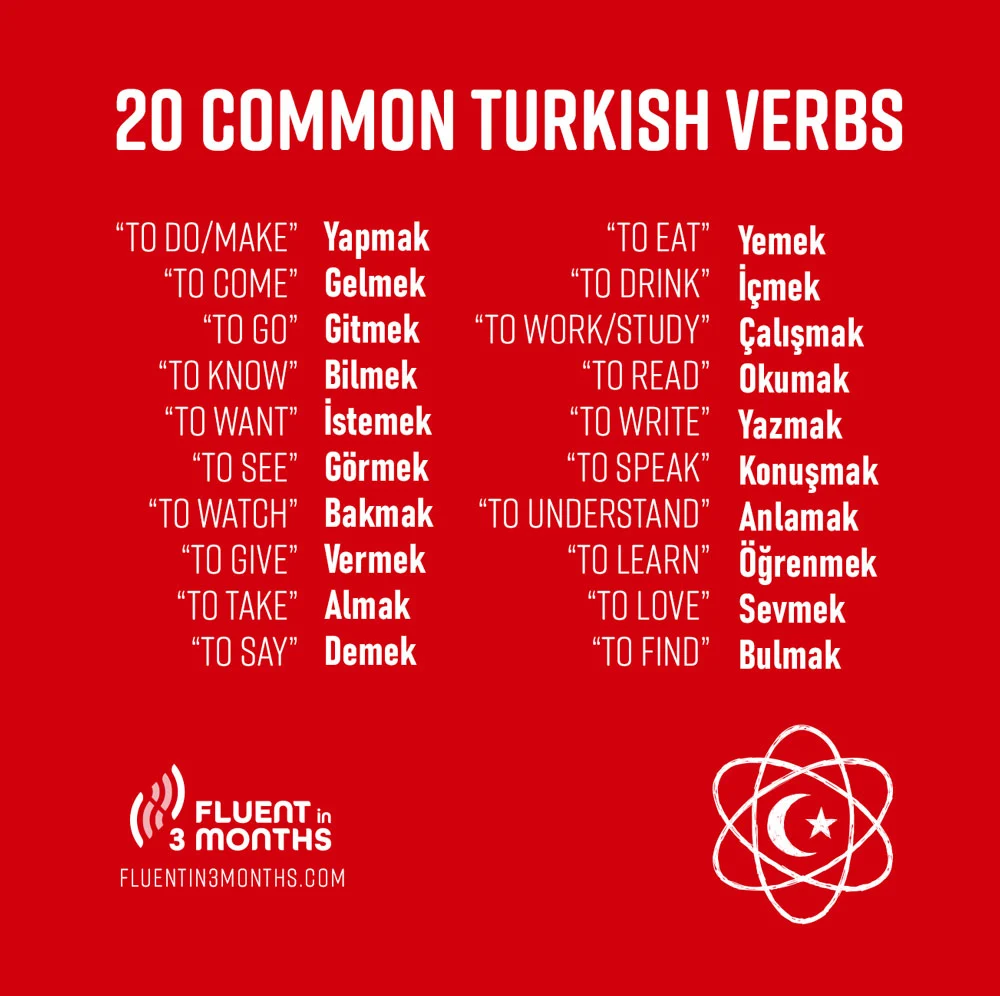
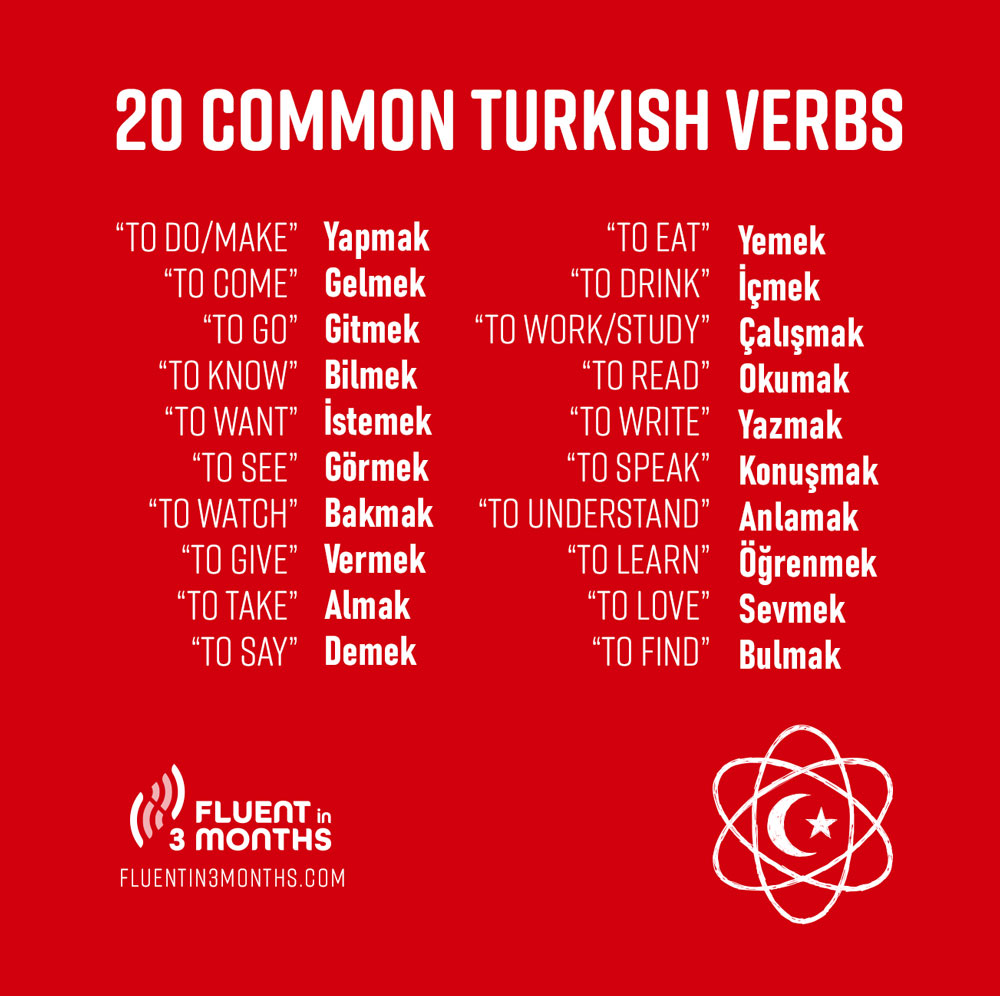
The following verbs constitute the majority of actions described in daily life:
- Yapmak: To do/make
- Gelmek/Gitmek: To come/To go
- İstemek: To want
- Çalışmak: To work/study
- Anlamak: To understand
A notable absence in Turkish vocabulary lists is a direct equivalent for the verbs "to be" or "to have." These concepts are expressed through suffixes or the words "var" (there is/exists) and "yok" (there isn’t/doesn’t exist). To say "I have a car," one says "Benim bir arabam var" (My one car-my exists). This structural shift requires a cognitive adjustment for those accustomed to Germanic or Romance languages.
Descriptive Power: Adjectives and Connectors
Adjectives in Turkish are placed before the noun, similar to English. Mastering opposites is the fastest way to expand descriptive range. "Büyük" (Big) vs. "Küçük" (Small), and "Yeni" (New) vs. "Eski" (Old) allow for basic commerce and navigation.
Color and Quality
Colors such as "Kırmızı" (Red), "Mavi" (Blue), and "Yeşil" (Green) are essential for identifying landmarks or clothing. Furthermore, conjunctions like "Ve" (And), "Ama" (But), and "Çünkü" (Because) allow learners to bridge isolated words into cohesive thoughts, facilitating the transition from A1 (Beginner) to A2 (Elementary) proficiency levels.
The "Dizi" Effect: Cultural Exports and Language Proliferation
The global rise of Turkish television dramas, known as "Dizi," has created an unprecedented surge in language interest. Exported to over 150 countries, these series have introduced international audiences to filler words and emotional expressions that are often absent from traditional textbooks.
Words like "İnşallah" (God willing), "Valla" (I swear), and "Canım" (My dear) are heard frequently in these dramas. This cultural phenomenon has provided a "natural immersion" environment for millions, with many learners reporting that they recognize these "bonus words" before they even begin formal study. The phrase "Yok artık!" (No way/You’re kidding!) has become a staple of digital communication among fans of Turkish media worldwide.
Statistical Analysis and Broader Implications
According to the Turkish Ministry of Culture and Tourism, the number of foreigners seeking Turkish language certification has increased by nearly 30% over the last decade. This trend is driven by Turkey’s emerging role as a regional hub for healthcare, technology, and education.
From a geopolitical perspective, the proliferation of the Turkish language strengthens "soft power" ties. For the learner, the implications are both economic and cognitive. Studies in neuroplasticity suggest that learning a non-Indo-European language like Turkish—with its unique logic and vowel harmony—enhances problem-solving skills and mental flexibility.
In summary, effective communication in Turkish does not require an exhaustive mental dictionary. By prioritizing the most common greetings, nouns, and verbs, and understanding the underlying SOV sentence structure, a learner can rapidly close the gap between being a silent observer and an active participant in Turkish life. As the language continues to expand its reach through trade and media, these basic "building blocks" serve as an essential toolkit for global citizens in the 21st century.