



The acquisition of numerical literacy in the Turkish language serves as a fundamental pillar for any individual seeking to navigate the socio-economic landscape of the Republic of Turkey. Whether engaging in high-stakes commercial negotiations in Istanbul’s financial districts, settling a hospitality bill in the Aegean region, or facilitating personal telecommunications, the Turkish numeral system provides the essential framework for precision and clarity. Unlike many Indo-European languages that feature irregular numerical structures, the Turkish system, rooted in the Ural-Altaic language family, is characterized by its remarkable mathematical consistency and logical progression. This guide provides an exhaustive analysis of Turkish numerals, their grammatical applications, and their vital role in contemporary Turkish society.
The Structural Foundations of Turkish Numerals 1-10
The Turkish numeral system is built upon a base-ten logic that remains consistent from the most basic digits to the most complex figures. For the language learner, the first ten digits represent the essential lexicon from which all subsequent numbers are derived. Linguistically, these numbers are phonetic, meaning they are pronounced exactly as they are written, which simplifies the learning curve for international speakers.
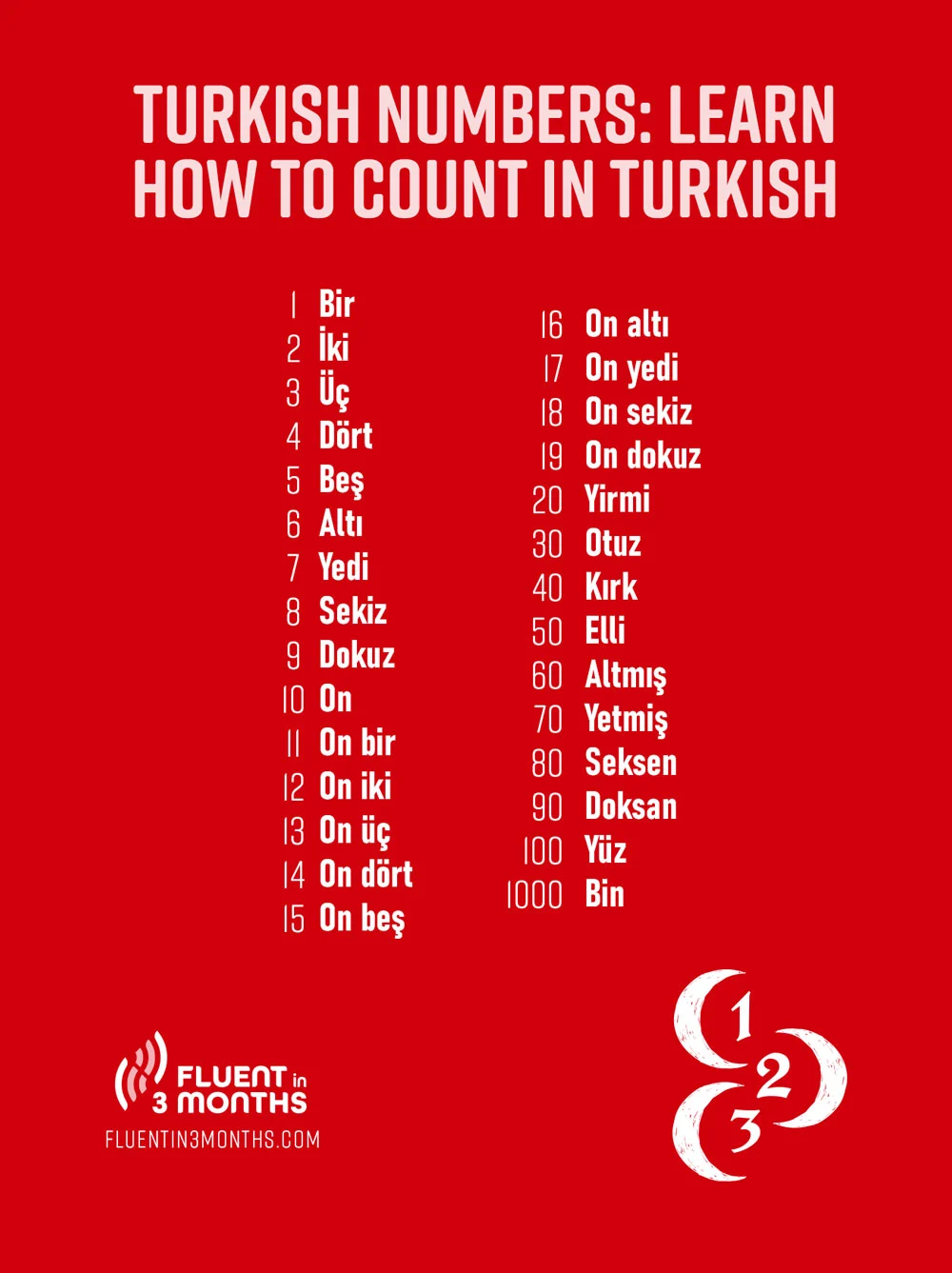
The primary digits are as follows: 1 (bir), 2 (iki), 3 (üç), 4 (dört), 5 (beş), 6 (altı), 7 (yedi), 8 (sekiz), 9 (dokuz), and 10 (on).
These ten words constitute the primary building blocks of the language. For example, the number 3 (üç) is not only a standalone value but also a critical component in forming 13 (on üç), 30 (otuz), and 300 (üç yüz). Experts in Turkish linguistics note that the lack of gendered numbers—a common feature in languages like Arabic or French—makes the Turkish system one of the most accessible for global commerce and rapid communication.
The Chronology of Compounding: 11 through 99
Once the primary digits are mastered, the construction of numbers from 11 to 19 follows a strict additive logic. In English, terms such as "eleven" and "twelve" are etymologically distinct from "one" and "two." In contrast, Turkish maintains a transparent structure by combining the word for ten (on) with the single digit. Consequently, 11 becomes "on bir" (ten-one), 12 becomes "on iki" (ten-two), and 19 becomes "on dokuz" (ten-nine).
This logical transparency extends into the multiples of ten. To navigate higher values, one must memorize the specific terms for each decadal milestone:
- 20: Yirmi
- 30: Otuz
- 40: Kırk
- 50: Elli
- 60: Altmış
- 70: Yetmiş
- 80: Seksen
- 90: Doksan
To form any intermediate number, such as 45 or 87, the speaker simply places the single digit after the multiple of ten. For instance, 45 is expressed as "kırk beş" and 87 as "seksen yedi." This systematic approach eliminates the need for complex mental conjugation, allowing for efficient transactions in fast-paced environments like the Grand Bazaar or modern retail outlets.
Scaling the System: Hundreds, Thousands, and Large-Scale Data
As the scale of numerical values increases, the Turkish language continues to utilize a modular approach. The term for 100 is "yüz." Unlike English, which requires the prefix "one" (one hundred), Turkish speakers frequently use "yüz" in its singular form to denote a single century or a hundred-unit value. However, for any multiple of a hundred, the multiplier is placed directly before the word "yüz." Thus, 200 is "iki yüz," 500 is "beş yüz," and 900 is "dokuz yüz."
The same logic applies to "bin" (one thousand). To express 5,000, one says "beş bin." To express a more complex figure such as 1,923—the year the Republic of Turkey was founded—the components are sequenced as follows: "bin" (1,000), "dokuz yüz" (900), "yirmi" (20), "üç" (3), resulting in "bin dokuz yüz yirmi üç."
In the context of modern economics, understanding these large numbers is critical. Following the currency revaluation in 2005, where the Turkish state removed six zeros from the Old Turkish Lira to create the New Turkish Lira (YTL), the precision of "bin" (thousand) and "milyon" (million) became central to daily financial stability.
The Complexity of Ordinal Numerals and Vowel Harmony
In a professional or journalistic context, numbers are often used to denote sequence or rank (first, second, third). In Turkish, these are known as ordinal numbers. The construction of ordinals introduces one of the most distinctive features of the Turkish language: four-way vowel harmony. The suffix added to a number to make it ordinal depends entirely on the last vowel of the base number.
The four possible suffixes are -ıncı, -inci, -uncu, and -üncü. This grammatical rule ensures that the suffix matches the phonetic resonance of the root word.
- Bir (ends in ‘i’) becomes Birinci (First)
- İki (ends in ‘i’) becomes İkinci (Second)
- Üç (ends in ‘ü’) becomes Üçüncü (Third)
- Dört (ends in ‘ö’) becomes Dördüncü (Fourth – note the consonant mutation from ‘t’ to ‘d’)
- Altı (ends in ‘ı’) becomes Altıncı (Sixth)
- Dokuz (ends in ‘u’) becomes Dokuzuncu (Ninth)
This sophisticated linguistic mechanism reflects the historical evolution of the Turkish language, which was standardized during the Alphabet Revolution of 1928 under Mustafa Kemal Atatürk. The transition from the Arabic-based Ottoman script to the Latin-based Turkish alphabet necessitated a clear, mathematical approach to grammar that remains in use by the Turkish Language Association (Türk Dil Kurumu) today.
Practical Applications in the Turkish Economy and Daily Life
The utility of Turkish numbers extends far beyond abstract counting; they are integrated into specific cultural and economic protocols.
-
Temporal Management and the 24-Hour Clock:
In formal sectors, such as aviation, government, and broadcasting, Turkey utilizes the 24-hour clock. A meeting at 2:00 PM is officially designated as "saat on dört" (hour fourteen). However, in informal daily life, the 12-hour clock is supplemented by the terms "buçuk" (half past) and "çeyrek" (quarter). For example, 10:30 is "on buçuk," while 10:15 is "onu çeyrek geçiyor" (ten and a quarter passing). -
Currency and Commercial Transactions:
The Turkish Lira (TL) is divided into 100 kuruş. When observing price tags, it is essential to note that Turkey uses the comma as a decimal separator and the period as a thousands separator—the inverse of the American and British systems. Therefore, a price of 1.500,50 TL represents one thousand five hundred lira and fifty kuruş. Journalistic data indicates that this distinction is a frequent point of confusion for foreign investors and tourists.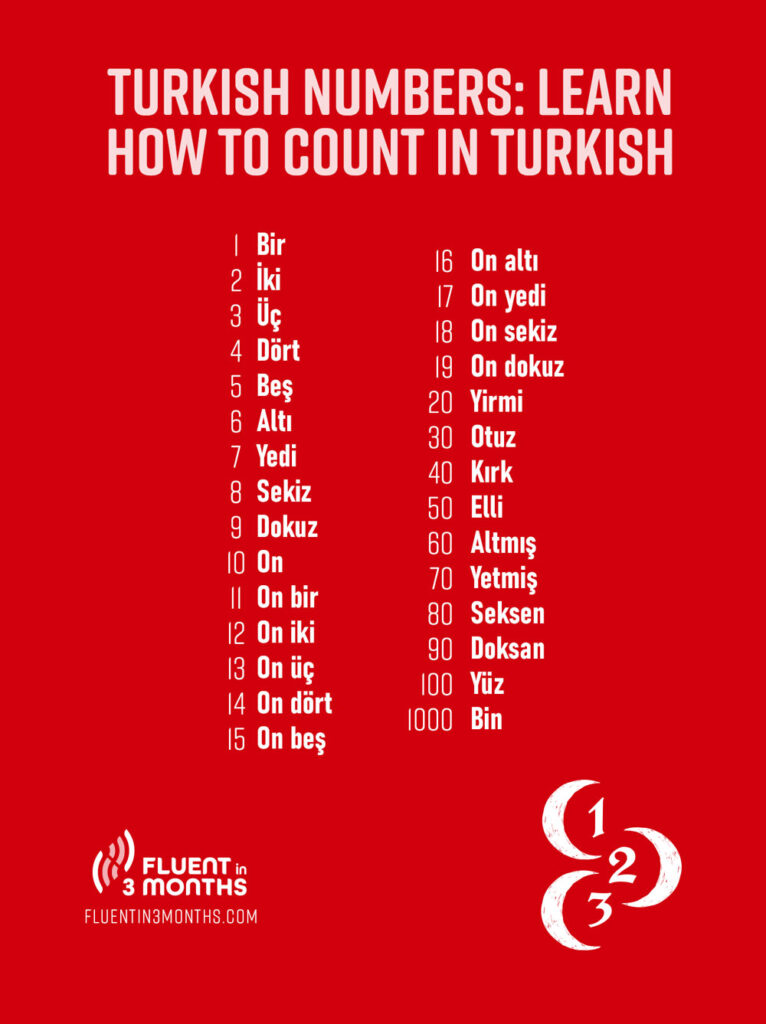
-
Telecommunications and Identification:
Turkish phone numbers are typically delivered in a specific rhythmic grouping: the three-digit area code, followed by a three-digit block, and two two-digit blocks (e.g., 05xx xxx xx xx). Similarly, the "T.C. Kimlik No" (Republic of Turkey Identity Number) is an 11-digit string that is essential for all legal and administrative actions within the country. -
Logistics and Measurements:
In the Turkish marketplace, the metric system is the legal standard. Consumers and wholesalers interact using "kilo" (kilogram), "gram," and "metre." Common phrases include "iki kilo elma" (two kilos of apples) or "beş yüz gram peynir" (five hundred grams of cheese).
Societal Impact and Historical Context
The standardization of the Turkish numeral system was a critical component of the early Republic’s modernization efforts. By adopting Latin numerals and a phonetic spelling system, the state significantly increased literacy rates and facilitated international trade. Today, this numerical clarity supports Turkey’s role as a major G20 economy and a hub for transcontinental logistics.
From a sociological perspective, the use of numbers in Turkey also reflects cultural values. In the tradition of "pazarlık" (haggling), which remains prevalent in traditional markets, the ability to manipulate and express numbers fluently is seen as a sign of respect and social competence. Furthermore, the concept of "nazar" (the evil eye) often involves numerical superstitions, where certain numbers are avoided or repeated to ensure good fortune.
Broader Implications for Global Integration
As Turkey continues to strengthen its ties with the European Union and expands its influence in Central Asia and the Middle East, the importance of the Turkish language as a regional lingua franca grows. For professionals in diplomacy, international trade, and journalism, mastering the Turkish numeral system is not merely a linguistic exercise but a strategic asset.
The logical, additive nature of the system reflects a broader cultural preference for directness and structural integrity. By understanding the nuances of vowel harmony in ordinals, the specificities of currency notation, and the rhythmic delivery of telecommunications data, one gains more than just the ability to count; one gains an entry point into the mechanics of Turkish thought and the engine of its national commerce.
In summary, the Turkish numerical system is a model of linguistic efficiency. Its adherence to base-ten logic, combined with the melodic requirements of vowel harmony, creates a system that is both mathematically sound and aesthetically consistent. For the global citizen, these numbers are the keys to unlocking the rich potential of one of the world’s most dynamic and historically significant nations. Whether for the purpose of academic study or practical relocation, the mastery of "bir" through "bin" serves as the definitive foundation for success in the Turkish-speaking world.