




The educational landscape has long been dominated by fervent discussions surrounding literacy, yet a critical component—writing instruction—has consistently remained on the periphery. While debates rage over phonics, fluency, and reading comprehension, the equally vital skill of written expression often receives scant attention, despite its intrinsic link to reading. This significant oversight in the broader literacy conversation is precisely what Melanie Meehan, a former curriculum coordinator and founder of an in-person writing center, and Maggie Roberts, a literacy consultant and veteran middle school teacher, aim to rectify with their new collaborative work, Foundational Skills for Writing: A Brain-Based Guide to Strengthen Executive Functions, Language, and Other Cornerstones for Writers. Published earlier this month, the book offers a comprehensive exploration into the intricate cognitive processes involved in writing and identifies common impediments to student proficiency, providing educators with actionable, research-backed strategies.
The Overlooked Pillar: Writing in Literacy Debates

For decades, the "reading wars" have captivated the attention of educators, policymakers, and parents, cycling through various pedagogical approaches from whole language to phonics-first instruction. This intense focus, while critical for reading development, has inadvertently created a chasm where writing, the other half of the literacy equation, is often relegated to a secondary, or even tertiary, concern. Statistics from organizations like the National Assessment of Educational Progress (NAEP) frequently highlight persistent challenges in writing proficiency among students across grade levels, underscoring a systemic issue. For instance, recent NAEP data consistently show that a significant percentage of students do not meet basic writing benchmarks, a trend that has prompted calls for a re-evaluation of instructional priorities. Despite this, the discourse surrounding "the science of reading" rarely extends to "the science of writing," leaving many teachers without adequate training or resources to effectively teach this complex skill.
The prevailing educational climate often treats writing as an output—a demonstration of reading comprehension or content knowledge—rather than a distinct, foundational skill requiring its own explicit instruction. This perspective overlooks the profound impact that strong writing abilities have on critical thinking, communication, and overall academic and professional success. Meehan and Roberts contend that this neglect stems partly from a lack of understanding regarding the cognitive demands of writing. Unlike reading, which involves decoding and comprehension, writing is a generative process that requires simultaneous engagement of multiple cognitive functions: ideation, organization, syntax, vocabulary, and transcription, all while managing working memory and attention.
A Deeper Dive into Foundational Skills: The Brain-Based Approach
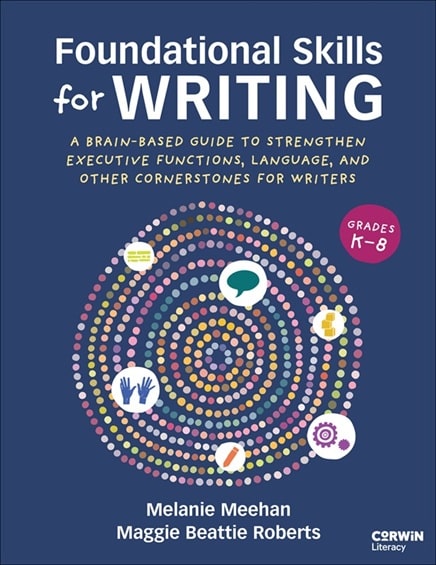
Foundational Skills for Writing distinguishes itself by adopting a brain-based approach, dissecting the seemingly monolithic act of writing into three core skill categories, each essential for developing proficient writers:
- Transcription Skills: This category encompasses the mechanical aspects of writing, including handwriting, keyboarding, spelling, and the development of both large and small motor skills necessary for physical execution. For many students, difficulties in these areas can consume an inordinate amount of cognitive energy, leaving little capacity for higher-order thinking like idea generation or organization. The book emphasizes that automatizing these skills is crucial, as it frees up cognitive resources for more complex writing tasks.
- Oral Language: Recognizing that speaking and listening are direct precursors to effective writing, this section focuses on developing strong oral language skills, particularly sentence construction. Students who struggle to articulate complex thoughts verbally often face similar challenges in written form. By strengthening their ability to form coherent sentences and express ideas orally, educators can build a vital bridge to written fluency.
- Executive Functioning: Perhaps the most innovative aspect of the book, this category addresses the critical role of executive functions—a set of cognitive processes that control and regulate other abilities and behaviors. Key executive functions for writing include working memory (holding information in mind while manipulating it), cognitive flexibility (shifting perspectives and adapting strategies), and inhibitory control (filtering distractions and irrelevant thoughts). When these functions are underdeveloped, students can struggle with planning, organizing, revising, and maintaining focus during the writing process.
The authors meticulously demonstrate how proficiency in each of these areas contributes to a student’s overall writing competence. They argue that by identifying and explicitly addressing deficits in these foundational skills, teachers can unlock students’ potential and transform their relationship with writing.
The Authors’ Expertise and Motivation

Melanie Meehan brings a wealth of experience from her tenure as a curriculum coordinator, where she directly observed the systemic challenges in writing instruction. Her current role running an in-person writing center provides her with direct, hands-on insight into students’ struggles and the effectiveness of targeted interventions. Maggie Roberts, a literacy consultant with nearly two decades of experience supporting teachers in middle school classrooms, offers a deep understanding of pedagogical practices and the practical realities of implementing new strategies in diverse educational settings. Their combined expertise forms a potent foundation for a book that is both theoretically sound and eminently practical.
Their motivation for writing Foundational Skills for Writing stems from a shared recognition of the disparity between the emphasis on reading and the neglect of writing. They observed that while educators were increasingly equipped with strategies for reading difficulties, a similar robust framework for writing challenges was conspicuously absent. This book is their contribution to filling that void, providing a structured, accessible guide for teachers to understand the ‘why’ behind writing difficulties and the ‘how’ of effective intervention.
"Minute Moves": Practical Strategies for Busy Classrooms

A cornerstone of Meehan and Roberts’ approach is their collection of "Minute Moves"—short, flexible activities designed to be easily integrated into the daily classroom routine. These activities, typically lasting only a couple of minutes, can serve as warm-ups, transitions between lessons, or quick interventions. The genius of "Minute Moves" lies in their efficiency and their explicit focus on automatizing foundational skills, thereby reducing the cognitive load on students during more extensive writing tasks. By making these skills automatic, students can allocate their mental energy to the higher-order processes of generating and organizing ideas, crafting compelling arguments, and developing their unique voice.
The authors outline eight specific strategies, categorizing them by the foundational skill they target:
Key Strategies for Spelling Development
Effective spelling is not merely rote memorization; it involves understanding patterns, etymology, and morphology. The "Minute Moves" for spelling aim to foster this deeper understanding:
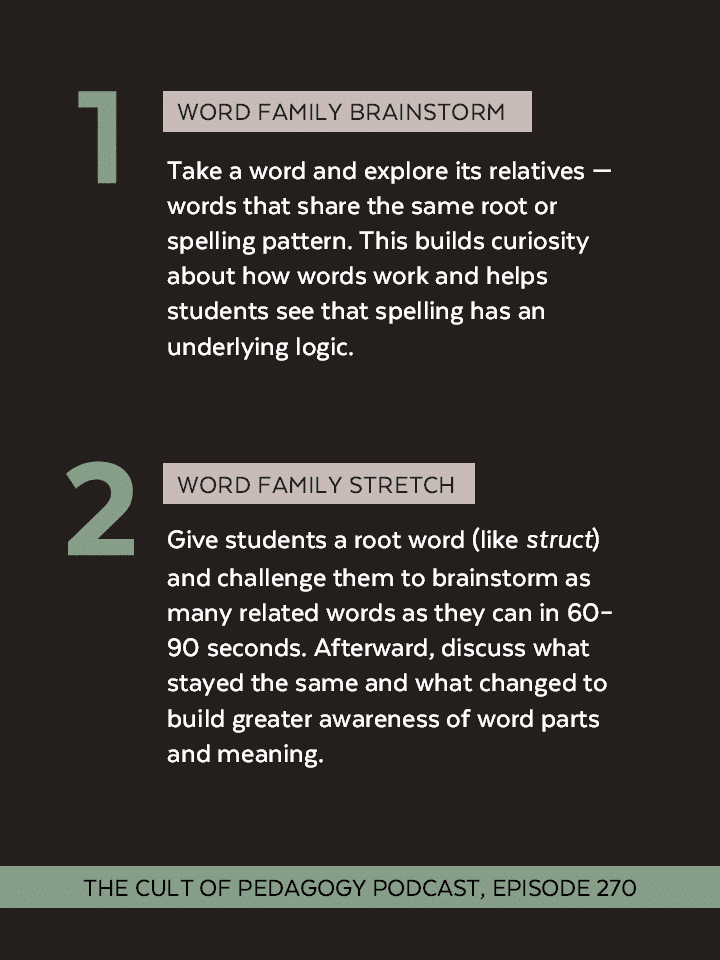
- Word Family Brainstorm: Inspired by spelling researcher Rebecca Treiman, this activity encourages students to uncover the "relatives" of a given word. For example, exploring the connection between "two" and words like "twin," "twine," and "twenty" reveals the "TW" pattern associated with the concept of "twoness." This cultivates curiosity and an appreciation for the logic within the English language. Another example provided by Meehan, linking "decision" to "decide," "incision," and "scissors" through a shared Latin root meaning "to cut," demonstrates how morphological awareness can demystify spelling.
- Word Family Stretch: Building on the brainstorm, students are given a root (e.g., "struct," meaning "to build") and challenged to generate as many related words as possible within a tight timeframe (60-90 seconds). The subsequent debrief is critical, prompting discussions about what parts of the word remained constant, what changed, and how prefixes or suffixes altered meaning. This exercise solidifies the understanding that word parts carry meaning, thereby enhancing academic vocabulary and spelling accuracy. Roberts distinguishes between "bound" roots (like "struct") and "free" roots (like "form"), deepening students’ linguistic insights.
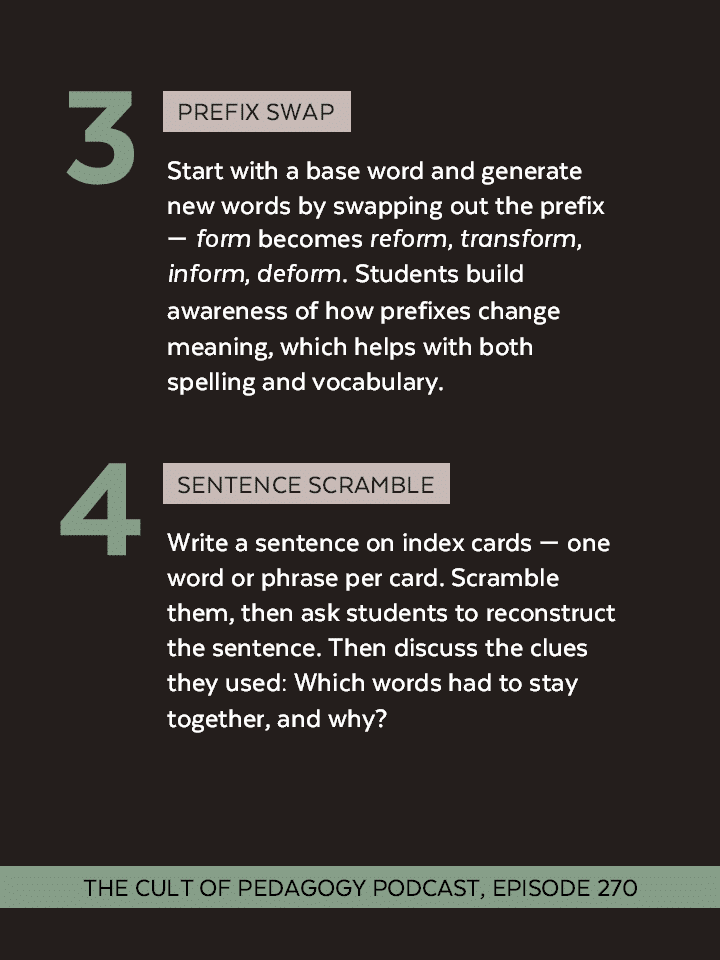
- Prefix Swap: This activity directly targets prefixes, demonstrating how their interchangeability alters word meaning. Students take a base word like "form" and create variations such as "reform," "transform," "inform," and "deform." This practice not only reinforces prefix meanings but also highlights the systematic nature of word construction. Meehan notes its particular power for multilingual learners, who can often leverage their knowledge of other languages to recognize common prefixes like "bene" and "mal," connecting them to words like "benevolent" and "malevolent." These three spelling activities collectively strengthen neurological pathways, aiding word retrieval and reducing spelling anxiety.
Enhancing Sentence Construction
Moving beyond individual words, the book provides strategies to help students master the art of building robust and varied sentences:
- Sentence Scramble: Students are given a sentence broken into individual words or phrases on separate cards. Their task is to reassemble the sentence. This tactile activity allows for experimentation and provides immediate feedback. Post-activity discussions encourage students to articulate their reasoning, identifying grammatical clues, dependent clauses, and essential phrases. The challenge can be escalated by removing punctuation, adding distractors, or asking students to extend the sentence, ultimately fostering an internalized understanding of sentence patterns.
- Sentence Expander: Starting with a simple kernel sentence (e.g., "The cat purrs"), students collaboratively build upon it by answering a series of questions: Which cat? What color? Where? When? Why? Meehan advocates for using accessible terms like "doer" and "doing" instead of the more abstract "subject" and "predicate," making sentence structure more comprehensible for younger learners. Once a sentence is fully expanded (e.g., "The orange cat is sleeping on the couch in the afternoon because he is tired"), students experiment with rearranging its components to create variations, developing flexibility and precision in their writing.
- Sentence Combining: Roberts describes this as a "high-impact" strategy for moving students beyond simple, choppy sentences to syntactically complex and precise expressions. Students are given two short sentences (e.g., "My cat is orange." and "My cat is big.") and instructed to combine them into one, such as "My big orange cat…" Scaffolding can involve underlining words to be "harvested." As proficiency grows, students can combine three sentences and experiment with conjunctions to alter meaning. This practice directly translates into their independent writing, leading to more sophisticated sentence structures.
Cultivating Cognitive Flexibility through Writing
Executive functions, particularly cognitive flexibility, are crucial for adapting to the dynamic demands of writing. These "Minute Moves" aim to strengthen this vital skill:
- What’s Another Way?: This activity directly targets cognitive flexibility by challenging students to rewrite a given sentence in multiple ways. Questions prompt students to consider alternative structures: starting with a dependent clause, replacing a noun with a pronoun, or intentionally shortening the sentence for impact. Meehan emphasizes that effective writing involves strategic variation—knowing when to use long, complex sentences and when a concise, impactful sentence is more appropriate. Crucially, naming this skill as "cognitive flexibility" empowers students, especially those who have struggled, by reframing their efforts as practicing a sophisticated cognitive ability.
- New Angle: Zooming out from the sentence to the narrative level, this strategy asks students to retell a familiar story, scene, or event from a different character’s perspective. Roberts illustrates this with a personal anecdote about a cafeteria food fight, highlighting how retelling it through the eyes of an impacted teacher drastically alters the narrative. This exercise demands students hold multiple viewpoints simultaneously, making deliberate choices about voice, detail, and interpretation. Meehan utilizes short animated videos, such as Pixar’s "Snack Attack," to facilitate this, allowing students to practice shifting perspectives and understanding diverse interpretations—a skill she rightly notes extends far beyond the writing classroom, fostering empathy and contributing to democratic discourse.
Broader Implications for Educational Practice
The release of Foundational Skills for Writing marks a significant contribution to the field of literacy education. By systematically breaking down the complexities of writing and offering practical, minute-long interventions, Meehan and Roberts provide a much-needed resource for teachers at all levels.
The implications for educational practice are substantial:
- Teacher Professional Development: The book offers a clear framework for professional development initiatives, addressing a recognized gap in teacher training for writing instruction. Many educators feel unprepared to teach writing effectively, and this resource can empower them with confidence and concrete strategies.
- Curriculum Development: School districts can integrate the book’s principles into their literacy curricula, ensuring that foundational writing skills are explicitly taught and regularly practiced, rather than assumed or overlooked.
- Student Outcomes: By addressing the underlying cognitive demands of writing, the "Minute Moves" can lead to measurable improvements in students’ writing proficiency, confidence, and engagement. Students who master these foundational skills are better equipped to tackle more complex academic writing and to express themselves effectively in all contexts.
- Equity in Education: The brain-based approach acknowledges that writing challenges are often rooted in specific cognitive or developmental areas. By identifying and addressing these challenges systematically, the book offers a more equitable approach to writing instruction, supporting diverse learners, including those with learning differences and multilingual students.
- Rebalancing Literacy Instruction: Ultimately, Foundational Skills for Writing advocates for a more balanced approach to literacy, one that recognizes writing not just as an outcome, but as a dynamic and foundational skill intrinsically intertwined with reading. This rebalancing is crucial for fostering truly literate individuals who can both consume and produce information effectively.
In an era where effective communication is more vital than ever, equipping students with robust writing skills is paramount. Meehan and Roberts’ Foundational Skills for Writing provides a timely and essential guide for educators seeking to elevate writing to its rightful place alongside reading in the pursuit of comprehensive literacy. By offering accessible, brain-based strategies, the book empowers teachers to cultivate not just better writers, but also more flexible, critical, and empathetic thinkers.