



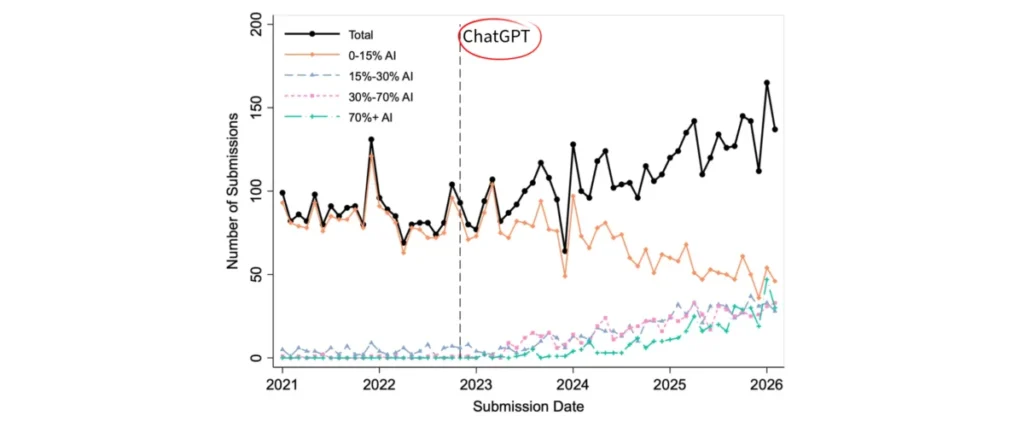
A significant disruption is unfolding within the hallowed halls of academic publishing, raising profound questions about the future of scholarly communication and the integrity of research. A recent report from an AI Task Force convened by the prestigious journal Organization Science has meticulously documented a troubling trend: the widespread adoption of generative artificial intelligence (AI) tools, particularly since the advent of ChatGPT in late 2022, is correlated with a substantial increase in submission volume, a marked decline in readability, and a concerning drop in the overall quality of submitted manuscripts. This phenomenon challenges the prevailing assumption that AI tools inherently enhance productivity and polish, instead presenting a complex scenario where ease of production may be inversely related to substantive intellectual contribution.
The Unmistakable Shift in the Academic Landscape
The alarm bells began to ring quietly among editors and peer reviewers long before the data fully illuminated the issue. As the Organization Science AI Task Force noted, a subtle but palpable change in the character of incoming manuscripts became apparent. "Something is up in academic research," their report stated, capturing the widespread sentiment of unease. Editors and reviewers, the gatekeepers of academic rigor, found themselves encountering a peculiar quality in submissions – a sense of "weightlessness" in the writing, despite superficial adherence to academic conventions. The prose, while grammatically correct and formally structured, often lacked the nuanced depth, clarity of thought, and precise articulation expected from scholarly work, frequently leaving readers grappling to discern the intended meaning. This observation marked the initial qualitative indicator of a systemic shift that subsequent quantitative analysis would starkly confirm.
Quantifying the Decline: Data from Organization Science
To move beyond anecdotal evidence, the Organization Science AI Task Force undertook a comprehensive analysis of submission data, correlating trends with the timeline of generative AI tool availability. The findings were unequivocal. Beginning in 2023, shortly after ChatGPT’s public release, the journal experienced a rapid surge in manuscript submissions. While an increase in submissions might, in isolation, be seen as a sign of a vibrant research community, the accompanying metrics painted a more concerning picture.
Crucially, the percentage of submissions classified as using minimal AI plummeted dramatically during this period. Before 2023, nearly 100% of submissions were identified as having minimal AI involvement. By 2023, this figure had dropped to approximately 30%, indicating a rapid and widespread integration of AI tools into the manuscript preparation process among researchers submitting to the journal. This rapid technological adoption set the stage for the observed qualitative and quantitative shifts in manuscript quality.
One of the most striking findings pertained to readability. Utilizing a standard "reading ease" metric—a quantitative measure often based on factors such as sentence length, word complexity, and syllable count to assess how easy a text is to comprehend—the Task Force observed a significant decline. Between January 2021 and January 2026, reading ease scores for submitted manuscripts fell by a staggering 1.28 standard deviations. This represents a substantial decrease in the comprehensibility of academic prose, implying that the average manuscript has become considerably more challenging for readers to parse and absorb.
The Task Force’s report explicitly stated, "Submissions have become far harder to read." This conclusion challenges a common perception that AI-generated text, often perceived as grammatically pristine and syntactically correct, would inherently be easier to understand. While AI tools can indeed produce text that is superficially polished in terms of grammar and spelling, the analysis revealed a deeper problem. The AI-generated content tended to employ "longer words, more complex sentence structures, more jargon, and more nominalizations," features that collectively contribute to decreased reading ease and intellectual opacity, rather than enhancing clarity. This paradox underscores a critical distinction: technical correctness does not automatically equate to effective communication or intellectual depth.
The Impact on Peer Review and Research Quality
The ultimate litmus test for academic quality lies in the peer review process, the cornerstone of scholarly publishing. Here, the data from Organization Science delivered another sobering assessment. The journal’s desk rejection rates—decisions to reject a paper before it is even sent out for formal peer review, usually due to fundamental flaws or irrelevance—showed a stark divergence based on AI usage. Manuscripts identified as making heavy use of AI faced a desk rejection rate of nearly 70%. In stark contrast, papers written with minimal AI involvement had a desk rejection rate of 44%. This substantial difference suggests that a significant proportion of AI-assisted submissions are failing to meet even the initial, foundational standards of quality and relevance required for scholarly consideration.
The trend continued through the full review cycle. Only 3.2% of high-AI papers were ultimately accepted for publication, compared to a considerably higher 12% of low-AI papers. This disparity underscores that while AI might expedite the writing process, it is not currently translating into a higher probability of producing publishable research. It is crucial to note that these analyses were conducted retrospectively; the editors making the initial desk rejection and subsequent acceptance decisions were not aware of the extent of AI involvement in the papers at the time. This blind assessment strengthens the validity of the findings, indicating an objective decline in quality rather than a bias against AI.
Broader Implications for Scientific Publishing and Integrity
The findings from Organization Science are not isolated incidents but resonate with growing concerns across the academic publishing ecosystem. The implications extend far beyond a single journal and touch upon the core pillars of scientific progress:
- Strain on the Peer Review System: The sheer increase in submission volume, coupled with the lower quality of many AI-assisted papers, places an immense burden on an already overstretched peer review system. Editors and reviewers, typically volunteer academics, are forced to dedicate more time to sifting through less substantive work, potentially delaying the review of genuinely high-quality research and contributing to reviewer fatigue and burnout. This bottleneck threatens to slow down the dissemination of legitimate scientific advancements.
- Erosion of Research Integrity: Beyond readability, concerns about research integrity are paramount. While AI can assist in drafting, its misuse can inadvertently (or intentionally) facilitate plagiarism, the generation of fictitious data descriptions, or the misrepresentation of findings. The ethical boundaries of AI use in research are still being defined, and instances of AI "hallucinations" (generating plausible but false information) pose a serious risk to factual accuracy.
- Diminished Critical Thinking and Originality: Over-reliance on AI tools for drafting entire sections or even entire papers could lead to a degradation of critical thinking, analytical skills, and the unique voice of researchers. The ability to articulate complex ideas with precision and originality is a hallmark of scholarly contribution, and an over-dependence on AI might stunt the development of these essential academic competencies.
- The "Publish or Perish" Conundrum: The academic incentive structure, often summarized as "publish or perish," pressures researchers to produce a high volume of publications. Generative AI offers a seemingly easy shortcut to meet these demands, potentially exacerbating the quantity-over-quality dilemma. This could lead to a proliferation of superficially adequate but intellectually weak papers, diluting the overall knowledge base.
Responses and Potential Solutions from the Academic Community
The academic community is actively grappling with these challenges. While no universal solutions have emerged, several approaches are being explored:
- Developing AI Usage Policies: Many journals, universities, and research institutions are formulating clear guidelines and policies regarding the ethical and acceptable use of AI in research and writing. These policies often distinguish between using AI for language refinement (e.g., grammar checks) and using it for generating substantive content, emphasizing transparency and accountability.
- AI Detection Tools: The development and implementation of AI detection tools are becoming a priority for publishers. However, these tools are still evolving and face challenges in accuracy and the ability to differentiate between human-edited AI output and purely human-generated text.
- Education and Training: There is a growing need for educational initiatives to inform researchers, particularly early-career academics, about the responsible use of AI, its limitations, and the ethical implications of its misuse.
- Rethinking Review Processes: Journals might need to adapt their peer review processes, potentially incorporating initial AI screening stages or providing reviewers with specific guidance on identifying AI-generated characteristics. Some discussions even revolve around the potential for AI-assisted peer review, though this remains a highly debated and nascent concept.
- Focus on Core Research Skills: A renewed emphasis on foundational research skills, including critical thinking, rigorous methodology, and clear scientific writing, is essential to counteract the potential for AI to undermine these competencies.
A Cautionary Tale for Productivity in the Digital Age
The experience documented by Organization Science serves as a potent cautionary tale, extending beyond academic publishing to the broader discourse on technological productivity. The prevailing narrative around AI often centers on its capacity to make tasks "faster" and "easier." However, as this report powerfully illustrates, making something faster or easier is not synonymous with making it better. In intellectual pursuits, especially those demanding nuanced thought, originality, and profound clarity, shortcuts can often lead to diminished quality rather than enhanced output.
The act of writing, particularly academic writing, is not merely a transcription of thoughts but a critical process of thinking, refining, and structuring ideas. It forces precision, clarifies arguments, and reveals gaps in understanding. When this iterative, often arduous, process is outsourced to an AI, the intellectual rigor inherent in the act of creation can be bypassed, leading to "weightless" prose that lacks genuine insight and depth.
In an era where technological advancements promise unprecedented efficiencies, the findings from Organization Science compel a re-evaluation of what constitutes true progress in research and scholarly communication. It underscores the enduring value of human intellect, critical engagement, and the painstaking effort required to produce truly impactful and readable scholarship. Sometimes, the most effective path forward demands patience, deliberate effort, and a recognition that there is no true shortcut to taking the time necessary for deep intellectual work. The challenge for the academic community now is to harness the genuine benefits of AI without sacrificing the fundamental principles of quality, integrity, and intellectual rigor that underpin scientific advancement.