


The human inclination to visualize complex ideas is a fundamental aspect of communication and understanding. When faced with the task of explaining intricate concepts, individuals instinctively reach for tools to illustrate their thoughts, often opting for diagrams, flowcharts, or sketches. This innate drive to represent knowledge visually underscores the profound efficacy of graphic organizers, particularly concept maps, as powerful pedagogical instruments. Far from being mere decorative additions to lessons, concept maps are robust learning tools deeply rooted in cognitive science, offering a structured yet flexible approach to knowledge representation that significantly enhances comprehension and retention.
Concept maps serve as graphic organizers, providing a visual architecture for knowledge. While often grouped with similar tools like mind maps or spider maps, concept maps distinguish themselves through their explicit focus on hierarchical relationships and propositional links. At their core, concept maps consist of key concepts, typically enclosed within nodes (boxes or bubbles), interconnected by lines or arrows. Crucially, these connections are not arbitrary; they are labeled with "linking words" or phrases that articulate the specific relationship between the connected concepts, forming meaningful propositions. This explicit articulation of relationships is a defining feature that elevates concept maps beyond simple brainstorming tools, transforming them into sophisticated instruments for knowledge construction and assessment.
The simplicity of concept maps belies their profound impact on learning. Requiring no complex technology, they can be created quickly and adapted to various learning contexts. Their effectiveness, however, is not accidental. It stems from their alignment with fundamental principles of cognitive science, particularly how the human brain acquires, organizes, and retrieves information. Leading experts in cognitive science, such as Dr. Kripa Sundar and Dr. Pooja Agarwal, have extensively researched and advocated for the strategic use of concept maps in educational settings. Dr. Sundar, a cognitive scientist specializing in concept mapping, contributes her expertise to the illuminating book, "Smart Teaching Stronger Learning: Practical Tips from 10 Cognitive Scientists," edited by Dr. Agarwal. This collaborative work brings together evidence-based classroom practices, highlighting the actionable strategies that cognitive science offers to educators.
Historical and Theoretical Foundations of Concept Mapping
The concept map was formally developed in the 1970s by Joseph D. Novak at Cornell University, stemming from his research program based on David Ausubel’s assimilation theory of learning. Ausubel’s theory posits that meaningful learning occurs when new knowledge is explicitly linked to existing relevant knowledge structures in the learner’s cognitive framework. Novak’s work provided a concrete methodology for students and teachers to externalize and organize this knowledge, making the process of meaningful learning visible.
Prior to Novak, various forms of visual representation for knowledge existed, from ancient diagrams to tree structures used in philosophy and science. However, Novak systematized the approach, emphasizing the hierarchical structure of concepts and the propositional nature of their connections. This historical context reveals concept mapping not as a fleeting educational fad, but as a method developed from deep theoretical insights into human learning processes, refined over decades of research and pedagogical application.

The Cognitive Science Behind Concept Map Efficacy
Dr. Sundar, in her work and contributions, emphasizes that concept maps are a "packed strategy" due engaging multiple facets of cognitive processing simultaneously. Numerous meta-analyses, synthesizing findings from hundreds of studies, consistently demonstrate that concept mapping often yields greater learning gains than traditional methods like lectures, discussions, or passive text summaries. This robust body of evidence positions concept maps as a high-impact instructional strategy.
The profound effectiveness of concept maps can be attributed to their activation of all three critical components of memory formation:
-
Encoding: This is the initial process of getting information into memory. When students create a concept map, they actively engage in selecting, organizing, and relating new information. This active processing, unlike passive listening or reading, creates stronger, more elaborate memory traces. The act of choosing concepts, deciding on their hierarchy, and formulating linking words requires deep semantic processing, which is crucial for effective encoding.
-
Storage: Once encoded, information needs to be stored in a way that allows for later retrieval. Concept maps facilitate storage by building interconnected knowledge networks. Instead of isolated facts, information is organized into a coherent structure, akin to a mental framework. This structured storage makes it easier for the brain to integrate new information with existing knowledge, strengthening the overall schema and making the stored information more resilient to forgetting.
-
Retrieval: The ultimate goal of learning is to be able to access and use information when needed. Concept maps are powerful retrieval practice tools. The very act of constructing a map is a form of retrieval, as learners must recall and connect concepts. Furthermore, reviewing a well-constructed concept map acts as a powerful retrieval cue, reactivating the entire knowledge structure and reinforcing the pathways to access that information. The visual nature of the map also aids retrieval, as visual memory can often be stronger than purely verbal memory.
Beyond memory formation, concept maps leverage other key cognitive principles:
- Dual Coding Theory: Developed by Allan Paivio, this theory suggests that information is better remembered if it is presented both visually and verbally. Concept maps inherently do this by combining textual concepts and linking words with a spatial, diagrammatic representation, creating two distinct mental representations that reinforce each other.
- Cognitive Load Theory: While a complex map can initially cause "concept map shock," when designed thoughtfully, concept maps can reduce extraneous cognitive load by organizing information efficiently. By presenting relationships visually, they can simplify complex information, allowing learners to focus their cognitive resources on understanding the core connections rather than sifting through dense text.
- Metacognition: The process of creating a concept map forces learners to reflect on their own understanding. They must identify what they know, what they don’t know, and how different pieces of information fit together. This metacognitive awareness is vital for self-regulated learning and helps students identify gaps in their knowledge.
Best Practices for Maximizing Concept Map Effectiveness
To harness the full potential of concept maps, educators and learners must employ specific best practices, as articulated by experts like Dr. Sundar. These practices transform concept mapping from a mere exercise into a deeply enriching learning experience.
-
Clarify the Motivation and Purpose: Before embarking on concept map creation, it is essential to define its "why." As Dr. Sundar notes, concept maps can serve diverse purposes: individual learning, collaborative group work, whole-class activities, note-taking, or even formal assessment. A clear objective—whether it’s to introduce a new topic, summarize a chapter, diagnose misconceptions, or prepare for an exam—will guide the mapping process and ensure its relevance. Understanding the motivation helps to tailor the scope and complexity of the map to the learning goal.
-
Establish a Guiding Question: A focused guiding question is paramount to prevent overwhelming complexity and maintain clarity. Without a specific query to address, concept maps can quickly become unwieldy, attempting to encompass too many ideas without a central theme. A guiding question narrows the scope, directing the learner’s attention to specific relationships and limiting the number of concepts to be included.
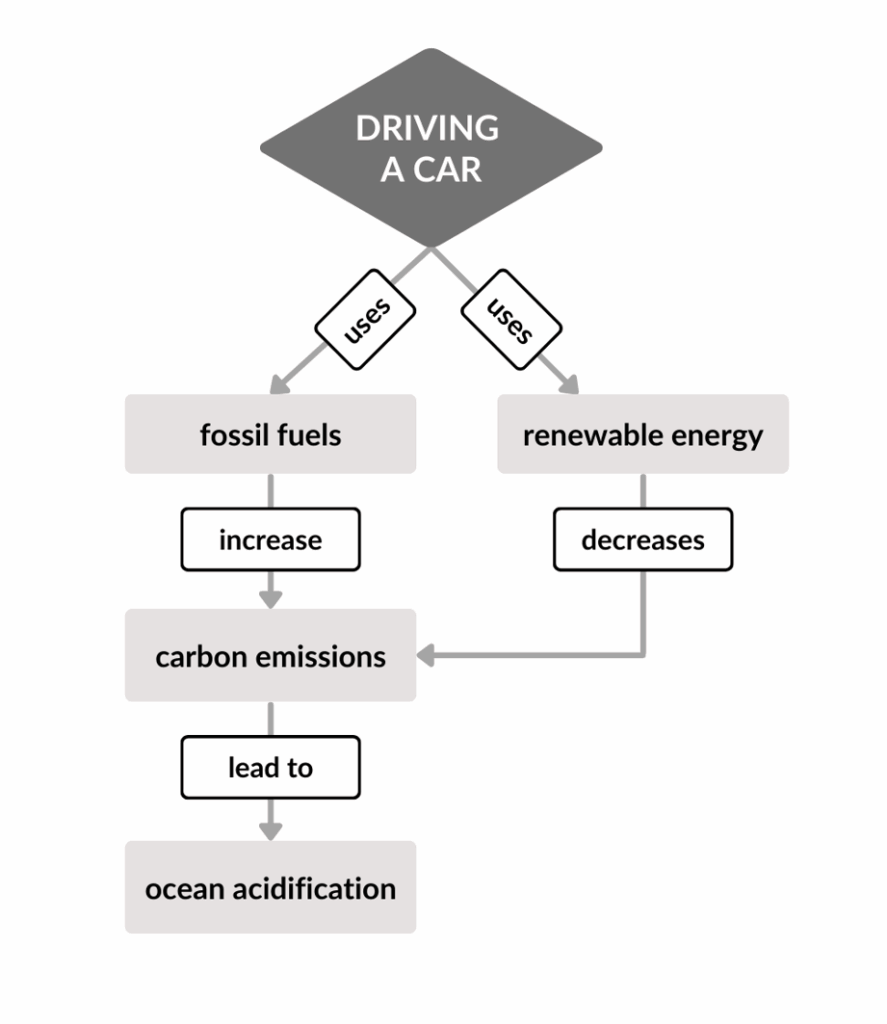
Consider the example provided by Dr. Sundar regarding ocean acidification. A broad question like "What is ocean acidification?" could lead to an unfocused, sprawling map. However, a precise question such as "What is the relationship between driving a car and ocean acidification?" yields a concise, clear map illustrating a specific cause-and-effect chain. Conversely, expanding the scope with "What is the relationship between human activities and ocean acidification?" necessitates a more intricate map, still structured by the guiding question but encompassing a broader array of interconnected human impacts. This demonstrates how the guiding question acts as a crucial boundary, making the mapping process manageable and the resulting map interpretable.
-
Emphasize Linking Words and Directional Arrows: One of the most critical, yet often overlooked, elements of effective concept mapping is the inclusion of descriptive linking words or phrases on the lines connecting nodes. These words explicitly state the nature of the relationship between two concepts, transforming a simple connection into a meaningful proposition. For instance, instead of merely drawing a line between "Cars" and "Carbon Dioxide," a linking phrase like "release" or "produce" clarifies the interaction: "Cars release Carbon Dioxide."
While adding linking words demands greater cognitive effort, it significantly deepens learning. Dr. Sundar aptly describes it as "a pain in the beep," but one that "pushes your learning harder." This effort forces learners to articulate their understanding, moving beyond surface-level associations to precise explanations of how concepts interact. Directional arrows further enhance clarity, indicating the flow of influence or causality within the map, thereby constructing a more robust and accurate representation of knowledge.

Practical Applications of Concept Maps in the Classroom
Concept maps are highly versatile and can be integrated into various stages of the learning process, from introduction to assessment.
-
Expert Maps for Unit Overview and Scaffolding: Teachers can create "expert maps" to provide students with a visual roadmap of key concepts and their interrelationships within a unit of study. Presented at the outset of a unit, these maps offer a "big picture" view, helping students understand how individual lessons or topics connect to a larger schema. This proactive overview can mitigate feelings of fragmentation and provide a coherent framework for incoming information.
However, Dr. Sundar cautions against "concept map shock," which can occur if students are overwhelmed by too much information at once. To prevent this, teachers can introduce a scaffolded approach:
- Initial Broad Map: Present an expert map with only the major concepts and their primary relationships.
- Progressive Revelation: As the unit progresses, gradually add more detailed concepts and intricate links to the map, or have students collaboratively build out sections. This iterative process allows students to absorb information incrementally and build their understanding without feeling inundated. Expert maps can then serve as a valuable reference tool throughout the unit, helping students track their learning journey.
-
Concept Maps as an Active Note-Taking Strategy: Traditional linear note-taking can often lead to passive transcription rather than active processing. Concept maps offer a dynamic alternative, encouraging students to synthesize information, identify main ideas, and articulate relationships during lectures or readings. Instead of writing lengthy paragraphs, students capture information concisely in nodes and link them, promoting deeper engagement with the content.
This visual approach to note-taking is more efficient, allowing students to encapsulate complex information in fewer words and diagrams. Teachers can facilitate this by providing a list of key terms (either on a whiteboard or in student notebooks) and regularly prompting students to construct or update concept maps that illustrate the relationships between these terms. This transforms note-taking into a powerful retrieval and organization exercise.
-
Formative Assessment and Diagnosis of Understanding: Concept maps are exceptional tools for formative assessment, offering teachers immediate insights into student comprehension. By asking students to create a concept map on a specific topic, educators can quickly identify:
- Misconceptions: Incorrectly linked concepts or inaccurate linking words reveal gaps or errors in understanding.
- Depth of Understanding: The complexity and accuracy of the map indicate how deeply a student has grasped the material.
- Connections Made: Maps highlight whether students are seeing isolated facts or integrated knowledge structures.
One highly effective strategy for formative assessment is to provide students with a partially completed concept map and ask them to fill in missing nodes or linking words. This targeted approach allows teachers to assess specific learning objectives and provides immediate feedback to students, guiding them toward more accurate understanding. Concept maps can also be used as pre-assessments to gauge prior knowledge or as post-assessments to summarize learning and consolidate understanding.
Broader Pedagogical Implications and Future Directions
The integration of concept maps into modern pedagogy extends beyond individual classroom activities. Their emphasis on relational thinking and visual organization aligns perfectly with 21st-century learning skills, promoting critical thinking, problem-solving, and collaborative learning. In an era of information overload, the ability to discern relationships and construct meaningful knowledge frameworks is invaluable.
Concept maps can be particularly beneficial for:
- Differentiated Instruction: They can be adapted for learners with varying cognitive styles and abilities, providing a visual pathway for those who struggle with purely textual information.
- Interdisciplinary Learning: Concept maps are excellent for illustrating connections between different subjects, fostering a more holistic understanding of complex topics.
- Project-Based Learning: Students can use concept maps to plan projects, organize research findings, and present their conclusions in a clear, structured manner.
- Self-Regulation and Study Skills: Teaching students how to create and use concept maps empowers them with a lifelong learning strategy for organizing and reviewing information independently.
While traditional paper-and-pencil mapping remains effective, digital tools have expanded the possibilities, allowing for easier editing, collaboration, and sharing of concept maps. However, the core principles of active construction and explicit linking remain paramount, regardless of the medium.
In conclusion, the enduring value of concept maps in education is firmly supported by decades of cognitive science research and practical application. By engaging learners in the active construction of knowledge, fostering deeper encoding, structured storage, and efficient retrieval, concept maps transcend their simple appearance to become indispensable tools for meaningful learning. As educators continue to seek effective, evidence-based strategies, the humble concept map stands out as a powerful, versatile, and accessible pathway to unlocking deeper understanding and cultivating stronger, more resilient learning.