




The innate human tendency to visualize complex ideas finds a powerful, evidence-based ally in concept mapping, a pedagogical tool now championed by leading cognitive scientists for its profound impact on learning and retention. Dr. Kripa Sundar, a distinguished cognitive scientist specializing in concept mapping research, and Dr. Pooja Agarwal, editor of the influential book Smart Teaching Stronger Learning: Practical Tips from 10 Cognitive Scientists, are at the forefront of advocating for the widespread adoption of this simple yet potent strategy in classrooms worldwide. Their collaborative efforts highlight how concept maps, far from being mere visual aids, are deeply rooted in the science of memory and cognition, offering a superior alternative to traditional learning methods.
The Foundational Role of Visual Representation in Cognition
Humans instinctively turn to visual representation when attempting to explain intricate concepts. The spontaneous act of grabbing a pen to sketch a diagram or draw a flowchart underscores a fundamental cognitive drive to externalize and organize thoughts visually. This natural inclination has been formalized and optimized in tools like concept maps, graphic organizers designed to visually represent knowledge structures. While terms such as "mind maps" or "spider maps" are sometimes used interchangeably, concept maps distinguish themselves through their structured approach to linking core ideas. They typically consist of "nodes"—boxes or bubbles containing key concepts—interconnected by lines or arrows that explicitly denote the relationships between these ideas. This straightforward design belies their profound capacity to enhance understanding and facilitate robust learning.
Despite their low-tech nature, requiring no complex software or elaborate setup, concept maps offer an exceptionally powerful framework for knowledge construction. Their efficacy, as articulated by Dr. Sundar, lies in their ability to engage learners actively in the process of meaning-making, transforming passive reception of information into dynamic, organized understanding. This effectiveness is not anecdotal; it is substantiated by extensive research within cognitive science, positioning concept maps as a cornerstone of evidence-based instructional design.
Cognitive Science Underpinnings: How Concept Maps Engage Memory
Dr. Kripa Sundar, whose expertise is prominently featured in Smart Teaching Stronger Learning, passionately asserts the multifaceted benefits of concept maps. In an article for the American Federation of Teachers (AFT), she underscores that multiple meta-analyses consistently demonstrate concept maps’ superior impact on learning outcomes compared to conventional methods such as lectures, discussions, or text summaries. This robust empirical support elevates concept mapping from a mere classroom technique to a scientifically validated learning strategy.
The profound effectiveness of concept maps can be attributed to their capacity to engage all three critical stages of memory formation: encoding, storage, and retrieval. This tripartite engagement ensures that information is not only absorbed but also deeply processed, firmly embedded in long-term memory, and readily accessible when needed.

-
Encoding: The process of actively identifying, selecting, and organizing information into a map demands deep semantic processing. Learners must critically analyze concepts, discern their hierarchical relationships, and articulate these connections through linking words. This active construction contrasts sharply with the passive encoding often associated with merely listening to lectures or reading text, leading to a more robust initial learning trace. The act of transforming verbal information into a spatial, visual format also leverages dual-coding theory, which posits that presenting information in both verbal and visual forms enhances memory by creating two distinct mental representations.
-
Storage: By explicitly illustrating the relationships between concepts, concept maps build a highly organized, interconnected knowledge structure. This structure resembles how knowledge is ideally stored in long-term memory, as a web of interconnected ideas rather than isolated facts. The visual arrangement aids in chunking information, reducing cognitive load, and making complex topics more manageable. The act of elaborating on connections through linking words further strengthens these neural pathways, promoting deeper integration of new information with existing knowledge frameworks.
-
Retrieval: Concept maps serve as powerful retrieval cues. The visual layout, with its nodes and linking phrases, acts as a mental scaffold, allowing learners to navigate their stored knowledge efficiently. When students create or review a concept map, they are actively engaging in retrieval practice, pulling information from memory and reinforcing its accessibility. This active recall is one of the most effective strategies for strengthening memory and improving long-term retention, as repeatedly demonstrated by cognitive science research. The process of reconstructing a map from memory, or even filling in a partially completed one, directly exercises these retrieval pathways, solidifying understanding and pinpointing areas needing further study.
Evolution of Visual Learning Tools: A Brief Chronology
The concept of representing knowledge visually has a long history, dating back to ancient philosophical diagrams. However, the modern concept map, as a specific pedagogical tool, gained prominence in the 1970s. Dr. Joseph Novak at Cornell University is widely credited with developing concept mapping as part of his research program, based on David Ausubel’s assimilation theory of learning, which emphasizes the importance of relating new information to existing knowledge structures.
- 1960s-1970s: Foundations in Ausubel’s assimilation theory and constructivist learning principles. Novak’s initial work focused on tracking changes in children’s understanding of science concepts over time.
- 1980s: Increased adoption in educational settings, particularly in science education, as researchers and educators recognized their potential for fostering meaningful learning and assessing conceptual understanding.
- 1990s-2000s: Expansion into various disciplines and development of digital tools for concept mapping, making them more accessible and versatile. Research continued to solidify their empirical backing.
- 2010s-Present: Integration with broader cognitive science principles (e.g., retrieval practice, dual coding) and advocacy by figures like Dr. Sundar and Dr. Agarwal, promoting their use as evidence-based "smart teaching" strategies.
This chronological development underscores a continuous refinement and validation of concept maps as a robust pedagogical instrument, moving from theoretical underpinnings to widespread practical application.
Best Practices for Maximizing Concept Map Effectiveness
To harness the full potential of concept maps, Dr. Sundar outlines several key best practices that guide their creation and utilization. These principles transform concept mapping from a simple drawing exercise into a sophisticated learning strategy.
1. Be Clear About Your Motivation
Before embarking on concept map creation, educators and learners must establish a clear purpose. As Dr. Sundar emphasizes, "the first question is why?" Concept maps are versatile and can serve various instructional goals:
- Group Activity: Facilitating collaborative learning and shared understanding.
- Whole Class Activity: Introducing new topics, summarizing units, or scaffolding complex ideas.
- Individual Activity: For personal note-taking, self-assessment, or independent study.
- Learning/Note-taking: A dynamic alternative to linear notes, promoting deeper processing.
- Formative or Summative Assessment: Gauging student comprehension and identifying misconceptions.
Defining the objective upfront dictates the map’s scope, complexity, and the level of detail required, ensuring that the tool is optimally aligned with the learning goal. For instance, a map for a quick review will differ significantly from one designed for a comprehensive unit assessment.
2. Have a Guiding Question
A focused guiding question is paramount for managing the scope of a concept map and preventing it from becoming an overwhelming tangle of information. By narrowing the focus, a guiding question helps to select relevant concepts and define the relationships to be explored, making the task manageable and purposeful.
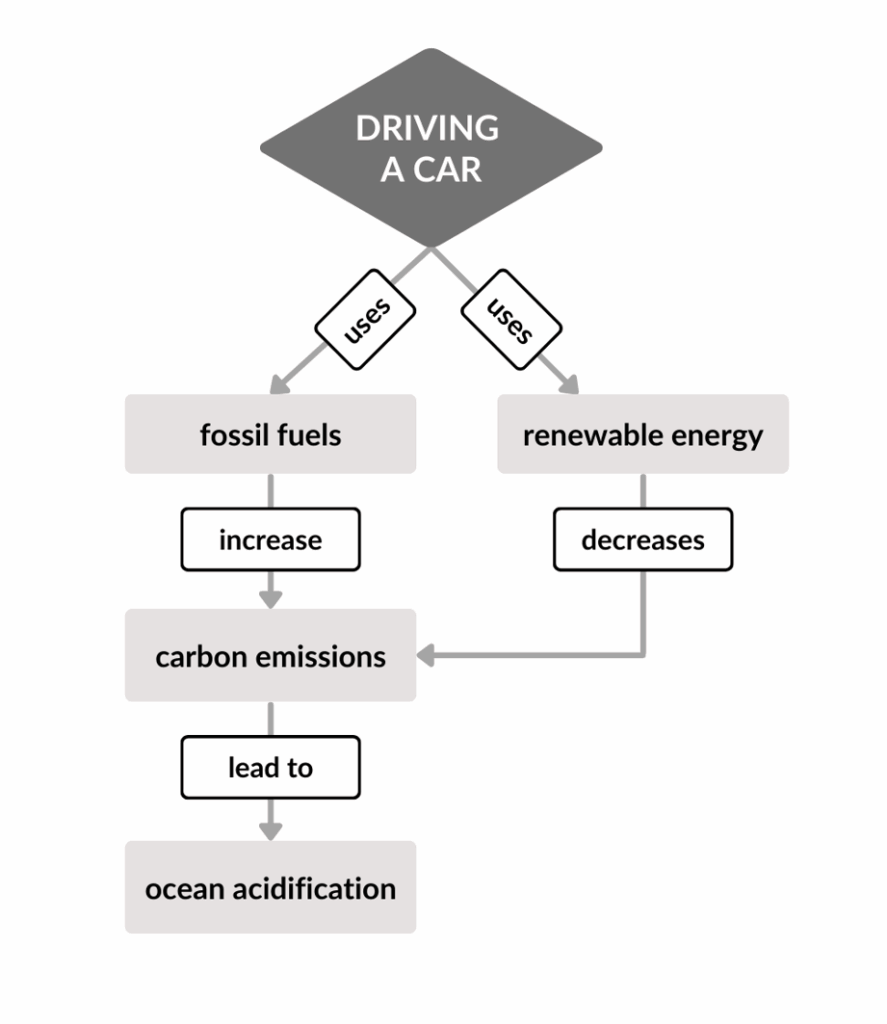
Dr. Sundar illustrates this with compelling examples related to ocean acidification. Consider the question: "What is the relationship between driving a car and ocean acidification?" This specific query leads to a relatively contained map, tracing the direct causal chain from vehicle emissions to atmospheric carbon dioxide, its absorption by oceans, and subsequent acidification. The map would detail steps like "car emits CO2" → "CO2 enters atmosphere" → "atmosphere CO2 absorbed by ocean" → "ocean pH decreases."
In stark contrast, a broader guiding question like, "What is the relationship between human activities and ocean acidification?" necessitates a far more intricate and expansive map. This map would branch out to include various anthropogenic sources of CO2 (e.g., industrial processes, deforestation, agriculture), their individual contributions to atmospheric CO2, and the broader ecological and economic consequences of ocean acidification. The complexity of the second map underscores how a guiding question directly dictates the depth and breadth of the conceptual exploration, serving as a vital navigational tool for both creator and interpreter.
3. Use Linking Words and Directional Arrows
One of the most distinguishing and critical features of a true concept map, as opposed to a mere cluster of ideas, is the inclusion of directional arrows and explicit linking words or phrases on the lines connecting nodes. While adding these linking words "is a pain in the beep," as Dr. Sundar candidly admits, it is precisely this effort that transforms a superficial diagram into a robust learning instrument.
Linking words force learners to articulate how concepts are related, moving beyond simple association to demonstrate a deep understanding of causal, hierarchical, or correlational connections. For example, instead of just connecting "driving a car" to "CO2," the link might be labeled "produces" or "releases." Connecting "CO2 in atmosphere" to "ocean acidification" could be labeled "contributes to" or "is absorbed by, leading to." This specificity reveals the learner’s mental model and helps identify misconceptions. The directional arrows further clarify the flow of influence or causality, ensuring logical coherence and accurate representation of knowledge structures. This rigorous articulation of relationships is what truly pushes cognitive effort and solidifies learning.
Practical Applications of Concept Maps in the Classroom

Concept maps are highly adaptable and can be integrated into various instructional practices, offering significant benefits for both teaching and learning.
1. Expert Maps for Unit Overviews and Scaffolding
Teachers can create "expert maps" to provide students with a visual representation of the key concepts and their relationships within a unit of study. These maps serve as invaluable reference tools, offering a "big picture" view from the outset. Dr. Sundar highlights their utility in preventing students from feeling lost in the details: "It’s a wonderful way to show people, look, over the next 16 weeks, we’re going to talk about all of these things. It’s going to feel random at points, but here’s how they all connect."
However, a crucial caution from Dr. Sundar is to avoid "concept map shock." Presenting an overly complex expert map at the beginning can overwhelm students, leading to disengagement. To mitigate this, teachers can employ a phased approach:
- Initial Broad Map: Display a simplified expert map with only the major concepts and their primary connections.
- Progressive Revelation: As the unit progresses and new concepts are introduced, incrementally add details, sub-concepts, and more intricate relationships to the map. This iterative process allows students to build their understanding gradually, integrating new information into an evolving conceptual framework.
Expert maps can also be used as pre-assessments, asking students to predict connections, or as post-instructional tools for review and consolidation.
2. Concept Maps as an Effective Note-Taking Strategy
Traditional linear note-taking often leads to lengthy, undifferentiated text that can obscure relationships between ideas. Concept mapping offers a more efficient and cognitively beneficial alternative. By forcing students to condense information into concise nodes and articulate connections, concept maps facilitate deeper processing and better organization of information.
"Sometimes when we write, we just go on and on," Dr. Sundar observes. Concept maps counteract this by demanding precision and conciseness, capturing more information in fewer words and visual links. This visual representation bypasses the need for verbose explanations, allowing learners to focus on the essence of the connections.
Teachers can encourage concept map note-taking in several ways:
- During Lectures/Readings: Students can actively construct maps as they encounter new information, identifying main ideas and their supporting details.
- Post-Instructional Review: After a lecture or reading, students can create a map from memory, serving as a powerful retrieval practice exercise.
- Key Term Lists: Provide students with a list of essential terms from a lesson or chapter and challenge them to construct a map showing how these concepts interrelate. This fosters active engagement with vocabulary and conceptual understanding.
3. Formative Assessment for Diagnostic Insight
Concept maps excel as a formative assessment tool, providing teachers with invaluable insights into students’ conceptual understanding and potential misconceptions. By analyzing a student’s concept map, educators can quickly identify gaps in knowledge, flawed connections, or areas where understanding is robust.
One highly effective method involves providing students with a partially completed concept map and asking them to fill in the missing nodes, linking words, or even entire sections. This targeted approach allows teachers to assess specific learning objectives. For example, a map might have key concepts provided, but students must draw the links and label them, or vice-versa.
Rubrics can be developed to assess concept maps based on criteria such as:
- Accuracy of Concepts: Are the concepts correctly identified and defined?
- Accuracy of Relationships: Are the links between concepts correct and logically sound?
- Completeness: Does the map include all essential concepts and relationships for the given topic?
- Hierarchy/Organization: Is the map well-structured, showing appropriate levels of detail and organization?
- Cross-Links: Does the map demonstrate complex, non-linear connections between different branches of knowledge?
This form of assessment moves beyond rote memorization, requiring students to demonstrate a synthesized understanding of how individual pieces of information fit into a larger coherent framework.
Broader Educational Implications and Future Outlook
The increasing advocacy for concept maps by cognitive scientists like Dr. Sundar and Dr. Agarwal signals a broader shift in educational pedagogy towards evidence-based practices. In an era where information overload is common, tools that help learners effectively organize, process, and retain knowledge are more critical than ever. Concept maps foster not just content knowledge, but also crucial metacognitive skills—the ability to think about one’s own thinking. By creating maps, students become aware of their own knowledge structures, identify gaps, and actively monitor their learning.
Furthermore, concept mapping aligns seamlessly with modern constructivist approaches to learning, where students actively construct their own understanding rather than passively receiving it. It encourages critical thinking, problem-solving, and the development of complex reasoning skills. For curriculum designers, integrating concept mapping can offer a structured way to ensure coherence across units and promote deeper conceptual understanding throughout a course.
While the core principles of concept mapping remain low-tech, the advent of digital tools (like CmapTools, MindMeister, or Lucidchart) offers additional avenues for creation, collaboration, and sharing. These digital platforms can make it easier to revise maps, integrate multimedia, and facilitate group projects, expanding the versatility of the tool without compromising its cognitive benefits.
In conclusion, concept maps are far more than just pretty diagrams. They are scientifically validated cognitive tools that, when implemented thoughtfully, can profoundly enhance learning, retention, and conceptual understanding. By engaging the full spectrum of memory formation and fostering active, elaborative processing, concept maps empower both educators and students to navigate the complexities of knowledge with greater clarity and depth. The insights from cognitive scientists like Dr. Kripa Sundar and Dr. Pooja Agarwal serve as a powerful call to action for educators to embrace this "packed strategy" and unlock a richer, more meaningful learning experience for all.