


Microsoft has officially released a comprehensive update to its Education AI Toolkit, signaling a strategic shift from exploratory artificial intelligence pilots to scalable, systemic institutional transformation. The redesigned toolkit arrives at a critical juncture for the global education sector, as primary schools, universities, and regional districts move beyond initial experimentation toward the full-scale integration of generative AI within their operational and pedagogical frameworks. This update, informed by extensive feedback from education leaders worldwide, introduces a streamlined layout, practical checklists, and a new "AI Sparks" framework designed to foster institutional capacity rather than isolated individual use.
The Evolution of AI in Education: From Tinkering to Transformation
The trajectory of artificial intelligence in the educational landscape has moved with unprecedented speed since the public emergence of large language models in late 2022. Initially, the focus for many institutions was on reactive policy-making—specifically regarding academic integrity and the potential for plagiarism. However, throughout 2023 and 2024, the narrative shifted toward "AI literacy" and the exploration of "AI Snapshots," which allowed individual educators to experiment with tools like Microsoft 365 Copilot for lesson planning and content creation.
The latest iteration of the Microsoft Education AI Toolkit reflects a more mature phase of adoption. Education leaders are no longer merely asking what AI is; they are asking how it can be managed at scale, secured against emerging threats, and utilized to solve deep-seated administrative and instructional challenges. The toolkit’s redesign acknowledges that while individual innovation is valuable, true impact requires a coordinated, campus-wide approach that aligns technical infrastructure with instructional goals.
A Three-Pillar Foundation for Institutional Growth
The updated toolkit is anchored by three primary themes that represent the core concerns of modern education leadership: Student Success, Institutional Innovation, and IT Security. By organizing resources around these pillars, Microsoft aims to provide a holistic roadmap that prevents "siloed" implementations where the IT department and the teaching faculty operate without a shared vision.

Under the banner of Student Success, the toolkit emphasizes the transition from basic automation to personalized learning. This includes the deployment of tutoring-style support systems, automated assessments that provide immediate feedback, and skills-based pathways that lead to industry-recognized certifications. The goal is to move AI from being a novelty to a foundational tool that prepares students for a workforce increasingly defined by human-AI collaboration.
Institutional Innovation focuses on the operational "back office" of education. By leveraging AI-powered insights, universities and districts can modernize their infrastructure, improve efficiency in enrollment and financial aid, and enhance the daily experiences of faculty and staff. Meanwhile, the "Simplify and Secure IT" pillar addresses the rising concerns regarding data privacy and cybersecurity. This section provides specific guidance on using tools like Microsoft Security Copilot for threat detection and implementing rigorous data governance practices to ensure that AI adoption does not compromise student or institutional data.
Scaling Innovation: AI Sparks versus AI Snapshots
One of the most significant conceptual additions to the updated toolkit is the introduction of "AI Sparks." While the previous "AI Snapshots" focused on empowering individual practitioners—such as a single teacher using a chatbot to differentiate a reading passage—the "AI Sparks" are designed for team-level and department-level implementation.
For example, a "Spark" in a K-12 setting might involve a district-wide literacy team utilizing Learning Accelerators, such as Reading Coach and Reading Progress, to create a unified strategy for early literacy across all primary classrooms. In a higher education context, a "Spark" might demonstrate how an IT department uses Microsoft Copilot Studio analytics to identify recurring helpdesk issues across the entire campus, allowing them to proactively update resources and deploy targeted solutions. This shift highlights a move toward collective institutional capacity, ensuring that the benefits of AI are not limited to "early adopters" but are accessible across the entire organization.
The Emergence of Agentic AI and Autonomous Operations
The toolkit also introduces the concept of "Agentic AI," representing the next frontier in educational technology. Moving beyond simple "assistance"—where a human prompts a machine for a specific output—agentic AI involves tools that can operate with a degree of autonomy to manage multi-step tasks. These agents can be designed to route common administrative questions, support complex workflows, and act as digital coaches.

The toolkit highlights two distinct paths for this implementation: Microsoft Copilot Studio for rapid, no-code agent creation, and Microsoft Azure Foundry for institutions requiring custom, sophisticated solutions. A cited real-world application at the University of Leicester illustrates the potential of this technology; the university deployed an AI-powered digital coach that significantly reduced staff workload while providing students with 24/7 access to essential campus information. This transition from "assistance to autonomy" allows human staff to focus on high-value interactions while AI handles the high-volume, repetitive tasks that often lead to administrative bottlenecks.
Action-Ready Checklists and Governance Frameworks
Recognizing that the path from planning to implementation is often fraught with logistical hurdles, Microsoft has integrated "action-ready checklists" into the toolkit. These checklists are designed to be assignable and trackable, ensuring that leadership teams do not skip the fundamental steps of governance and readiness.
The checklists cover several critical areas:
- AI Leadership Committee Formation: Guidance on assembling a cross-functional team that includes IT, academic leadership, and legal counsel.
- Data Governance and Privacy: Step-by-step protocols for ensuring compliance with regional regulations (such as GDPR or FERPA) and institutional policies.
- Strategic Planning: Frameworks for aligning AI initiatives with the institution’s long-term mission and key performance indicators.
- Professional Development: Roadmaps for upskilling faculty and staff to ensure they are equipped to lead AI-enhanced classrooms.
Cultivating Global Networks and AI Literacy
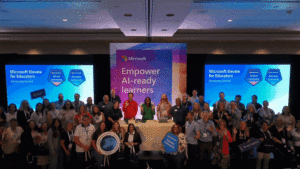
Beyond technical resources, the toolkit emphasizes the human element of AI transformation. It highlights "Microsoft Elevate for Educators," an expanded framework that merges the Microsoft Showcase Schools and the Microsoft Innovative Educator Expert (MIEE) programs. This global community provides a platform for leaders to share "blueprints" of success, troubleshoot common challenges, and earn recognition for their innovations.
Furthermore, the toolkit integrates the "Hour of AI" initiative, launched in partnership with Code.org in late 2025. This program builds on the global "Hour of Code" movement to help learners understand the underlying mechanics of AI technology. Through interactive lessons, such as "Minecraft AI Foundations" and "Generation AI," students develop foundational AI literacy. This pedagogical focus ensures that students are not just passive consumers of AI, but informed citizens who understand the ethical and technical implications of the tools they use.

Grounding Strategy in Evidence-Based Research
To counter the hype often associated with emerging technology, the toolkit includes a strengthened Research section. This resource is curated to help institutions make data-driven decisions and build stakeholder confidence. By providing access to the latest studies on AI’s impact on learning outcomes, teacher retention, and operational efficiency, Microsoft aims to provide a "single source of truth" for boards and faculty committees.
The research section is organized into categories that address common concerns, such as the efficacy of AI tutoring, the impact of automation on administrative costs, and the long-term societal implications of AI in the workforce. This evidence-based approach is intended to validate implementation strategies and provide the necessary justification for the significant investments required for institutional-scale AI.
Broader Impact and Industry Analysis
The release of this updated toolkit reflects a broader trend in the global education market. According to recent industry reports, the market for AI in education is expected to grow at a compound annual growth rate (CAGR) of over 35% through 2030. However, a significant gap remains between institutional interest and institutional readiness. While nearly 90% of higher education institutions report that AI will be "very important" to their future, fewer than 30% have a formal, campus-wide AI strategy in place.
Microsoft’s move to provide a structured, "plug-and-play" toolkit is a direct attempt to bridge this gap. By lowering the barrier to entry for complex implementations like Agentic AI and data governance, the company is positioning itself as the primary infrastructure provider for the "AI-first" campus.
The implications for the labor market are equally significant. As institutions like Auburn University and the University of Leicester demonstrate, the successful integration of AI can lead to more efficient operations and better-supported students. However, it also necessitates a shift in the roles of educators and administrators. The focus is increasingly moving toward "prompt engineering," data literacy, and the management of AI systems, rather than just the delivery of content.

The updated Microsoft Education AI Toolkit represents more than just a software update; it is a comprehensive guide for the structural reimagining of educational institutions. By providing the frameworks, checklists, and research necessary for systemic change, Microsoft is enabling a future where AI is not just a tool for the few, but a foundational element of the global learning experience. Education leaders are encouraged to download the updated resources and begin the transition from adoption to true institutional transformation.