


In an ambitious move to secure its home state’s position as a global leader in the emerging artificial intelligence economy, Microsoft has unveiled "Microsoft Elevate Washington," a comprehensive initiative designed to democratize access to AI technology and training. The program aims to reach every high school and community college student across Washington’s 39 counties, addressing a stark "opportunity gap" that currently exists between the state’s tech-heavy urban centers and its rural regions. By providing advanced software, professional development for educators, and direct financial grants, the Redmond-based tech giant seeks to ensure that the next generation of Washington’s workforce is uniquely equipped to navigate a labor market increasingly defined by generative AI.
The initiative represents a localized extension of Microsoft’s broader $4 billion global commitment to education and non-profits, focusing specifically on the unique socio-economic landscape of Washington state. For more than a century, Washington has served as a global launchpad for industry-defining innovations, from the early aerospace breakthroughs of Boeing to the digital revolutions led by Microsoft and Amazon. However, as the world enters the "AI era," internal data suggests that the benefits of these technological advancements are not being shared equally across the state’s diverse geography.
Addressing the Digital and AI Diffusion Disparity
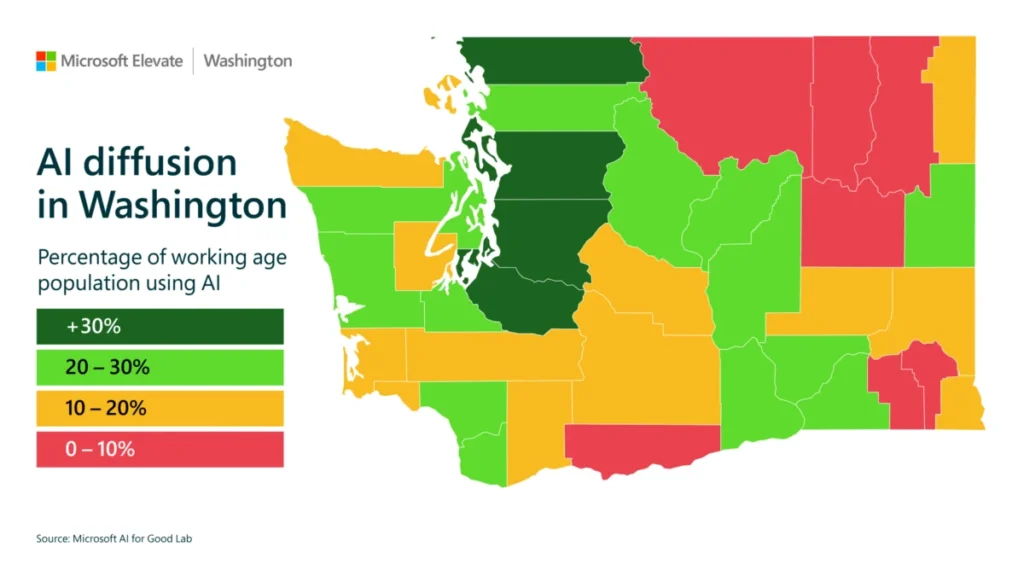
The catalyst for Microsoft Elevate Washington is a series of troubling findings from Microsoft’s AI for Good Lab. An analysis of internal usage data revealed a significant disparity in AI adoption rates across the state. In the highly connected Puget Sound corridor—encompassing Snohomish, King, Pierce, and Whatcom counties—AI usage among the working-age population has already surpassed 30 percent. Snohomish County currently leads the state with a 35 percent adoption rate.
In sharp contrast, seven rural counties in Eastern Washington report AI usage rates below 10 percent. The most extreme example is Ferry County, where only 2.5 percent of residents are currently utilizing AI tools. This tenfold gap between the state’s most and least connected regions suggests that without intervention, the "digital divide" of the broadband era could evolve into a more permanent "AI divide." Microsoft executives have characterized this not merely as a technology gap, but as an opportunity gap, noting that future economic mobility will likely depend on a worker’s ability to leverage AI to enhance productivity and creative problem-solving.
A Phased Rollout for Schools and Community Colleges
To combat these disparities, Microsoft Elevate Washington will implement a tiered rollout of software and support services beginning in early 2026. The program is structured to support three primary stakeholders: institutional administrations, students, and the educators who guide them.
Starting in January 2026, Microsoft will provide Copilot Studio free of charge for up to three years to all 295 public school districts and 34 community and technical colleges in the state. Copilot Studio is a low-code platform that allows users to create custom AI agents. For school administrators, this tool is intended to streamline complex logistical tasks such as class scheduling, data analysis for student performance, and school year planning. By automating these administrative burdens, the initiative aims to return valuable time to educators, allowing them to focus more on direct student engagement.
Furthermore, Microsoft has pledged $25,000 in dedicated technology consulting to a select group of 10 school districts and 10 community colleges. These grants are designed to help institutions build bespoke AI agents tailored to their specific regional or workplace needs. The insights gained from these early adopters will then be shared through a statewide network to accelerate AI expertise in other districts.
Empowering the Next Generation of the Workforce
The student-focused components of the initiative are divided by educational level to ensure the tools are age-appropriate and relevant to the students’ immediate goals.
Beginning in July 2026, high school students (grades 9–12) will receive three years of free access to a suite of advanced tools, including Copilot Chat, Microsoft 365 desktop applications, and Teams for Education. A key feature of this package is the inclusion of "Learning Accelerators," which are AI-powered tools designed to help students improve reading fluency, information literacy, and critical thinking. These tools provide real-time, tailored feedback, allowing students to progress at their own pace—a move that many educational experts believe could help mitigate the learning loss experienced during the pandemic.
For community college students, the timeline is more immediate. Microsoft is offering 12 months of free Microsoft 365 Personal subscriptions to all community college students in the state, provided they sign up by November 15, 2025. This package includes Copilot integration across Word, Excel, PowerPoint, and Outlook, as well as one terabyte of OneDrive cloud storage. The goal is to provide these students—many of whom are adult learners or transitioning workers—with the same high-level tools used in modern corporate environments.

Collaboration with State Agencies and Educators
Recognizing that technology alone cannot transform education, Microsoft is partnering with several major state and national organizations to facilitate professional development. The initiative will work closely with the Washington Office of Superintendent of Public Instruction (OSPI), the Washington Education Association (WEA), and the National Education Association (NEA).
These partnerships will focus on training Washington’s 100,000 educators to use generative AI responsibly and effectively. Professional development programs will be made available to all public school districts, targeting certificated teachers, instructional assistants, and administrative staff. A central component of this effort will be the AI Innovation Summit, an in-person and virtual conference intended to bring together over 1,000 educational leaders to discuss best practices for AI implementation in the classroom.
State Superintendent Chris Reykdal has previously emphasized the importance of preparing students for an AI-driven world, noting that avoiding the technology is not an option if Washington wants its graduates to remain competitive. By involving the WEA and NEA, Microsoft aims to ensure that the voices of frontline teachers are heard in the deployment of these tools, addressing concerns regarding academic integrity and the changing nature of instruction.
Timeline and Chronology of the Initiative
The rollout of Microsoft Elevate Washington follows a strategic timeline designed to build momentum and institutional readiness:
- July 2025: Announcement of the global "Microsoft Elevate" business unit, establishing the $4 billion funding pool for schools and nonprofits.
- November 15, 2025: Deadline for community college students to claim 12 months of free Microsoft 365 Personal.
- January 2026: Launch of free Copilot Studio access for all 295 school districts and 34 community colleges.
- Early 2026: Commencement of technology consulting grants for 20 selected institutions and the start of the AI Innovation Summit series.
- July 2026: Full rollout of AI tools and Microsoft 365 access for high school students statewide.
- 2026–2029: Continued professional development and cash grants to support the integration of AI into K-12 and community college instruction.
Broader Economic and Societal Implications
The implications of Microsoft Elevate Washington extend far beyond the classroom. By targeting rural areas like Ferry, Stevens, and Pend Oreille counties, the program attempts to prevent a "brain drain" where talented youth feel compelled to move to the I-5 corridor to access high-tech careers. If students in rural Washington can master AI tools while still in high school, they may be better positioned to engage in remote work or start tech-enabled businesses within their own communities, potentially revitalizing local economies that have traditionally relied on agriculture or timber.
From a journalistic perspective, this initiative also highlights the shifting role of major tech corporations in public infrastructure. As AI becomes as fundamental to modern life as literacy or electricity, companies like Microsoft are increasingly stepping into roles traditionally held by the state, providing the tools and the training necessary for civic and economic participation.
However, the program also raises important questions for policymakers. The three-year window of free access provides a significant "jump-start," but it remains to be seen how school districts—many of which are currently facing budget shortfalls—will sustain these technologies once the subsidized period ends. Furthermore, the integration of AI into schools will require ongoing scrutiny regarding data privacy and the ethical use of algorithms in grading and student assessment.
Building a Statewide Movement
Microsoft has stated that the success of Elevate Washington depends on a "statewide movement" rather than a top-down corporate mandate. To this end, the company is collaborating with nonprofits like Code.org to promote the "Hour of AI," an initiative aimed at demystifying the technology for younger students. Microsoft is also encouraging its 50,000-plus employees in Washington to volunteer as mentors and workshop leaders.
The company has also issued an open call for innovators, developers, and educators to partner with educational institutions to build scalable, AI-enabled solutions. This "open-source" approach to problem-solving suggests that Microsoft views Elevate Washington as an evolving laboratory for educational reform.
As Washington state navigates this transition, the eyes of the nation will likely be on the Pacific Northwest. If Elevate Washington succeeds in closing the 10-to-1 usage gap between urban and rural counties, it could provide a blueprint for other states struggling to keep pace with the rapid acceleration of artificial intelligence. For now, the initiative stands as a significant bet on the people of Washington, rooted in the belief that the state’s historical legacy of innovation can be preserved only if the tools of the future are placed in the hands of every student, regardless of their zip code.