




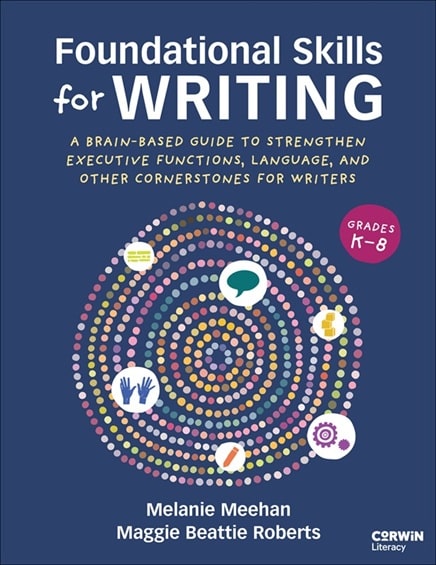
Literacy education has long been a dynamic and often contentious field, with intense debates frequently centered on reading instruction. However, a significant omission in these discussions has become increasingly apparent: the critical role of writing. While phonics, fluency, and reading comprehension dominate pedagogical discourse, writing instruction often remains a peripheral concern, despite the profound and undeniable interconnectedness of reading and writing processes. This imbalance is now being addressed by leading educators Melanie Meehan, a former curriculum coordinator who recently established an in-person writing center, and Maggie Roberts, a literacy consultant and former middle school teacher. Their new collaborative work, Foundational Skills for Writing: A Brain-Based Guide to Strengthen Executive Functions, Language, and Other Cornerstones for Writers, published earlier this month, seeks to shift this paradigm. The book offers a comprehensive, brain-based exploration of the complex cognitive demands of writing and provides educators with practical strategies to cultivate essential writing skills in students.
The Overlooked Pillar: Writing in the Literacy Landscape

For decades, the spotlight in literacy education has predominantly shone on reading. The "Reading Wars," a long-standing debate over the most effective methods for teaching reading, have seen various approaches—from whole language to phonics-first—gain and lose prominence. More recently, the "Science of Reading" movement has significantly influenced educational policy and practice, advocating for explicit and systematic instruction in phonological awareness, phonics, fluency, vocabulary, and comprehension. While undoubtedly crucial, this intense focus has, perhaps unintentionally, led to writing being relegated to a secondary, often less structured, position in the curriculum.
National assessment data underscores this concern. The National Assessment of Educational Progress (NAEP), often referred to as "The Nation’s Report Card," consistently reveals that a significant percentage of American students struggle with writing proficiency. For instance, the 2011 NAEP Writing Assessment (the last one administered) showed that only 27% of eighth and twelfth graders performed at or above the Proficient level. More recent NAEP reading results, while not directly assessing writing, often show correlations with broader literacy challenges. This persistent gap highlights a systemic issue: if students are not explicitly taught the foundational skills required for effective written communication, their overall literacy development, including reading comprehension, will inevitably suffer.
The neuroscientific perspective strongly supports an integrated approach. Research in cognitive psychology and neuroscience indicates that reading and writing engage overlapping neural networks and cognitive processes. Writing, in particular, is a highly complex cognitive task that demands the simultaneous coordination of multiple brain functions, including motor skills (handwriting or typing), linguistic knowledge (spelling, grammar, vocabulary), working memory (holding ideas in mind), and executive functions (planning, organizing, revising). When any of these foundational elements are underdeveloped, the cognitive load on the writer increases dramatically, making the act of composing difficult and often frustrating. Meehan and Roberts’ book directly confronts this challenge by dissecting the intricate mental processes involved in writing and offering targeted interventions.
A Brain-Based Approach to Writing Instruction
Foundational Skills for Writing presents a compelling argument for breaking down the monumental task of writing into manageable, teachable skill categories. The authors, drawing on their extensive experience and current research, identify three core areas crucial for developing proficient writers:
- Transcription Skills: These are the mechanical aspects of writing, including legible handwriting, efficient keyboarding, accurate spelling, and the underlying fine and gross motor development necessary for these tasks. Automatizing these skills is paramount, as it frees up cognitive resources for higher-level thinking.
- Oral Language: Recognizing that written language is often a reflection of spoken language, the book emphasizes the importance of developing robust speaking and listening skills. This includes the ability to construct grammatically correct sentences orally, articulate ideas clearly, and engage in meaningful verbal discourse, all of which serve as crucial precursors to effective written expression.
- Executive Functioning: This category encompasses a suite of cognitive processes vital for planning, problem-solving, and self-regulation. Key executive functions for writing include working memory (the ability to hold and manipulate information), cognitive flexibility (the capacity to adapt strategies and consider alternative approaches), and inhibitory control (the ability to filter out distractions and stay focused). These skills are essential for managing the multi-faceted demands of the writing process, from brainstorming to revision.
The book’s innovative contribution lies in its collection of "Minute Moves"—short, flexible activities designed to be easily integrated into the daily classroom routine. These "Minute Moves" are not meant to replace comprehensive writing instruction but rather to complement it by providing consistent, low-stakes practice that helps students automatize foundational skills. By reducing the cognitive burden associated with transcription and basic sentence construction, these activities enable students to allocate more mental energy to the generative, creative, and analytical aspects of writing.

Cultivating Foundational Skills: "Minute Moves" in Action
Meehan and Roberts advocate for intentional, brief practice sessions that can be woven into transitions, used as warm-ups, or even during informal moments. These strategies are particularly valuable in today’s packed curricula, offering high-impact learning in minimal time.
Spelling Minute Moves: Unlocking Word Structure and Meaning
Spelling is often taught through rote memorization, which can be inefficient and fail to build deep understanding. The "Minute Moves" for spelling focus on developing morphological awareness—the understanding of word parts (roots, prefixes, suffixes)—and etymological connections, making spelling a more logical and engaging process.

-
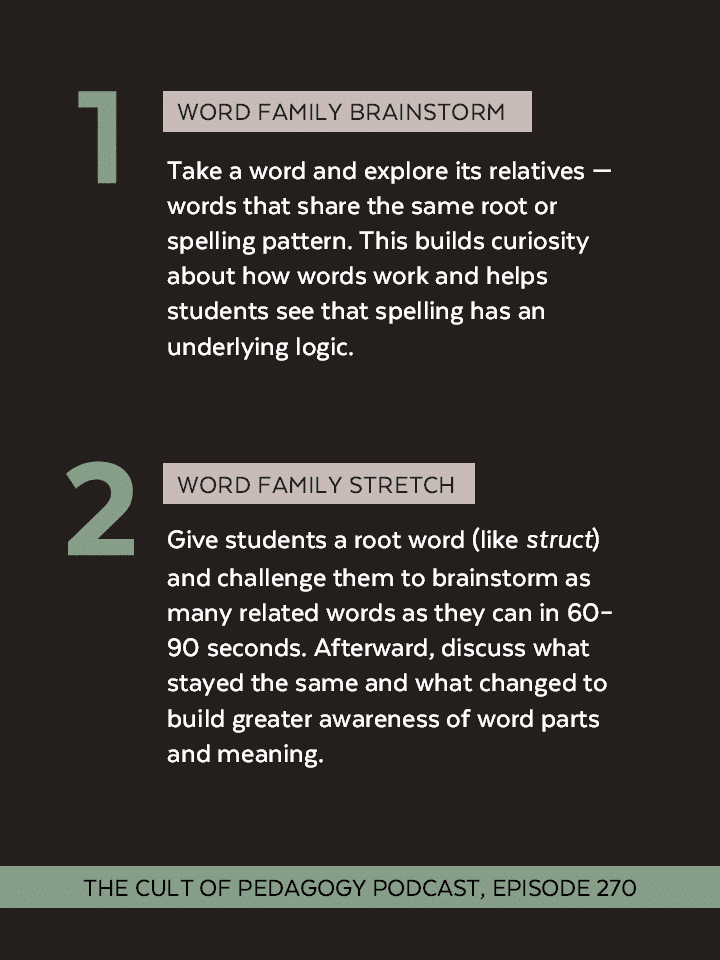
Word Family Brainstorm: Inspired by spelling researcher Rebecca Treiman, this activity encourages students to explore the "relatives" of a given word. Instead of merely memorizing commonly confused homophones like two, to, and too, students delve into the morphological connections. For example, connecting two (the number) to twin, twine, and twenty reveals a pattern where the "TW" combination often signifies "twoness." This approach moves beyond surface-level memorization to build orthographic mapping, where students link sounds, spellings, and meanings in their brains. Similarly, linking decision to decide, incision, concise, and scissors by tracing them back to the Latin root "caedere" (to cut) illuminates a powerful semantic and orthographic pattern, making the spelling of "decision" more intuitive. This fosters a sense of curiosity and reveals the inherent "coolness" of words, as Meehan notes.
-
Word Family Stretch: This variation builds on the brainstorming concept with a timed challenge. Given a root word like struct (meaning "to build"), students are given 60 to 90 seconds to generate as many related words as possible: structure, destruction, construct, structural, instruct, instruction. The crucial follow-up is the debrief: "What stayed the same? What changed? How did the meaning shift with prefixes or suffixes?" This meta-cognitive reflection helps students internalize that word parts carry meaning, revealing consistent patterns across academic vocabulary. Roberts highlights the distinction between "bound" roots (like struct, which cannot stand alone) and "free" roots (like form, which works independently and also in reform, transform), further deepening students’ understanding of word mechanics.
-
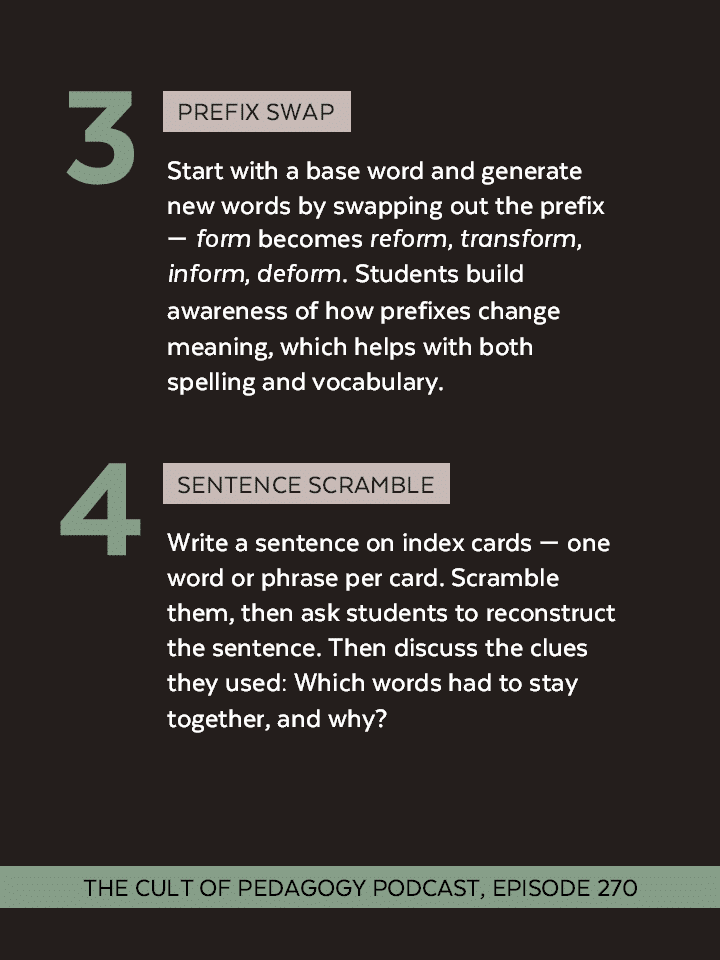
Prefix Swap: Directly extending the previous activities, this focuses specifically on the transformative power of prefixes. Students are given a base word, such as form, and challenged to create variations by swapping prefixes: reform, transform, inform, deform. Each swap alters the meaning, prompting students to discover these semantic shifts. This strategy is particularly effective for multilingual learners, who may recognize prefixes like bene and mal from their native languages, allowing them to rapidly grasp the meaning of words like benevolent and malevolent. These three activities collectively strengthen neurological pathways, facilitating quicker word retrieval and more accurate spelling, thereby reducing the cognitive load during writing.
Sentence Construction Minute Moves: Building Syntactic Fluency
Moving beyond individual words, these activities target the development of robust oral language and the ability to construct clear, complex sentences—a cornerstone of effective communication.
-
Sentence Scramble: This hands-on activity involves breaking a sentence into individual words or phrases written on index cards. Students then scramble and reassemble the sentence. The physical manipulation of cards allows for experimentation. Following the reconstruction, guided questions like "How did you figure out the order? What clues did you use? Which words had to stay together, and why?" prompt students to articulate their understanding of syntax and grammar. The activity can be scaffolded by removing punctuation, adding a distractor word, or challenging students to extend the sentence. Roberts emphasizes that the goal is to build an "internalized understanding of sentence patterns and sentence construction" that students can transfer to their own compositions.
-
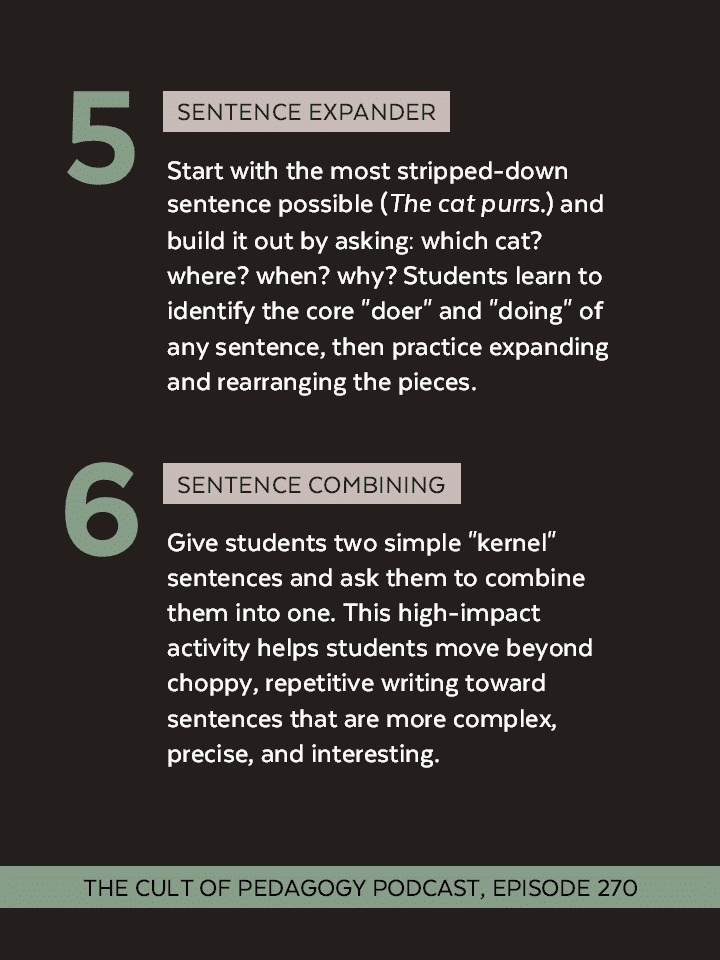
Sentence Expander: Starting with a basic "kernel sentence" (e.g., The cat purrs), students collaboratively expand it by answering a series of questions: Which cat? What color? Where? When? Why? Meehan advocates for using accessible terms like "doer" and "doing" instead of the more abstract "subject" and "predicate" to help students identify the core elements of a sentence. As the sentence grows (e.g., The orange cat is sleeping on the couch in the afternoon because he is tired), students learn how details modify and enrich the basic structure. Experimenting with rearranging expanded sentences helps students develop a nuanced understanding of sentence flow and learn to craft richer, more complex expressions.
-
Sentence Combining: Roberts identifies sentence combining as a "high-impact, quick way" to move students beyond simple, choppy sentences toward more syntactically complex, interesting, and precise writing. Students are given two short sentences (e.g., My cat is orange. My cat is big.) and tasked with combining them into one more sophisticated sentence (e.g., My big orange cat…). Initial scaffolding might involve underlining words to be "harvested" and inserted. As proficiency grows, students can combine three or more sentences, experimenting with various conjunctions (because, and, but) to alter meaning and create varied sentence structures. Consistent practice with sentence combining naturally leads to students integrating these skills into their independent writing, transforming basic prose into more sophisticated narratives and explanations.
Executive Functioning Minute Moves: Sharpening Cognitive Flexibility
Executive functions are the brain’s control center, crucial for managing the demands of complex tasks like writing. These "Minute Moves" directly target cognitive flexibility, a key executive function that enables writers to adapt, revise, and consider multiple perspectives.
-
What’s Another Way?: This activity directly cultivates cognitive flexibility at the sentence level. Students are presented with a sentence and challenged to rewrite it in multiple ways. This might involve starting with a dependent clause, substituting a noun with a pronoun, or intentionally shortening a complex sentence for impact. Meehan stresses that effective writing isn isn’t solely about length or complexity; sometimes the most powerful statement is a concise one. The "art and craft of writing," she explains, lies in the ability to vary sentence structure intentionally—using long, complex sentences when impactful and short, direct ones when appropriate. Critically, explicitly naming this skill as "cognitive flexibility" empowers students, especially those who have historically struggled with writing, by reframing their efforts as practicing a sophisticated cognitive skill.
-
New Angle: This strategy broadens the focus on cognitive flexibility from sentences to narrative perspective. Students retell a familiar scene—from a class text, a book, or a short film—from the viewpoint of a different character. Roberts vividly illustrates this with a personal anecdote: a cafeteria food fight experienced as a ninth-grader takes on an entirely different dimension when retold through the eyes of the teacher who had applesauce poured on her head. This exercise demands that students hold multiple viewpoints simultaneously, making deliberate choices about voice, detail, and interpretation. Meehan uses short videos, such as the Pixar short "Snack Attack," which depicts the same event from two distinct perspectives, to facilitate this. In a tutoring session, she and a student each wrote one character’s perspective, then swapped documents to continue the other character’s narrative. Beyond fostering a competitive spirit, this activity profoundly practices empathy and the ability to understand diverse perspectives, a skill Meehan rightly notes extends far beyond the writing classroom into "democracy and thinking about how other people think."
Implications and the Path Forward
The work of Melanie Meehan and Maggie Roberts, encapsulated in Foundational Skills for Writing, represents a vital call to action for educators, curriculum developers, and policymakers. By meticulously breaking down the complexities of writing and offering practical, brain-based strategies, they provide a roadmap for integrating robust writing instruction into every classroom.
The broader implications are significant:
- For Students: A more systematic approach to foundational writing skills can demystify the writing process, reduce anxiety, and empower students to become more confident and capable communicators. This, in turn, enhances their reading comprehension, critical thinking, and overall academic performance.
- For Teachers: The "Minute Moves" offer accessible, high-leverage strategies that can be seamlessly incorporated into existing curricula, addressing a common challenge of limited instructional time. The book also provides a deeper understanding of the cognitive science behind writing, equipping teachers with the knowledge to diagnose and address specific student needs more effectively.
- For Curriculum and Policy: The book underscores the necessity of a holistic literacy framework that explicitly values and integrates writing instruction alongside reading. It advocates for professional development that equips teachers with specialized knowledge in writing pedagogy, mirroring the attention given to reading instruction. Moving forward, educational standards and assessments must reflect this integrated understanding of literacy.
In an era where effective communication is more critical than ever, both in academic and professional spheres, the insights provided by Meehan and Roberts are timely and essential. By prioritizing the foundational skills of writing through targeted, consistent practice, educators can cultivate a generation of articulate, thoughtful, and cognitively flexible individuals, capable of navigating and shaping an increasingly complex world. Their work serves as a powerful reminder that true literacy is a two-way street, demanding equal attention to both the consumption and production of written language.