



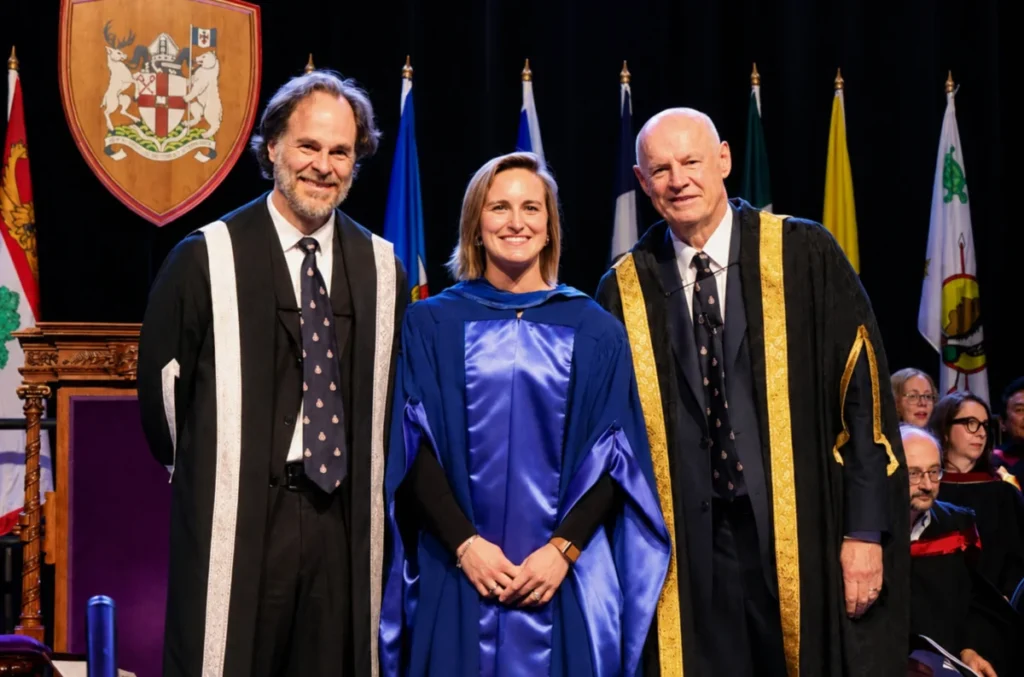
The familiar cadence of Canadian convocation ceremonies this year has carried a distinct undertone, moving beyond the traditional exhortations of ambition and risk-taking. In an era marked by persistent global conflict, deepening political polarization, and ongoing economic anxieties, a growing chorus of influential voices is urging graduating classes to prioritize empathy, tolerance, and kindness as they step into the next chapter of their lives. This subtle yet significant shift reflects a societal reckoning with complex challenges, prompting esteemed honorary degree recipients to imbue their addresses with a call for character-driven leadership and mindful engagement with the world.
The academic year concluding across Canada has seen universities bestow honorary degrees upon individuals whose life’s work exemplifies resilience, innovation, and a profound commitment to societal betterment. These recipients, from legal luminaries to pioneering technologists and decorated athletes, have leveraged their platforms to offer graduates not just congratulations, but also profound guidance rooted in lived experience. The prevailing sentiment underscores a recognition that academic achievement, while vital, must be complemented by a robust ethical framework and a deep sense of human connection to navigate the complexities of the 21st century.
A Call for Shared Humanity and Compassionate Action
Marion Buller, a retired judge and former Chief Commissioner for the National Inquiry into Missing and Murdered Indigenous Women and Girls, articulated this evolving message with poignant clarity during her address at the University of Toronto. Accepting an honorary degree, Buller challenged graduates to reframe their perception of human interaction, posing a fundamental question: "What would our world look like if we saw every person we met as part of our shared journey? Not a threat to defeat, but a human to walk alongside." This powerful invocation, drawing upon Indigenous teachings of collective responsibility and shared destiny, resonated deeply within the graduating cohort and beyond.
Buller’s address, delivered against the backdrop of ongoing reconciliation efforts in Canada, highlighted the importance of Indigenous perspectives in fostering a more inclusive and collaborative society. She emphasized the Lekwungen-speaking People’s wisdom in advocating for collective effort and the integration of "good hearts and minds" into all endeavors. This sentiment, she noted, is essential for graduates entering diverse professional fields, from technology and public service to the arts and healthcare.
"You will shape policy, and you’ll shape culture," Buller stated, underscoring the profound influence graduates will wield. "Most of all, you will shape others, and by doing so you will shape the future for all of us." Her parting counsel was a direct plea for a legacy built on empathy: "Let kindness be part of your legacy. Make space for each other. Offer grace when someone is learning. Choose generosity over ego. Speak truth but speak it with care. Promote hope." She concluded by asserting that while degrees open doors, "it’s your character that walks you through those doors." In a world often driven by competition, her call to prioritize fairness, compassion, and kindness served as a vital counterpoint.
Navigating the Age of Artificial Intelligence with Ethical Prudence
The rapid advancement of artificial intelligence (AI) presents one of the most significant technological frontiers for this graduating generation. Latha Vishnubhotla, a prominent technology executive and advocate for mentorship, addressed this critical juncture at Carleton University, where she received an honorary doctorate in engineering. Vishnubhotla urged graduates to actively steer the ethical development and deployment of AI.
"Across every technology wave that I lived through – networking, cloud, and now AI – the work I’m most proud of is the work that expanded opportunity, connected people and improved lives," Vishnubhotla shared. She underscored the transformative potential of AI, noting its capacity to amplify existing societal values, for better or worse. "AI will amplify whatever values we build into it – inclusion or exclusion, trust or fear, empowerment or concentration of power."
Her call to action for the new engineers and technologists was clear: "So, be the person in the room who asks what positive impact will this create at scale and will this be expansive and inclusive? Ask this question. Do not wait for someone to assign meaning to your work. Bring meaning to whatever work you do." This emphasis on proactive ethical consideration and value-driven innovation reflects a growing awareness of the profound societal implications of technological progress, particularly in fields with the potential for widespread impact. The demand for ethically-minded tech professionals is projected to increase by an estimated 30% in the next decade, according to industry analyses, making Vishnubhotla’s counsel particularly prescient.
The Power of Connection and Resilience in Adversity
The importance of human connection and mutual support in overcoming challenges was a recurring theme, powerfully articulated by Marie-Philip Poulin, a celebrated professional hockey player and three-time Olympic gold medalist. Speaking at Bishop’s University, Poulin drew parallels between the dynamics of elite sports teams and the collaborative spirit required in all professional and personal endeavors.
"One thing I learned playing for Team Canada and La Victoire is that the best teams are not perfect teams. They are connected teams. They are groups that stay together when things become difficult," Poulin explained. She recounted personal experiences of loss and pressure, emphasizing that sustained connection during adversity was often the differentiator for teams that emerged stronger. "Often the difference was how people chose to show up for one another."
Poulin’s message encouraged graduates to pursue excellence and ambition while simultaneously prioritizing the cultivation of strong character. "As you leave here today, I encourage you to chase excellence, work hard, be ambitious, dream big and push yourself. But, while you build your career, also build your character. Be someone people trust. Be someone who brings energy into a room. Be someone who listens. Be someone who helps others succeed. Be someone who stays kind even in competitive environments." This perspective highlights the enduring value of interpersonal skills and integrity in a world that can often foster intense competition.
Social Purpose as a Business Imperative
In the realm of business and entrepreneurship, the integration of social responsibility is no longer a niche concern but a fundamental expectation. Murad Al-Katib, an entrepreneur recognized for his work in addressing global food security and a winner of the Oslo Business for Peace Award, spoke at the University of Saskatchewan about the inextricable link between business success and social conscience.
Al-Katib challenged the notion that social entrepreneurship is a separate entity, asserting instead that "only entrepreneurship or business or life with social purpose exists." He highlighted the growing influence of consumers and stakeholders in driving this shift. "Consumers are driving it by the way they buy and spend their hard-earned dollars."
His philosophy of "compassionate entrepreneurism" centers on leveraging private enterprise to solve societal problems while simultaneously creating economic opportunities. He cited his work with the United Nations World Food Program and the International Red Cross/Red Crescent in providing millions of refugee meals, clarifying that this was not mere philanthropy but an "alignment of profit and purpose." This strategic integration, he argued, provides an "unlimited license to do good in the world," signaling a profound evolution in how businesses are expected to operate and contribute to global well-being. The global market for socially responsible investing alone has surpassed $35 trillion, underscoring the tangible financial and societal implications of this trend.
Leading with Empathy in a Divided World
The necessity of tolerance and understanding in navigating societal divisions was a core message delivered by evolutionary biologist Peter Grant at the University of British Columbia. Accepting an honorary degree alongside his wife and scientific collaborator, Rosemary Grant, he invoked the words of Michelle Obama: "Lead in hope, not in fear."
Grant acknowledged that conflict is an inevitable part of human interaction, even within academic institutions. He stressed the importance of cultivating tolerance and understanding, particularly when encountering those with different perspectives. "These two themes of tolerance and understanding on the one hand, and of leadership on the other, need to be woven together."
He envisioned a future where graduates would assume leadership roles across various sectors, from academia and healthcare to exploration and public service. However, he also emphasized the pervasive influence of leadership through example. "Many more of you will lead simply by example, by your rational, kind and socially responsible behavior, by your opinions and ethics, fundamentally by your attitudes towards others, imbued by your experience at UBC." This perspective highlights that impactful leadership is not solely defined by hierarchical positions but by the consistent demonstration of ethical conduct and a commitment to positive social engagement.
Creative Expression of a Call to Action
In a distinctive approach, Roslyn Bern, an educator and philanthropist dedicated to empowering women and girls, employed spoken word poetry at Dalhousie University to convey her message to the graduating class. Her performance was a creative call to action, encapsulating the spirit of the evolving convocation messages.
"You sit in your seats. You stare at the screen. You begin your journey sight unseen, but you view the world unfurled before you," Bern recited, drawing the graduates into her narrative. "You question ethics and directives from so many voices that choices stretch before you. It’s your world, not mine, to create."
Her poem urged graduates to engage with the world actively and purposefully: "Debate, uncrate into the void. It’s your turn to shine. Combine your forces with your voices that define a kinder, gentler population that rises with anticipation of the dawning of a new day." Bern concluded by encouraging graduates to wield their academic achievements as tools for positive change: "Hold your degree and decree your rewards in a way that allows for change." This innovative delivery underscored the urgency and personal relevance of her message, encouraging a generation to actively shape a more compassionate and equitable future.
The collective impact of these addresses suggests a maturing perspective within Canadian higher education, one that recognizes the profound responsibility graduates carry as they enter a world grappling with unprecedented challenges. The emphasis on kindness, tolerance, and social purpose signals a hopeful trajectory, encouraging a generation to build not just successful careers, but also meaningful and ethically grounded lives. As these graduates disperse into their chosen paths, the echoes of these convocation messages will undoubtedly shape their contributions to society for years to come.