



Despite widespread initial apprehension and bold forecasts from leading figures in the artificial intelligence sector, a predicted "jobs apocalypse" has largely failed to materialize. Early comparisons of AI’s impact to that of industrial automation, which dramatically reshaped physical labor, suggested a similar wholesale displacement of "brain-reliant" white-collar professions. However, a growing consensus among these same industry pioneers and labor market analysts points towards a more nuanced reality: AI is less about outright job replacement and more about profound job transformation and augmentation. This evolving perspective challenges the prevailing narratives of mass unemployment, suggesting instead a future where AI tools redefine tasks and empower a new era of work, rather than rendering human intellect obsolete.
The initial wave of enthusiasm and concern surrounding AI’s capabilities led to several high-profile predictions about its potential to dismantle established employment structures. Dario Amodei, CEO of Anthropic, a prominent AI research and development company, has on multiple occasions suggested that AI-powered tools could automate as much as half of all entry-level white-collar jobs. His remarks underscored a prevailing fear that AI, particularly large language models (LLMs), would swiftly absorb routine cognitive tasks, making human input redundant in vast swathes of the service and knowledge economy. Further amplifying these concerns, Mustafa Suleyman, CEO of Microsoft AI, made a stark prediction in February, stating that AI would achieve "human-level performance on most if not all professional tasks" within a remarkably short twelve to eighteen months. These pronouncements, often made in the context of rapid technological breakthroughs, fueled public anxiety and prompted urgent discussions about the future of work, economic stability, and societal adaptation.
However, a notable shift in rhetoric has begun to emerge from these very same AI leaders, indicating a reassessment of their earlier, more alarmist forecasts. This evolution in perspective suggests a deeper understanding of AI’s practical deployment and its interaction with complex human work environments. Just two weeks prior, at a conference in Australia, Sam Altman, CEO of OpenAI, expressed his "delight" at being proven wrong about the impending "jobs apocalypse" he had previously envisioned. His revised stance reflects an observation that while AI is undeniably impactful, its effects on the labor market are not manifesting as a wholesale culling of positions.
Similarly, Dario Amodei, who once spoke of automating half of white-collar entry-level roles, has refined his prognosis. He now posits that AI will not replace entire jobs but rather specific parts of existing jobs. This distinction is crucial; it implies that AI’s role is to modify the nature of work, shifting the responsibilities and skill requirements for employees within their roles, rather than eliminating the roles themselves. This updated viewpoint aligns with the concept of AI as a co-pilot or an assistant, handling repetitive or data-intensive segments of a job, thereby freeing human workers to focus on tasks requiring higher-order cognitive functions, creativity, emotional intelligence, and strategic thinking. This chronological shift from dire predictions to more nuanced assessments highlights an industry grappling with the real-world implications of its innovations.
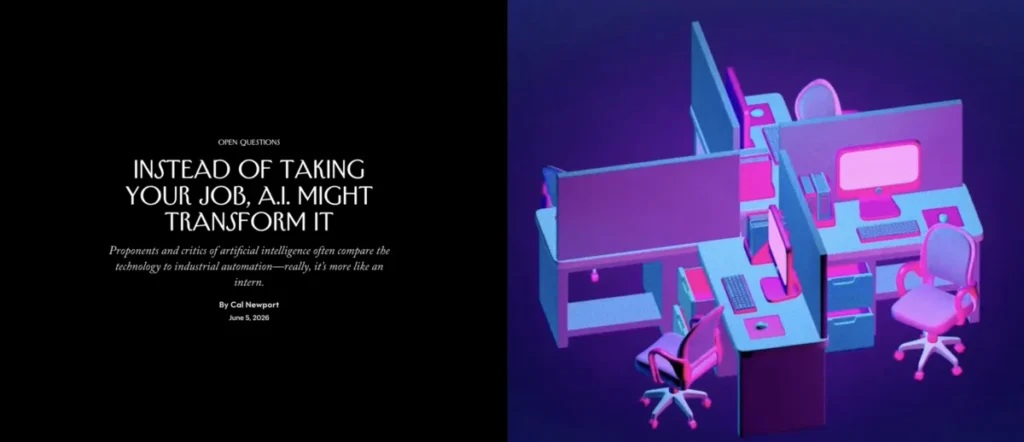
If the automation analogy, which envisions machines fully replacing human labor, is proving to be inadequate, what then offers a more accurate framework for understanding AI’s integration into the workforce? Cal Newport, a prominent author and computer science professor, offers a compelling alternative in his recent article for The New Yorker, titled "Instead of Taking Your Job, A.I. Might Transform It." Newport’s investigation suggests that AI’s impact mirrors less a factory floor’s complete mechanization and more a highly adaptable, bespoke tool-building process.
Newport illustrates this point by recounting a summer job he held during high school. Working at a corporate office park, he programmed custom, web-based applications designed for internal use at a management consulting firm. These weren’t polished, enterprise-grade software packages; rather, they were "quick-and-dirty" tools, rapidly cobbled together to address specific, often annoying, operational inefficiencies. One application streamlined timesheet management, while another tracked inventory for the IT department. These solutions, though rudimentary, significantly eased administrative burdens for the consultants, allowing them to focus more intensely on their core work. Crucially, Newport emphasizes that his efforts did not lead to any consultants losing their jobs; instead, his tools "just made their efforts a little deeper."
Drawing a direct parallel, Newport describes his interviews with several small business owners who were actively integrating AI into their operations. What he discovered echoed his high school experience: these businesses were not deploying AI to replace human workers with autonomous systems. Instead, they were leveraging AI to "vibe code" — a term implying rapid, iterative, and often informal development — quick-and-dirty tools. These AI-powered solutions were being used to simplify various facets of their operations, from generating initial drafts of marketing copy to analyzing customer data, optimizing scheduling, or automating routine communications. This pragmatic application of AI underscores its role as an enabler of efficiency and problem-solving, rather than a harbinger of job displacement.
Newport articulates this observation succinctly: "These examples were not the digital equivalent of a power loom, making large numbers of human jobs superfluous. Turns out, A.I. was assisting these small businesses in roughly the same way that my teen-age self had helped that consulting company—by hacking together whatever was useful." This perspective positions AI not as a replacement for human cognition, but as a powerful augmenter, capable of handling specific, often tedious or data-intensive, sub-tasks, thereby amplifying human productivity and allowing for a deeper focus on more complex, creative, and strategic endeavors. The conclusion of his piece carries a hopeful tone, stating, "so far, we don’t seem to be hurtling toward the darker vision of a workforce hollowed out by this technology."
Empirical data and economic analyses from various reputable institutions largely support this nuanced view, tempering the initial fears of mass unemployment. Labor markets in many developed economies have demonstrated remarkable resilience, with unemployment rates remaining low despite the accelerating integration of AI technologies across industries. This resilience suggests that AI’s impact is more about structural shifts and skill re-evaluation than widespread job destruction.
The World Economic Forum (WEF), in its "Future of Jobs Report," has consistently highlighted a pattern of simultaneous job displacement and creation. While AI is expected to automate a significant number of tasks and eliminate certain roles, it is also projected to be a net job creator, driving demand for entirely new professions, particularly in areas like AI and machine learning specialists, data analysts and scientists, robotics engineers, and green economy jobs. The WEF’s analysis underscores that the challenge lies not in a lack of jobs, but in a significant skills gap, necessitating large-scale reskilling and upskilling initiatives to prepare the workforce for these evolving demands.
Consulting giants like PwC, McKinsey, and Deloitte have published extensive research forecasting substantial productivity gains and economic growth driven by AI. Their reports frequently emphasize that AI will primarily complement human workers, particularly in roles requiring uniquely human attributes such as creativity, critical thinking, complex problem-solving, strategic decision-making, and emotional intelligence. For instance, in legal services, AI might automate document review and research, but the human lawyer’s role in client negotiation, courtroom advocacy, and ethical judgment remains paramount. Similarly, in healthcare, AI can assist in diagnostics and personalized treatment plans, but the empathetic interaction and holistic patient care provided by human medical professionals are irreplaceable.
Furthermore, the concept of the Jevons Paradox, as invoked by Dario Amodei in his revised outlook, offers an economic lens through which to understand AI’s potential long-term impact. The paradox suggests that increased efficiency in resource use can lead to increased demand for that resource, rather than a reduction. Applied to labor, if AI makes certain tasks significantly more efficient, it might lower the cost or increase the availability of related services, thereby stimulating greater overall demand for those services and potentially creating more work, not less. For example, if AI makes legal research cheaper and faster, it might expand access to legal services, requiring more human legal professionals to manage the increased caseloads and client interactions. This perspective offers a powerful counter-narrative to the initial fears of a shrinking job market.
A key implication of AI’s transformative role is the emergence of what Cal Newport terms "freestyle work." This refers to a dynamic where individuals, armed with accessible AI tools, can rapidly design and deploy bespoke solutions to specific, often transient, operational needs within their roles or organizations. This agility allows for unprecedented levels of customization and responsiveness, bypassing the need for extensive IT development cycles or off-the-shelf software that may not perfectly fit a unique problem. For small businesses, this democratizes access to sophisticated capabilities previously reserved for large enterprises with dedicated technology departments, leveling the playing field and fostering innovation.
This shift necessitates a significant evolution in skill sets. While traditional technical competencies remain valuable, there’s a growing emphasis on "prompt engineering"—the ability to effectively communicate with and guide AI systems to achieve desired outcomes. More broadly, the value of uniquely human skills—such as critical thinking, complex problem-solving, creativity, empathy, and strategic communication—is being amplified. As AI takes over routine and analytical tasks, humans are increasingly expected to leverage these higher-order cognitive and interpersonal abilities to navigate complex challenges, foster collaboration, and innovate. Consequently, lifelong learning and adaptability are becoming indispensable attributes for navigating a constantly evolving professional landscape. Educational systems and corporate training programs face the urgent task of preparing the current and future workforce for these new demands, focusing on skills that complement, rather than compete with, AI capabilities.
While the "jobs apocalypse" scenario has receded, it is crucial to acknowledge that AI’s integration is not without its challenges and potential disruptions. Significant job disruption, though not mass unemployment, is inevitable. Certain tasks, and consequently parts of roles, will undoubtedly change or diminish, requiring workers to acquire new skills or transition to different functions. The concern of a "hollowing out" of middle-skill jobs, where AI automates routine cognitive tasks while high-skill and low-skill jobs persist, remains a valid area of scrutiny. This could exacerbate income inequality if access to AI tools, training, and upskilling opportunities are not equitably distributed across the workforce.
From a policy perspective, governments, educational institutions, and businesses must collaborate to address these implications proactively. This includes reforming education curricula to emphasize AI literacy and complementary human skills, developing robust worker retraining programs, and potentially exploring new social safety nets to support individuals through transitional periods. The future of work in an AI-driven era is undeniably complex and continues to evolve at a rapid pace. However, the prevailing understanding has moved beyond panicked predictions of widespread job loss to a more nuanced appreciation of AI as a powerful, transformative, and augmentative force. It demands not a retreat from technology, but a strategic engagement with it, fostering adaptability, continuous learning, and a focus on amplifying human potential through intelligent collaboration with machines. The initial alarm has given way to a more pragmatic and hopeful outlook, centered on human ingenuity in concert with artificial intelligence.