

In a complex and high-stakes maritime operation, a juvenile humpback whale (Megaptera novaeangliae) was successfully liberated from life-threatening fishing gear in the remote waters of Endicott Arm, Alaska. The rescue, spearheaded by the National Oceanic and Atmospheric Administration (NOAA) Fisheries and supported by multiple state and local agencies, underscores the growing challenges of marine mammal conservation in regions where industrial activity and wildlife habitats overlap. Endicott Arm, a narrow and deep-water fjord situated approximately 50 miles southeast of Juneau, serves as a critical corridor for both marine life and commercial interests, including cruise ships and professional fishing fleets.
The incident began on the evening of May 10, when several mariners operating in the area spotted the young whale in distress. The animal appeared anchored to the spot, unable to dive or move forward effectively. Recognizing the severity of the situation, the mariners immediately contacted the NOAA Fisheries Alaska Marine Mammal Stranding Network’s 24-hour hotline. This initial report was the catalyst for a 24-hour mobilization effort that would eventually involve biologists, federal researchers, and local maritime experts.
The Chronology of the Rescue Operation
The timeline of the rescue reflects a masterclass in inter-agency coordination and rapid response. Following the initial sighting on May 10, regional coordinators spent the night analyzing the report and developing a tactical response plan. Because Endicott Arm is a remote location with limited immediate infrastructure, the response team had to ensure all necessary specialized equipment was gathered and a skilled crew was assembled before departing from Juneau.
On the morning of May 11, a specialized response team was formed. This group included biologists from NOAA Fisheries, experts from the Alaska Department of Fish and Game’s Marine Mammal Program, and partners from Alaska Sea to Shore, a local organization with deep knowledge of the regional waters. The team arrived on-site and spent more than five hours meticulously assessing the whale’s condition and the nature of the entanglement.
The whale was found to be caught in lines connected to two commercial Tanner crab pots. In the Alaskan fishing industry, Tanner crab pots are substantial pieces of equipment, often weighing approximately 800 pounds each. With two of these pots acting as deadweight, the juvenile whale was effectively tethered to the seafloor by 1,600 pounds of metal and mesh. This weight is particularly devastating for a juvenile whale, which lacks the sheer muscle mass of a 40-ton adult to drag such a load to the surface for air.
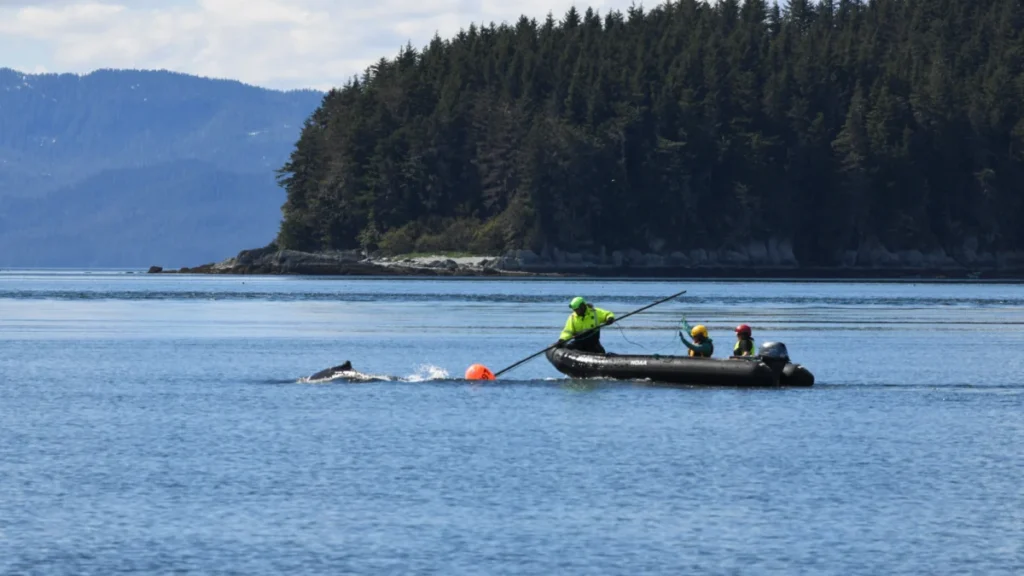
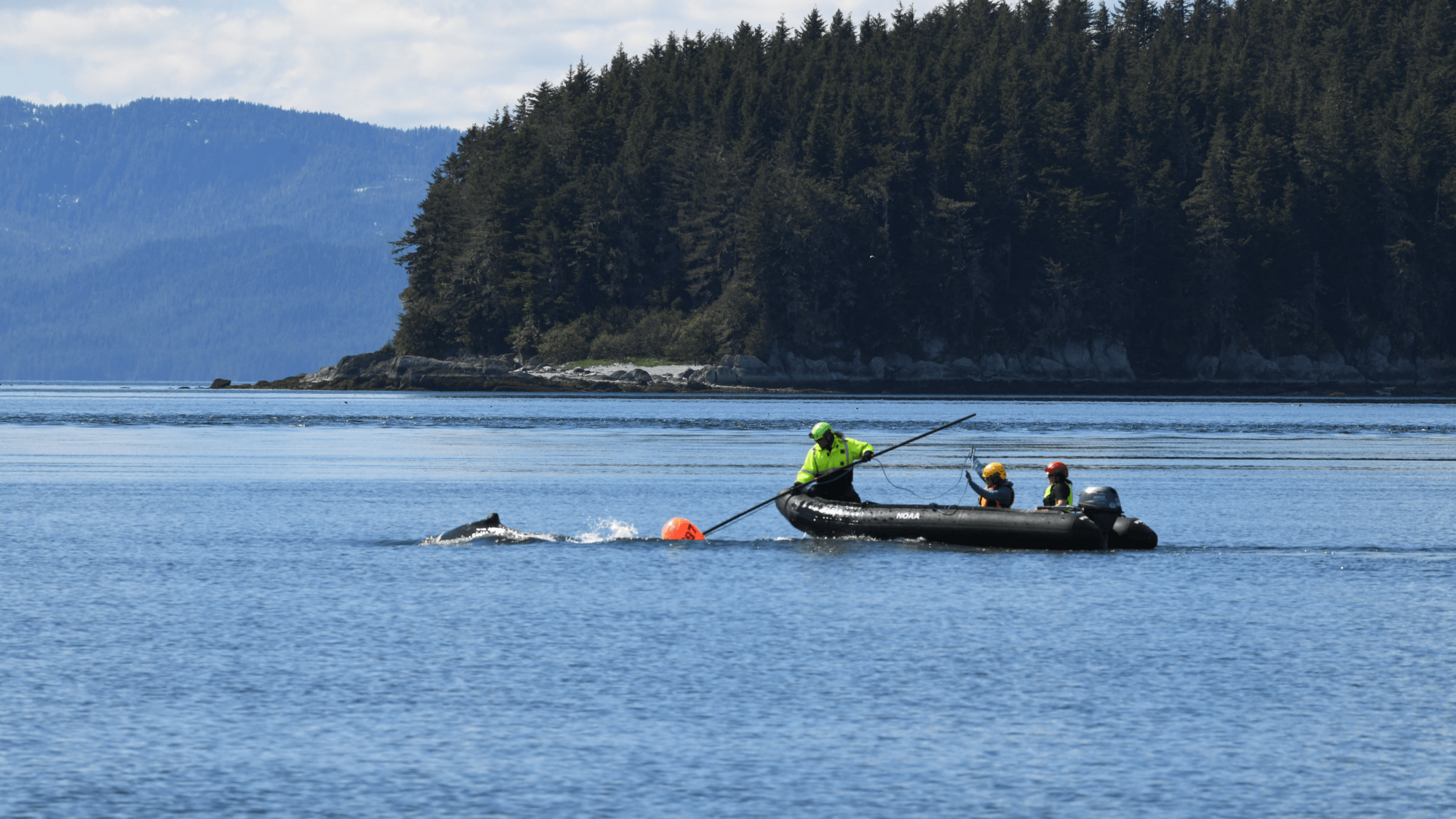
The rescue team utilized an inflatable boat to approach the whale, a maneuver that requires extreme precision. Using long poles equipped with specialized, razor-sharp knives, the responders made four strategic cuts. These cuts were designed to release the tension of the primary lines while ensuring the safety of both the whale and the humans. By the end of the five-hour ordeal, the whale was freed from the heavy pots and the majority of the trailing lines. Experts expressed optimism that the remaining fragments of rope would eventually shed naturally as the whale moved through the water.
Technical Challenges and Safety Protocols
The physical act of freeing a whale is one of the most dangerous tasks in marine biology. John Moran, a NOAA research fisheries biologist and an advanced responder on the team, emphasized the inherent risks of the operation. Even a juvenile humpback possesses enough power to capsize a small vessel or inflict fatal injuries with a single flick of its pectoral fins or tail fluke.
"Cutting gear off an animal of this size can be dangerous," Moran stated. "We use long poles fitted with specialized knives to extend our reach. That allows us to cut lines while reducing the risk of being injured by a 40-ton animal."
The specialized knives used in these operations are often V-shaped or hook-shaped, designed to slice through thick, industrial-grade polypropylene or nylon rope without needing to apply significant pressure that might startle the animal. The responders must also account for the "stored energy" in the lines; when a rope under extreme tension is cut, it can snap back with enough force to cause injury.
The Ecological and Industrial Context of Endicott Arm
Endicott Arm is a glacial fjord that terminates at the spectacular Dawes Glacier. While its beauty makes it a premier destination for the Alaskan cruise industry, its deep, nutrient-rich waters also make it a prime feeding ground for humpback whales. These whales migrate thousands of miles from breeding grounds in Hawaii or Mexico to reach the "buffet" of the Alaskan summer, where they feast on krill and small schooling fish like herring.
However, this biological hotspot is also a productive zone for commercial fishing. The Tanner crab fishery is a vital part of the Southeast Alaskan economy, but the vertical lines used to connect seafloor pots to surface buoys pose a constant "snare" risk to migrating cetaceans. When a whale swims through these lines, the rope can become caught in its baleen, wrapped around its pectoral fins, or cinched around its peduncle (the tail stock).
Supporting Data on Whale Entanglements in Alaska
The rescue in Endicott Arm is not an isolated incident. According to NOAA Fisheries data, there have been more than 140 confirmed reports of large whale entanglements in Alaska since 1998. However, conservationists warn that this number represents only a fraction of the actual occurrences. In the vast, unmonitored reaches of the Alaskan coastline, many entangled whales likely perish without ever being sighted.
Entanglement is a slow-acting threat. Unlike a ship strike, which can be instantly fatal, entanglement often leads to a protracted decline. The primary causes of mortality associated with gear include:
- Drowning: If the gear is heavy enough or if the whale becomes anchored in a way that prevents it from reaching the surface to breathe.
- Starvation: Lines wrapped around the mouth or baleen can prevent the whale from filter-feeding effectively.
- Infection: Heavy ropes can saw through the skin and blubber, leading to chronic wounds and systemic infections.
- Increased Energy Expenditure: Dragging heavy gear causes the whale to burn through its fat reserves much faster than normal, which is particularly dangerous for juveniles that need that energy for growth.
Official Responses and the Importance of Public Reporting
The success of the May 11 mission was largely attributed to the "network of eyes" provided by the local maritime community. Suzie Teerlink, a NOAA Fisheries Marine Mammal Specialist, noted that the real-time updates from vessel crews allowed the team to build a safe and effective response plan.
"That communication was critical," Teerlink said. "It gave us insight into the nature of the entanglement, helped us build a safe response plan, and gave us confidence that we could relocate the whale."
Sadie Wright, the Large Whale Entanglement Response Coordinator for the NOAA Fisheries Alaska Region, extended gratitude to the whale-watching community and the mariners who utilized the hotline. She emphasized that the public should never attempt to disentangle a whale themselves, as it is illegal under the Marine Mammal Protection Act and extremely hazardous. Instead, providing photos, GPS coordinates, and staying with the animal from a distance is the most helpful action a citizen can take.
Broader Implications and Future Mitigation
This incident highlights the ongoing tension between marine conservation and the commercial use of the oceans. As whale populations, particularly humpbacks, continue to recover from the era of commercial whaling, the frequency of "human-wildlife overlap" is expected to increase. This necessitates a multi-faceted approach to mitigation.
One area of active research is the development of "ropeless" or "on-demand" fishing gear. This technology stores the vertical buoy line on the seafloor with the pot, only releasing it to the surface when a fisher sends an acoustic signal. While currently expensive and in the testing phase, such innovations could virtually eliminate the risk of entanglement in fixed-gear fisheries.
Furthermore, the incident serves as a reminder of the importance of the Marine Mammal Stranding Network. Federal funding and support for these networks are vital for maintaining the specialized equipment and training required for these rescues. In the case of the Endicott Arm humpback, the investment in these resources resulted in a positive outcome for an animal that belongs to a species of significant ecological and cultural value to the state of Alaska.
As the juvenile humpback swims away from the fjords of Endicott Arm, its survival stands as a testament to the efficacy of collaborative conservation. The mission not only saved a single life but also provided valuable data and experience that will inform future rescue efforts in the challenging, icy waters of the North Pacific.