



Hiring managers across the global labor market are reporting a fundamental shift in the criteria used to evaluate prospective employees, moving away from a static list of technical tools toward a deeper, more resilient set of human capabilities. New research released by Microsoft, titled Preparing Students for the Future of Work, indicates that the professional landscape is undergoing its most significant transformation in decades. According to the report, approximately 70% of the skills currently utilized in the majority of job roles are expected to evolve or become obsolete by 2030. This rapid metamorphosis is primarily driven by the integration of Generative Artificial Intelligence (AI) into the workplace, a shift that has seen AI literacy requirements in job listings increase sixfold over the past twelve months. Furthermore, 66% of organizational leaders now state they would decline to hire a candidate who lacks fundamental AI skills, signaling that technological fluency is no longer an optional advantage but a baseline requirement for modern employability.
The findings underscore a pivotal moment for global education systems, which are now tasked with bridging the gap between traditional academic knowledge and the fluid demands of an AI-augmented economy. Success in this new era is increasingly defined by the interplay of foundational knowledge, specialized aptitudes, and the practical skilling necessary to turn emerging technologies into trusted professional practices. As educators and policymakers grapple with these changes, the focus is shifting toward a model that prioritizes "human flourishing"—a concept that balances economic productivity with the development of the individual’s capacity to live a meaningful and valued life.
A Chronology of the AI Integration in the Global Workforce
The transition toward an AI-centric labor market has moved with unprecedented velocity. In late 2022, the public release of sophisticated Large Language Models (LLMs) catalyzed a global conversation regarding the automation of cognitive tasks. By 2023, corporations began aggressive internal pilots of AI tools to enhance productivity, leading to a surge in demand for "prompt engineering" and digital literacy.
By early 2024, the "AI Divide" became a central concern for educational institutions, as students with access to these tools began to outpace their peers in research and content generation capabilities. This prompted a wave of curriculum revisions across K-12 and higher education sectors. The timeline culminated in the 2025 release of the Organization for Economic Co-operation and Development (OECD) framework, "Education for Human Flourishing." This framework argued that education must move beyond a narrow "human-capital" view—where students are seen merely as future workers—to a holistic view where learners are equipped with the agency to shape their own lives and contribute to society.
As the calendar moves toward the ISTELive 2026 conference, the focus has matured from initial "AI panic" to a structured integration of these technologies into the bedrock of pedagogical practice. The current landscape reflects a world where AI is no longer a separate subject of study but a pervasive layer in every discipline, from the humanities to the hard sciences.
Five Fundamentals Reshaping Professional Readiness
The OECD and Microsoft reports collectively identify five fundamental shifts that are redrawing the boundaries between entry-level and experienced personnel. These fundamentals suggest that AI readiness is built not just through technological access, but through governance, practical experience, and the refinement of human-centric skills.

1. Context Engineering
The ability to provide AI systems with the necessary context, data, and constraints is becoming a core competency. Professionals must be able to "engineer" the environment in which AI operates to ensure outputs are relevant, accurate, and aligned with organizational goals. This requires a high level of domain expertise and the ability to synthesize information from multiple sources.
2. The Agent Boss Mindset
As AI evolves from simple chatbots to autonomous "agents" capable of executing multi-step tasks, the role of the human worker is shifting toward that of a manager or "boss" of digital agents. This requires skills in delegation, oversight, and the ability to evaluate the quality of work produced by non-human entities.
3. Judgment and the Human Standard
In an era where AI can generate vast amounts of content, the "human standard" becomes the ultimate differentiator. Critical thinking, ethical judgment, and the ability to identify bias or hallucination in AI outputs are essential. The labor market increasingly rewards those who can apply wisdom and ethical frameworks to technological outputs.
4. Adaptive Problem Solving
The volatility of the current market means that specific technical skills have a shorter half-life than ever before. Consequently, the capacity to learn, unlearn, and relearn is the most valuable asset a student can possess. This involves a shift from "knowing what" to "knowing how to figure out."
5. Ethical Competence and Responsibility
As AI systems take on more significant roles in decision-making, the need for ethical governance grows. Students must understand the legal, social, and moral implications of AI, ensuring that technology is used responsibly to support, rather than undermine, human dignity and societal well-being.
Supporting Data: The Scale of the Shift
The Microsoft research provides a data-driven look at the urgency of this educational pivot. The 70% projected shift in skills by 2030 highlights a "velocity of change" that traditional four-year degree programs are currently struggling to match. When 66% of leaders express a refusal to hire without AI skills, it creates an immediate pressure on career services and vocational training centers to provide rapid-response skilling.
Additional data from the OECD suggests that countries prioritizing "Social and Emotional Skills" (SES) alongside digital literacy see higher levels of student well-being and long-term employment stability. This correlates with the Microsoft finding that curiosity and judgment—distinctly human traits—are the most sought-after qualities in the new economy. The increase in AI-related job listings (6x) is not limited to the tech sector; it spans healthcare, finance, manufacturing, and the arts, proving that AI literacy is a universal requirement.

Official Responses and Institutional Implementation
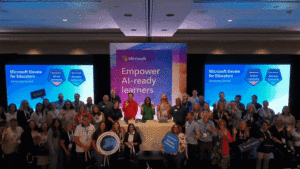
Educational institutions and technology providers are responding with large-scale initiatives designed to democratize AI access and training. The Microsoft Elevate for Educators program is one such example, providing school leaders and teachers with a global community and credentials to integrate AI into their classrooms confidently.
In the United Kingdom, several universities have begun embedding "AI Ethics" into every undergraduate major, ensuring that a philosophy student and a civil engineering student both graduate with a shared understanding of algorithmic bias. In India, K-12 schools are utilizing AI-powered personal tutors to provide individualized support in rural areas, demonstrating how technology can be used to foster "agency" in learners who were previously underserved.
A spokesperson for a major global education collective noted, "The goal is not to replace the teacher with a machine, but to use the machine to free the teacher to do what only humans can do: inspire, mentor, and provide emotional support. We are moving toward a ‘high-tech, high-touch’ model of schooling."
Broader Impact and Implications for Global Policy
The implications of this shift extend far beyond the classroom. If the majority of jobs will require AI literacy by 2030, there is a significant risk of a "Global AI Divide," where nations with fewer resources fall further behind. International bodies are now calling for "Digital Public Infrastructure" that treats AI access as a utility, similar to electricity or water.
Furthermore, the focus on "Human Flourishing" suggests a potential shift in how we measure national success. Instead of focusing solely on GDP or employment rates, governments may begin to track "Capability Indices"—measures of how well an education system prepares its citizens to adapt to change and lead meaningful lives.
The analysis suggests that the future of work is not a battle between humans and machines, but a collaboration. The students who will thrive are those who view AI as a powerful tool to be directed by human wisdom. As the Microsoft report concludes, "Work is changing. People are not." The enduring human qualities of curiosity, empathy, and moral reasoning remain the anchors in a sea of technological change.
As the global community looks toward the ISTELive 2026 event, the mandate for educators is clear: build the literacy and adaptability that employers describe as being "skilled for life." By grounding technological training in the framework of human flourishing, education systems can ensure that the AI revolution leads to a future of expanded opportunity rather than widespread displacement. The transition requires a bold reimagining of what it means to be "ready" for the world, ensuring that every learner has the tools not just to survive in the new economy, but to shape it.