


Every week, faculty members across higher education institutions dedicate countless hours to the painstaking task of authenticating student submissions, grappling with the pervasive question of whether a human, not an artificial intelligence, authored the work. This Sisyphean endeavor involves deploying AI detection software, meticulously cross-referencing suspicious phrases against internet searches, and scrutinizing subtle shifts in sentence complexity within a student’s broader portfolio. The unfortunate reality for these dedicated educators is that, in this particular struggle, they are largely losing. Their defeat stems not from a lack of intellect or commitment, but from a fundamental misdirection of effort: they are engaged in the wrong battle.
The emergence of sophisticated generative AI models, spearheaded by tools like OpenAI’s ChatGPT in late 2022, sent shockwaves through the academic world. Initially, the response on many campuses was one of alarm, triggering an urgent, often reactive, focus on detection. The prevailing question became: "How do we catch students using AI when they shouldn’t?" This immediate impulse to safeguard academic integrity is undeniably legitimate, reflecting a core tenet of educational institutions. However, this detection-first approach, while well-intentioned, possesses a fatal and increasingly evident flaw.
The Unwinnable Arms Race: Flaws of AI Detection
The reliance on AI detection tools quickly proved to be an unwinnable arms race, characterized by significant inaccuracies and inherent biases. These tools, designed to identify patterns indicative of machine generation, frequently misclassify legitimate student writing as AI-generated. This includes work where students may have only utilized widely accepted grammar-checking software or minor editing aids. Conversely, lightly edited AI-generated content often sails through undetected, rendering the entire exercise moot.
The accuracy problem is exacerbated by a pronounced bias issue. Groundbreaking research conducted by Stanford University, for instance, revealed that AI detectors misclassified an alarming 61% of essays written by non-native English speakers as AI-generated. This statistic alone underscores a profound ethical dilemma, placing an unfair burden of proof on a vulnerable student demographic and potentially leading to false accusations that can severely impact academic careers and student well-being. Further validating these concerns, a comprehensive 2023 study published in the International Journal for Educational Integrity rigorously tested 14 different AI detection tools and unequivocally concluded that they are neither accurate nor reliable for the purpose of identifying AI-generated text.
As prominent educators Bowen and Watson have sagely argued, institutions are compelled to confront an uncomfortable truth: how many false accusations are they willing to accept as collateral damage in this pursuit of detection? The technological landscape is evolving at an unprecedented pace, with AI models becoming more sophisticated and their outputs increasingly indistinguishable from human writing. Any detection tool developed today is likely to be obsolete tomorrow, trapped in a perpetual cycle of attempting to catch up. This "arms race" against ever-advancing AI is not merely challenging; it is unwinnable. In the interim, universities are diverting immense energy and resources towards a policing function rather than investing in the core mission of teaching and learning.
Beyond the Symptom: The Deeper Problem of Assessment Validity

Crucially, the fixation on detection overlooks a more profound and systemic issue. Focusing on catching AI use treats a symptom rather than addressing the underlying disease. The real challenge is not merely that students are employing AI; it is that the advent of AI has fundamentally undermined the validity of many assessment tools that higher education has relied upon for decades. The traditional five-paragraph essay, the end-of-semester research paper, the take-home case study – these assignments were always proxies for learning, never the learning itself. They were designed as scalable methods to gauge understanding, critical thinking, and synthesis in an era where information retrieval and text generation required significant human effort. AI has not changed the inherent nature of these proxies; it has simply made the gaping chasm between the proxy and the actual learning it purports to measure impossible to ignore.
This stark realization marks the true beginning of a genuine and effective institutional response. It necessitates a paradigm shift, moving beyond superficial solutions to a fundamental re-evaluation of educational philosophy and practice.
The Paradigm Shift: Verifying Learning, Not Detecting Misconduct
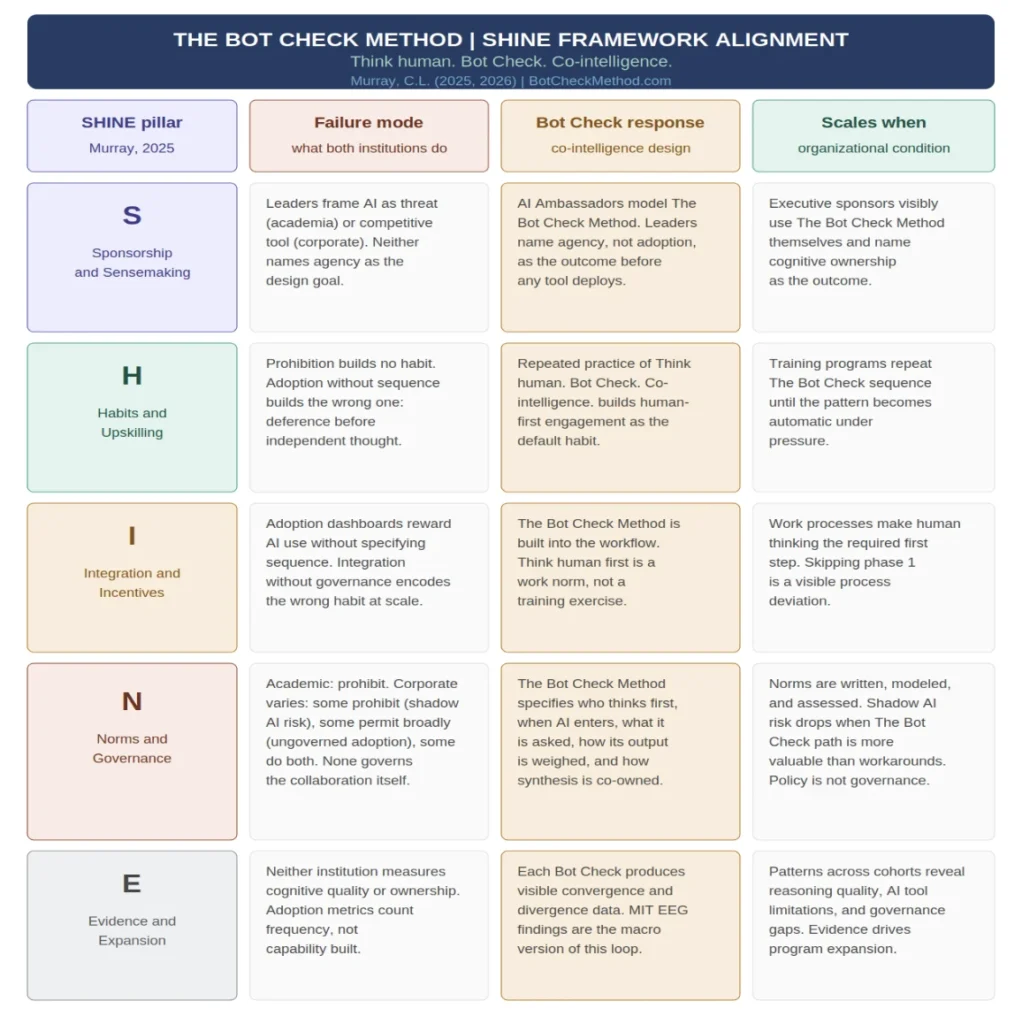
Institutions that are successfully navigating this unprecedented technological disruption are not asking, "How do we catch students using AI?" Instead, they are posing a profoundly different and more pertinent question: "How do we know if our students are actually learning?" This reorientation of the central inquiry alters everything downstream: institutional policy, the design of assessments, faculty development initiatives, and the very culture of the institution.

Such a profound shift requires robust and visionary leadership from the highest levels of university administration. Faculty members, while instrumental in implementation, cannot be expected to make this pivot in isolation. The overarching framework and strategic direction must emanate from the top, because what is truly being asked of faculty is nothing short of a significant professional and intellectual reorientation – a recalibration of their pedagogical approaches, assessment strategies, and even their understanding of academic integrity in the digital age.
An illustrative example of this forward-thinking approach can be seen at institutions like Grand Canyon University, whose strategy rests on three interconnected pillars:
- A Clear Institutional Position: Articulating a unified stance on AI’s role in education, moving beyond outright bans to embrace responsible integration and critical engagement.
- Curricular Modernization: Proactively reviewing and redesigning curricula and assignments to be "AI-resistant" or "AI-inclusive," focusing on higher-order thinking skills that AI cannot yet fully replicate.
- Learning Integrity Framework: Shifting the focus from merely detecting misconduct to empowering faculty with tools and strategies to verify genuine learning outcomes, fostering a culture where students understand the purpose of assessments as demonstrations of their own acquired knowledge and skills.
Chronology of the AI Challenge in Higher Education
The timeline of AI’s impact on higher education illustrates a rapid progression from initial shock to a nascent period of adaptation:

- November 2022: OpenAI publicly releases ChatGPT, a powerful generative AI chatbot. Its ability to produce coherent, contextually relevant text instantaneously triggers widespread alarm in academic circles.
- December 2022 – March 2023: Many universities respond with immediate bans or stern warnings against AI use. A scramble ensues to find technological solutions for detection. Initial AI detection tools gain traction, despite limited efficacy.
- April – August 2023: Early research and anecdotal evidence begin to expose the significant flaws of AI detection software, particularly regarding false positives and bias against non-native English speakers. Faculty express frustration with unreliable tools and the time sink involved in policing.
- September – December 2023: A growing consensus emerges among educational technologists and thought leaders that detection is a losing battle. Discussions pivot towards redesigning assignments, promoting "AI literacy," and integrating AI as a tool rather than viewing it solely as a threat.
- January 2024 – Present: Institutions begin to formulate more nuanced AI policies, often emphasizing responsible use, ethical guidelines, and pedagogical innovation. The focus shifts towards authentic assessment and faculty development to equip educators with new strategies. Conferences and workshops on "AI in Education" proliferate, signaling a move towards proactive engagement.
The Implications for Pedagogy and Assessment Design
The core implication of this paradigm shift is a fundamental re-evaluation of pedagogical practices and assessment design. Traditional assessments, often designed for scalability and ease of grading, inadvertently prioritized the product of learning (e.g., a well-structured essay) over the process of learning (e.g., critical thinking, research skills, analytical reasoning). AI short-circuits this process, making it possible to generate a plausible product without genuine engagement with the learning journey.
To genuinely verify learning in the age of AI, educators must move towards assessments that are:
- Authentic: Mirroring real-world tasks and problems, requiring application of knowledge in complex, novel situations. This could include project-based learning, simulations, case studies requiring innovative solutions, or collaborative group work.
- Process-Oriented: Valuing and assessing the steps involved in learning, such as research methodologies, drafting processes, peer review, and iterative revisions, rather than solely the final output. Oral defenses of written work or presentations of research findings become crucial.
- Personalized and Contextualized: Requiring students to integrate personal experiences, local contexts, or unique insights that AI models, trained on general datasets, struggle to replicate.
- AI-Integrated: Teaching students how to use AI tools ethically and effectively as assistants for brainstorming, drafting, or research, but requiring them to demonstrate critical evaluation, synthesis, and original thought in their final submissions. This fosters "AI literacy," a vital skill for future careers.
- Performance-Based: Focusing on demonstrating skills and competencies through actions, such as coding assignments, laboratory experiments, artistic creations, public speaking, or problem-solving exercises in real-time.
This pedagogical pivot requires significant investment in faculty development. Many educators, accustomed to traditional methods, need training, resources, and peer support to redesign their courses and assessment strategies. This is not merely about learning new software; it is about rethinking the very purpose and mechanics of education.

Statements and Reactions from Related Parties (Inferred)
- University Administrators: Initially, a tone of cautious alarm, focusing on "maintaining academic integrity" and "exploring technological solutions." More recently, statements reflect a growing understanding of the deeper challenge, emphasizing "innovation in teaching," "preparing students for an AI-driven world," and "investing in faculty professional development." The focus has shifted from punitive measures to proactive adaptation.
- Faculty Members: A spectrum of reactions, from deep frustration and a sense of being overwhelmed by the new demands, to cautious optimism and a willingness to experiment. Many express a need for clear institutional guidance, shared resources, and dedicated time for course redesign. There’s a strong desire for solutions that empower teaching rather than draining energy into policing.
- Student Bodies: Concerns about the fairness and accuracy of AI detection tools are prominent, particularly among international students or those who might inadvertently trigger false positives. Many students are eager for clear guidelines on ethical AI use and express interest in learning how to leverage AI tools responsibly for their studies and future careers.
- AI Developers and Researchers: While acknowledging the challenges AI poses to academic integrity, many developers highlight the potential of AI as a powerful learning tool when used ethically. Companies offering AI detection often frame their products as "risk assessment" tools rather than definitive plagiarism detectors, recognizing the inherent limitations and potential for error.
Broader Impact and Long-Term Implications
The AI revolution in higher education is not a fleeting trend; it is a transformative force that will fundamentally reshape the landscape of learning and assessment. The implications extend far beyond the immediate challenge of detecting AI-generated text:
- Reshaping the Value Proposition of Higher Education: In a world where information and basic content generation are commoditized by AI, the value of a university degree will increasingly lie in fostering uniquely human skills: critical thinking, complex problem-solving, creativity, ethical reasoning, collaboration, and the ability to synthesize disparate information into novel insights. Universities must demonstrably cultivate these capacities.
- Equity and Access: The biases embedded in AI detection tools exacerbate existing inequities, particularly for non-native English speakers or students from diverse educational backgrounds. Furthermore, access to premium AI tools or training in AI literacy could create new divides, necessitating institutional efforts to ensure equitable access and support for all students.
- Ethical AI Literacy: Beyond simply using AI, students must learn to critically evaluate AI outputs, understand algorithmic bias, recognize the ethical implications of AI development and deployment, and become responsible digital citizens. This requires integrating AI ethics into curricula across disciplines.
- Institutional Culture Shift: Moving from a punitive, policing culture to one that fosters curiosity, ethical engagement with technology, and a growth mindset around learning. This involves building trust between faculty and students and encouraging open dialogue about the challenges and opportunities presented by AI.
- Investment in Human Capital: The shift demands significant institutional investment in faculty development, instructional design support, and technology infrastructure. Universities that prioritize this investment will be better positioned to thrive in the AI era.
Ultimately, the challenge presented by AI is an opportunity for higher education to reaffirm its core mission: to cultivate critical thinkers, innovative problem-solvers, and ethically engaged citizens. By pivoting from an unwinnable battle against detection to a proactive embrace of learning integrity and pedagogical innovation, institutions can ensure that their students are not just equipped for the future, but are actively shaping it.