



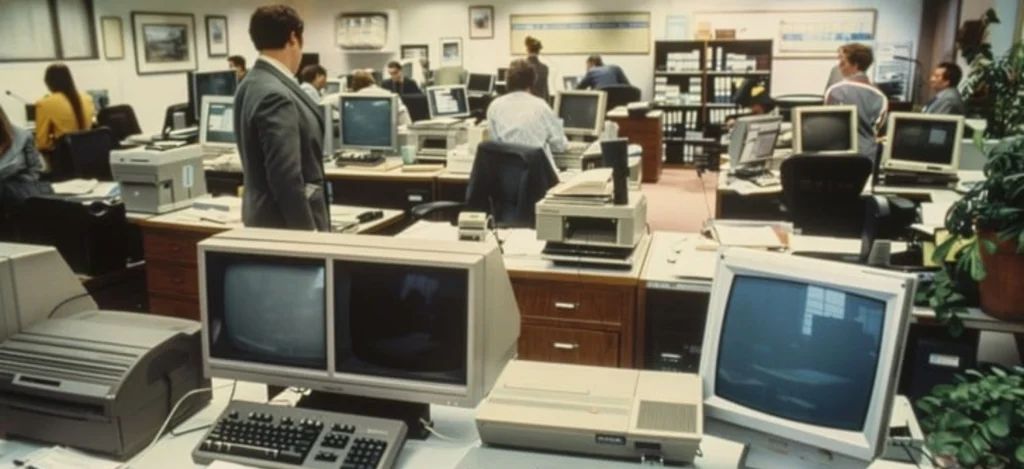
Few recent technological innovations were better poised to become a productivity slam dunk than the personal computer. With the advent of spreadsheets, word processors, databases, presentation software, and email, the list of programs that promised to vastly simplify common professional tasks seemed endless. The anticipation was that these tools would usher in an era of unprecedented efficiency, liberating workers from tedious manual processes and accelerating output across all sectors. However, as the widespread adoption of personal computers progressed through the late 20th and early 21st centuries, reality proved significantly more complicated than initial projections. The promised revolutionary leap in aggregate productivity often remained elusive, giving rise to what economists termed the "productivity paradox." This historical precedent offers crucial insights as the world now grapples with the profound potential and complex integration challenges posed by artificial intelligence (AI).
The Personal Computer: A Revolution of Unforeseen Complexities
The journey of the personal computer from a niche enthusiast’s tool to an indispensable fixture in virtually every office and home began in earnest in the late 1970s and exploded in the 1980s and 1990s. Early proponents envisioned a future where PCs would automate routine calculations, streamline document creation, and facilitate instant communication, thereby dramatically boosting economic output. For individual users, the benefits were often palpable: a spreadsheet program could complete complex financial models in seconds, a word processor could edit and format documents with unprecedented ease, and email offered a rapid alternative to traditional mail and faxes.
Yet, despite massive investments in information technology (IT) infrastructure and the near-ubiquitous presence of PCs in the workplace by the turn of the millennium, aggregate productivity statistics did not immediately reflect the expected surge. Economist Robert Solow famously quipped in 1987, "You can see the computer age everywhere but in the productivity statistics." This observation encapsulated the burgeoning "productivity paradox," a phenomenon where significant technological advancements, particularly in IT, did not translate into proportional gains in measured economic productivity.
Data from the U.S. Bureau of Labor Statistics and other economic indicators during the 1980s and early 1990s showed only modest increases in productivity growth, certainly not the dramatic acceleration anticipated from such a transformative technology. While individual tasks undoubtedly became faster, the broader economic impact was less clear-cut. This led to extensive debate among economists, technologists, and business leaders regarding the true value and integration challenges of personal computing.
Unpacking the PC Paradox: Why Expectations Fell Short
Several factors contributed to the perceived discrepancy between the individual utility of PCs and their broader economic impact:
-
Information Overload and Context Switching: While email and instant messaging facilitated rapid communication, they also introduced new forms of distraction and increased the volume of incoming information. Workers found themselves constantly interrupted by notifications, leading to reduced focus and the need for frequent context switching, which is known to degrade cognitive performance. The "always-on" culture fostered by digital communication often extended working hours without necessarily increasing effective output. Studies have shown that knowledge workers spend a significant portion of their day managing emails and attending virtual meetings, often at the expense of deep, focused work.
-
Learning Curves and Skill Gaps: The introduction of PCs required significant investment in training and adaptation. Users needed to learn new software, operating systems, and digital workflows. Organizations had to build IT support structures, manage software licenses, and upgrade hardware regularly. This substantial upfront and ongoing investment in human capital and infrastructure was often underestimated and absorbed a portion of the potential productivity gains.
-
Organizational Inertia and Complementary Investments: Simply deploying new technology was insufficient. True productivity gains required fundamental changes to organizational structures, business processes, and work culture. Many companies initially grafted new technologies onto old processes, failing to fully leverage the transformative potential of digital tools. For instance, a paperless office remained an elusive dream for decades because organizations struggled to re-engineer their entire document management systems. The need for complementary investments in process redesign, change management, and new organizational paradigms was crucial but often overlooked or delayed.
-
Measurement Challenges in Knowledge Work: A significant portion of the PC revolution impacted knowledge work, where output is inherently harder to quantify than in manufacturing or agriculture. How does one precisely measure the productivity gain from a well-written email, a more visually appealing presentation, or a faster data analysis? Traditional productivity metrics, often focused on tangible output per hour, struggled to capture the qualitative improvements and complex, interconnected nature of digital knowledge work.
-
The "Work-Intensification" Effect: Instead of freeing up time, PCs often enabled workers to take on more tasks, leading to work intensification. The ability to process more data or communicate more frequently did not always translate into fewer working hours or higher value-added tasks, but rather into an increased workload within the same or even extended timeframes.
Historical Context: General Purpose Technologies and Their Diffusion
To understand the PC paradox, it is helpful to look at historical precedents of other "General Purpose Technologies" (GPTs). Technologies like the steam engine, electricity, and the internal combustion engine also triggered profound economic and societal transformations, but their full impact was rarely immediate.
- Steam Engine: While invented in the early 18th century, its widespread application in factories, railways, and ships took decades, requiring significant complementary innovations in metallurgy, engineering, and infrastructure.
- Electricity: The electrification of factories in the early 20th century initially saw limited productivity gains. It was only when factory layouts were completely redesigned, moving away from centralized steam power to decentralized electric motors, that the true productivity boom occurred. This required a fundamental rethinking of production processes, not just replacing old power sources with new ones.
These examples illustrate that GPTs often have a long and complex diffusion path. They require not just invention and adoption, but also a complete overhaul of existing systems, skills, and organizational structures to unlock their full potential. The personal computer, as a GPT for information processing, followed a similar trajectory. Its impact was undeniable in the long run, contributing to the productivity surge witnessed in the late 1990s and early 2000s, but the initial decades were characterized by a learning curve and systemic adjustments.
The AI Era: Echoes of the Past, New Frontiers of Promise
Today, the world finds itself at the precipice of another transformative technological wave: artificial intelligence. From generative AI models that can produce human-like text and images to advanced analytics that can derive insights from vast datasets, AI promises to automate mundane tasks, enhance creativity, accelerate research, and personalize experiences across virtually every industry. The rhetoric surrounding AI often mirrors the boundless optimism that accompanied the early days of personal computing, envisioning a future of unprecedented productivity and innovation.
Early indicators suggest that AI can indeed make certain common professional activities easier. Tools powered by large language models can draft emails, summarize documents, generate code, and assist with research, potentially saving significant amounts of individual worker time. Companies are reporting promising initial results from pilot programs implementing AI solutions for customer service, data analysis, and content creation.
However, as we struggle to figure out how to think about the promise of these tools, it’s worth remembering the lessons from the digital world’s past: productivity doesn’t always match our expectations. The "AI productivity paradox" is already being discussed, even in these nascent stages of widespread adoption.
Anticipated Challenges and the Emerging AI Paradox:
- Individual vs. Aggregate Gains: While an individual worker might save an hour a day using AI, scaling this across an entire organization or economy presents complex challenges. The aggregate impact depends on how that saved hour is reinvested – into higher-value tasks, new innovations, or simply more work.
- Ethical Considerations, Bias, and "Hallucinations": AI models are prone to biases present in their training data and can "hallucinate" or generate factually incorrect information. The need for human oversight, fact-checking, and ethical governance adds layers of complexity and cost, potentially offsetting some efficiency gains.
- The Demand for New Skills and Reskilling: The integration of AI will undoubtedly require new skills. Workers will need to learn how to effectively prompt AI, critically evaluate its outputs, and collaborate with AI systems. A significant global reskilling effort will be necessary to bridge potential skill gaps and avoid job displacement without sufficient re-employment in new roles.
- Infrastructure, Energy Consumption, and Cost: Developing and deploying advanced AI models require massive computing power and energy resources, leading to significant infrastructure investments and environmental concerns. The cost of running sophisticated AI systems can be substantial, influencing their accessibility and widespread adoption, particularly for smaller enterprises.
- Potential for New Forms of Digital Overload: Just as email led to information overload, unchecked AI could flood workplaces with automated communications, generated content, or overwhelming data, potentially creating new forms of digital distraction and cognitive burden. The imperative to manage and curate AI-generated content will be critical.
Expert Perspectives and Industry Reactions
Economists are closely monitoring AI’s early impact, with some like Erik Brynjolfsson and Andrew McAfee, authors of "The Second Machine Age," suggesting that AI could finally deliver the productivity gains that digital technology has long promised, but only if properly managed. Others, drawing parallels to the PC era, caution against overoptimism, emphasizing the long lag times for systemic change. Business strategists widely acknowledge that successful AI integration will hinge not just on the technology itself, but on parallel investments in human capital, organizational restructuring, and innovative business models. Leaders are increasingly emphasizing the need for a "human-in-the-loop" approach, ensuring AI augments human capabilities rather than simply replacing them without forethought.
Navigating the Future: Strategies for Maximizing AI’s Potential
To avoid repeating the productivity paradox of the personal computer era, a strategic and holistic approach to AI integration is essential:
- Beyond Tool Adoption: Holistic Integration: Organizations must move beyond simply deploying AI tools. True transformation requires a re-evaluation of entire workflows, business processes, and strategic objectives. AI should be integrated as part of a broader digital transformation strategy, not as a standalone solution.
- Investment in Human Capital: Continuous learning, training, and upskilling are paramount. Employees need to develop new competencies in AI literacy, critical thinking, problem-solving, and ethical reasoning to effectively collaborate with AI systems and leverage their capabilities.
- Rethinking Workflows and Organizational Structures: AI offers an opportunity to fundamentally redesign how work is done, moving away from legacy processes. This may involve flatter hierarchies, more agile teams, and new roles focused on AI management, oversight, and innovation.
- Developing Robust Measurement Frameworks: New metrics are needed to accurately assess the impact of AI on knowledge work productivity. These should go beyond traditional output measures to include qualitative improvements, innovation rates, employee engagement, and overall business value creation.
- The Imperative of Responsible AI Development: Addressing ethical concerns, ensuring fairness, transparency, and accountability in AI systems is not merely a compliance issue but a fundamental requirement for successful, sustainable integration. Trust in AI is crucial for its adoption and long-term societal benefit.
Conclusion: A Pragmatic Optimism for the Digital Age
Much like early PCs, it seems unlikely that AI is a technological genie that will be fully returned to its bottle. There is too much untapped convenience and potential to be ignored. However, the history of digital technology, particularly the personal computer, offers a powerful cautionary tale. While the individual conveniences of PCs were immediate and profound, their aggregate productivity impact took decades to fully materialize, requiring significant complementary investments, organizational redesign, and a learning curve for both individuals and institutions.
The current AI moment presents a similar landscape of immense promise intertwined with complex challenges. By acknowledging the lessons learned from the personal computer era – that technological adoption is only the first step, and true transformation requires deep systemic change, human adaptation, and strategic foresight – we can approach AI with a pragmatic optimism. The goal is not just to integrate AI, but to integrate it wisely, ensuring that this powerful technology genuinely amplifies human potential and drives measurable, sustainable progress, rather than simply creating a new iteration of the digital productivity paradox. The uneven impact of computing and network technology on knowledge work, as explored in extensive research, underscores the critical importance of this thoughtful approach for the future of work and economic growth.