

The integration of artificial intelligence within the global academic landscape has reached a critical saturation point, according to the latest findings from the 2026 Microsoft AI in Education Special Report. Data indicates that 92% of students and education leaders, alongside 88% of educators, have already incorporated AI into their school-related workflows. While the initial phase of AI adoption was characterized by a focus on speed and administrative efficiency, the industry is now pivoting toward a more complex objective: ensuring these technologies actively support deep learning and critical thinking rather than merely automating tasks. Microsoft’s latest suite of announcements addresses this shift, introducing a range of AI-powered teaching capabilities and literacy frameworks designed to move beyond the "answer engine" model toward a "learning coach" paradigm.
The current state of education reflects a transition from early-stage experimentation to a demand for structured support systems. According to Microsoft’s research, which surveyed over 3,300 respondents across the United States, the United Kingdom, Australia, Brazil, Japan, and Saudi Arabia, a significant gap exists between tool availability and professional competency. The report reveals that 66% of educators and 52% of students are actively seeking monthly or quarterly AI training. Furthermore, there is a clear consensus on the long-term importance of these technologies, with 87% of education leaders and 79% of students agreeing that effective and responsible AI usage is a prerequisite for future career success.
A Chronology of AI Integration in the Modern Classroom
The journey to this current technological milestone began in late 2022 and early 2023 with the sudden proliferation of Large Language Models (LLMs). Initially met with skepticism and widespread bans in various school districts due to concerns over plagiarism, the narrative around AI began to shift in 2024 as educational institutions recognized the inevitability of the technology. During this period, Microsoft and other major tech providers began integrating basic generative AI features into existing productivity software, such as Word and PowerPoint.

By 2025, the focus evolved from general-purpose assistants to specialized educational tools. This period saw the development of "safety-first" AI environments that prioritized data privacy and institutional control. The 2026 announcements represent the third wave of this evolution: the pedagogical refinement phase. In this stage, AI is no longer a separate utility but a core component of the learning science framework, integrated directly into the Microsoft 365 Education ecosystem. This latest rollout is the culmination of extensive feedback gathered through the Education Insiders Program, which allowed practitioners to test and refine features before their global release.
Transforming the Student Experience Through Learning Science
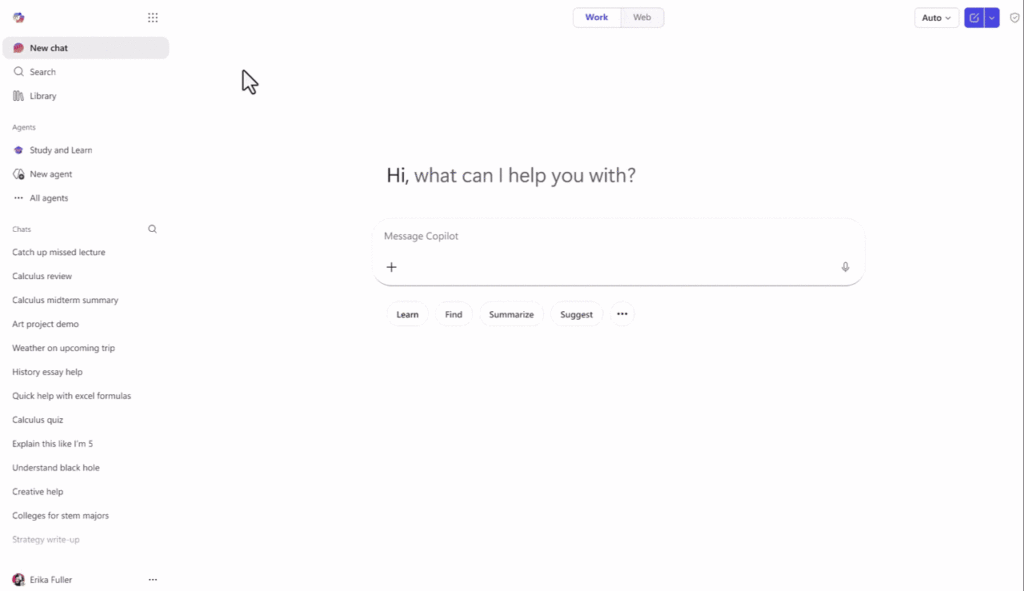
At the center of Microsoft’s new offerings is the Study and Learn Agent, a specialized experience within Copilot Chat tailored for students aged 13 and older. Unlike standard chatbots that provide direct answers to queries, the Study and Learn Agent is built on research-based principles of scaffolding and active recall. This tool is designed to act as an interactive coach that guides students through complex problems without performing the work for them.
The Study and Learn Agent utilizes several key pedagogical strategies to enhance knowledge retention:
- Scaffolded Questioning: Instead of providing a solution to a physics problem or a historical inquiry, the AI asks leading questions that prompt the student to retrieve information or apply logic.
- Interactive Practice: The tool can instantly generate flashcards, quizzes, and matching exercises based on the specific curriculum the student is currently studying.
- Immediate Feedback: Students receive real-time corrections and explanations, allowing them to identify misconceptions before they become ingrained habits.
This experience is provided at no additional cost to institutions using Microsoft 365 Education. To ensure safety and institutional alignment, IT administrators retain full control, requiring them to enable Copilot Chat for K-12 students before the Study and Learn Agent becomes accessible. Future updates are expected to allow educators to assign specific modules within the Study and Learn environment directly through Microsoft Teams Assignments.

Enhancing Educator Workflows and Institutional Governance
For educators, the focus of the new AI capabilities is the reduction of "drudge work" to allow for more direct student engagement. New intelligent experiences are being integrated into the daily workflows of Microsoft 365, moving beyond simple text generation to complex unit planning and curriculum mapping. These tools allow teachers to input learning objectives and receive structured lesson plans that are grounded in established educational standards.
The introduction of Copilot Notebooks further bridges the gap between student materials and AI assistance. This workspace allows students to aggregate lecture slides, handouts, and personal notes into a single, secure environment. The AI then assists the student by grounding its responses exclusively in those uploaded sources, minimizing the risk of "hallucinations" or the inclusion of irrelevant external data. This "grounded" approach ensures that the AI remains a relevant study aid for the specific curriculum taught in the classroom.
To streamline access, Microsoft has introduced "Teach and Learn" taskbar shortcuts on Windows devices. These shortcuts provide one-click access to personalized AI tools, reducing the friction often associated with adopting new software. For IT leaders, these features are designed with institution-wide rollout in mind, featuring robust governance and security protocols that comply with global data protection regulations.
Addressing the Training Gap and the AI Literacy Framework
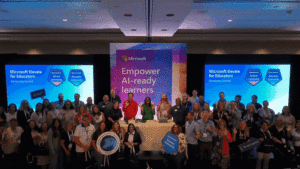
The technical deployment of AI is only one half of the equation; the other half is the human capacity to use it effectively. Microsoft Elevate for Educators has been expanded to meet the demand for professional development. This program offers community support, credentials, and capacity-building resources aimed at helping school leaders navigate the complexities of digital transformation.

In a move toward global standardization, Microsoft has collaborated with the European Commission and the OECD, alongside CodeAI, to support the AI Literacy Framework. This framework serves as a comprehensive playbook for policymakers and curriculum designers, outlining what students should understand about AI at various stages of their educational journey. It covers technical understanding, ethical considerations, and practical application.
Furthermore, a new "AI Literacy for Educators" credential pathway has been released in partnership with ISTE (International Society for Technology in Education) and ASCD. This pathway is designed to move teachers from basic awareness to expert-level implementation. Educators can now apply for the Expert tier of Microsoft Elevate for Educators, which provides advanced training on integrating AI into diverse subject areas while maintaining academic integrity.
Implications for the Future of Pedagogy and Assessment
The shift toward AI as a "learning coach" carries significant implications for how student success is measured. Traditional homework assignments, which often focus on the final output, are becoming less effective as a metric of understanding in an age of generative AI. Experts suggest that the focus of assessment will likely shift toward the "process" of learning. By using tools like the Study and Learn Agent, educators can gain insights into how a student arrived at an answer, the types of questions they asked, and the areas where they struggled.
There is also a broader socioeconomic implication to consider. By integrating these advanced tools into the standard Microsoft 365 Education package at no additional cost, there is a concerted effort to prevent a "digital AI divide." Ensuring that students in various geographic and economic contexts have access to high-quality, secure AI tools is essential for equitable career preparation.

However, the transition is not without challenges. Institutional leaders must grapple with the ethics of data usage and the potential for over-reliance on automated systems. The 2026 report highlights that while the desire for AI is high, the need for "clearer guidance on responsible use" remains a top priority for 52% of students. This suggests that the next few years will require a delicate balance between technological adoption and the development of robust ethical guidelines.
As the 2026-2027 academic year approaches, the focus for Microsoft and the wider educational community remains on building confidence. The goal is to move past the novelty of AI and treat it as a foundational utility—much like the calculator or the internet before it—that, when used responsibly, can significantly enhance the human element of teaching and learning. Through a combination of student-centered tools, educator-focused efficiency, and global literacy frameworks, the groundwork is being laid for a future where AI does not replace the teacher, but rather empowers the learner.