



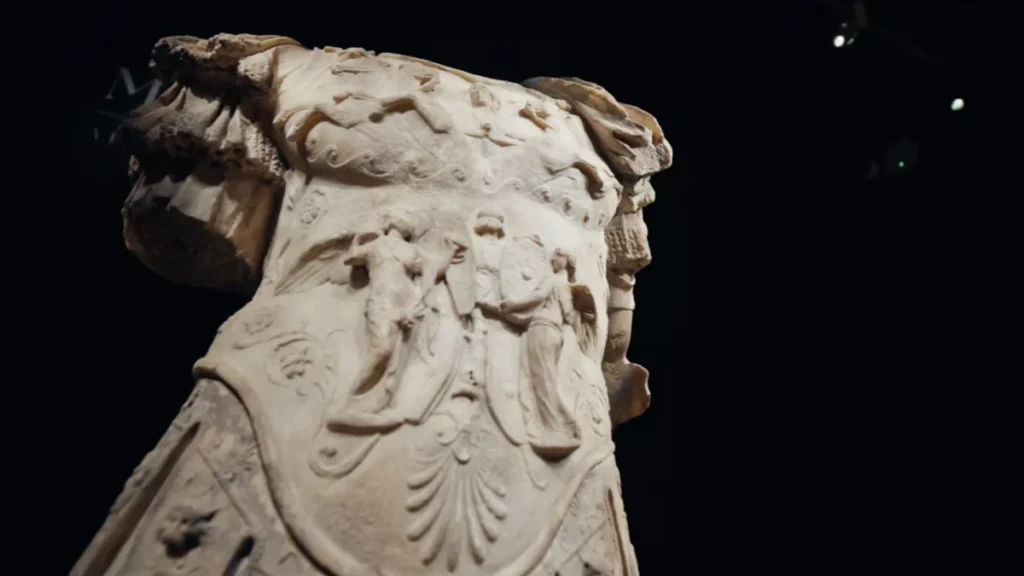
A rare, intricately carved 2,000-year-old marble sculpture of an emperor’s chestplate, scheduled for auction this month at Sotheby’s, offers an extraordinary window into the mechanics of ancient Roman propaganda and territorial control. Dating back to the Julio-Claudian dynasty, the artifact was originally housed in a prominent temple in Salona—a major Roman urban center in present-day Croatia. Far more than a static piece of decorative art, the torso served as a calculated psychological instrument designed to impress upon recently conquered populations the absolute, unyielding authority of the expanding Roman Empire.
The upcoming sale has drawn intense interest from international art collectors, museum curators, and historians alike. As specialists prepare to bring the artifact to the auction block on October 21, the piece has sparked renewed academic discussion regarding how visual iconography was standardized and deployed across the Mediterranean basin during the formative decades of the Pax Romana.
Main Facts and Physical Characteristics of the Sculpture
The sculpture is a well-preserved marble torso depicting a cuirass, the decorative military breastplate worn by high-ranking Roman commanders and emperors. Crafted during the Julio-Claudian era—a foundational period stretching from 27 BCE to 68 CE that encompassed the reigns of Rome’s first five emperors: Augustus, Tiberius, Caligula, Claudius, and Nero—the fragment exemplifies the pinnacle of classical stone-carving craftsmanship.
The artifact was sculpted from Parian marble, a material quarried exclusively from the Aegean island of Paros. Prized since antiquity for its fine, uniform grain and luminous crystalline quality, Parian marble allowed sculptors to achieve extraordinary depth, subtlety, and durability in relief carvings.
While the head and limbs of the sculpture are missing, this absence is historically consistent with the functional life of such monuments. In ancient Roman civic and religious architecture, imperial statues placed inside provincial temples were frequently modular by design. Heads and limbs were often carved separately or updated dynamically whenever a new emperor ascended to the throne, ensuring that the local population continually looked upon the likeness of the reigning sovereign without the expense and labor of commissioning entirely new monuments.
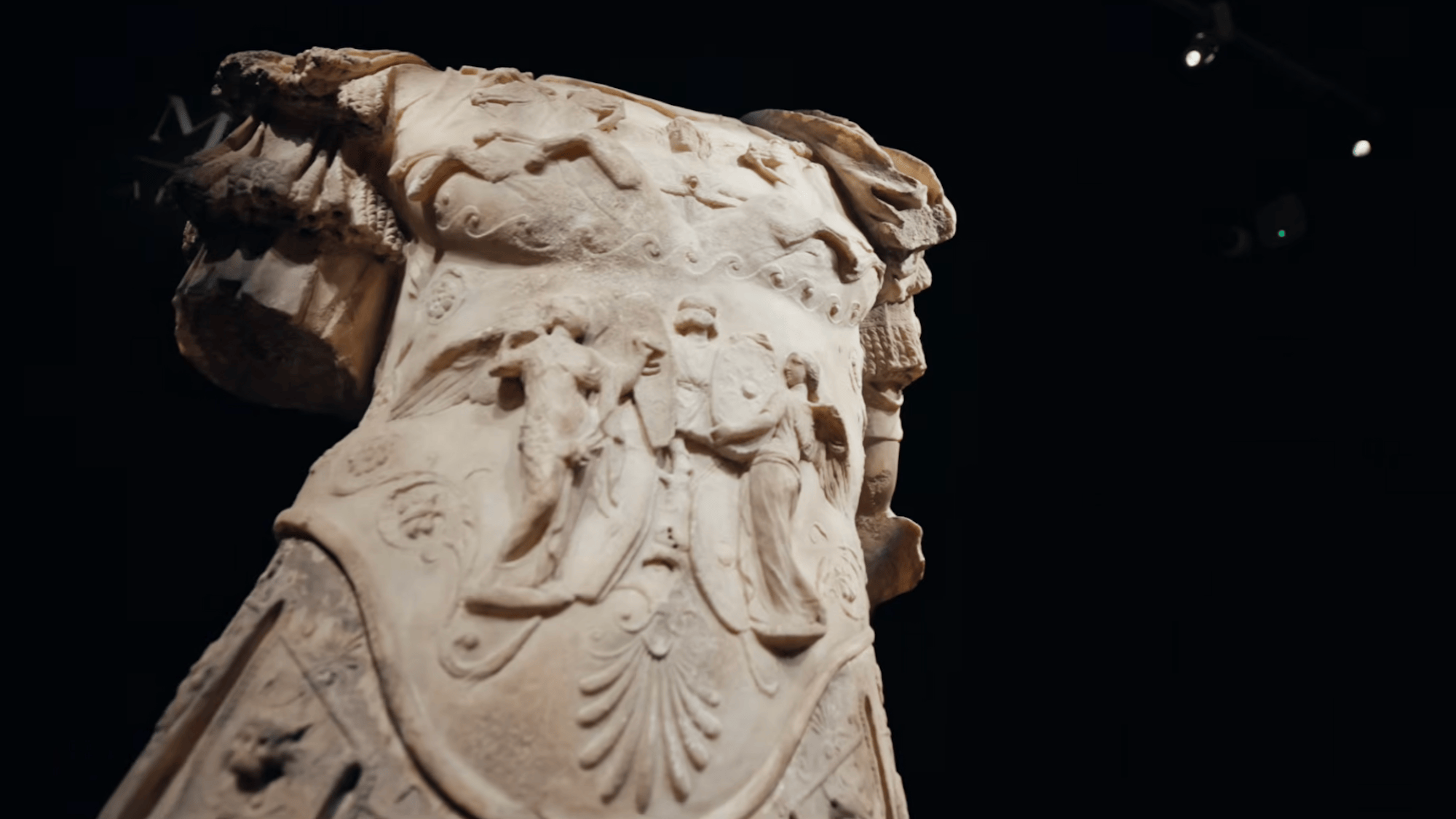
The iconography packed into the relatively small surface area of the chestplate is densely layered with political and cosmological symbolism. At the exact center of the cuirass is a depiction of Sol, the Roman sun god, driving his quadriga—a chariot pulled by four horses—across the sea to herald the dawn of a new day. According to art historians and antiquities specialists, this imagery was chosen deliberately to communicate the triumph of Roman order, civilization, and light over chaos and barbarism.
Flanking and positioned below the solar imagery are depictions of the goddess Victoria. She is shown standing on either side of a tropaeum, a traditional Roman victory monument constructed from the captured shields, weaponry, and armor of defeated adversaries, complete with the symbolic rendering of a conquered enemy’s head. Additional defensive and apotropaic symbols, including miniaturized ram and feline faces etched onto overlapping leather straps (pteruges), were meant to project brute strength and ward off malevolent forces.
Historical Context and Chronological Background
To fully understand the significance of the Salona torso, historians examine the volatile geopolitical climate of the early Roman Empire. During the Julio-Claudian period, Rome transitioned rapidly from a fractured republic into a sprawling, centralized autocracy. Consolidating authority across newly annexed territories required more than military garrisons; it demanded a pervasive ideological framework that could convince diverse populations of the inevitability of Roman rule.
The chronology of this era underscores the urgency of such propaganda:
- 27 BCE: Octavian is granted the title Augustus by the Roman Senate, marking the official beginning of the Roman Empire and the dawn of the Julio-Claudian dynasty.
- Early 1st Century CE: Rome aggressively expands its borders along the Danube and Balkan regions, annexing territories such as Dalmatia, where the ancient city of Salona served as a vital administrative and military hub.
- Mid-1st Century CE: Imperial Cult temples proliferate throughout the provinces. Statues of the emperor are consecrated alongside traditional deities to merge civic loyalty with religious devotion.
- 68 CE: The Julio-Claudian dynasty collapses with the suicide of Nero, ending an era defined by rapid artistic standardization and aggressive provincial integration.
In towns like Salona, which served as a crucial bridge between the Italian peninsula and the Danubian provinces, establishing cultural hegemony was paramount. Conquered communities frequently harbored resentment toward occupying authorities, making visual reminders of Rome’s military might and divine mandate essential for maintaining public order. By placing monumental cuirass sculptures in local temples, the Roman administration ensured that every citizen who entered sacred spaces was visually confronted with the physical embodiment of imperial power.
Expert Analysis and Curatorial Perspectives
The strategic use of art as an instrument of statecraft has been a focal point for modern antiquities scholars. Alexandra Olsman, an antiquities specialist focusing on sculpture and works of art at Sotheby’s, emphasized the intentionality behind the design in an official video feature released by the auction house.

"The Romans at this period in time were asking, ‘How does this convey power? How do you legitimize a new imperial structure? What iconography do you land on to convey these things?’" Olsman noted, describing the piece as a physical manifestation of "Rome becoming Rome."
Art historians point out that the cuirass served a dual psychological purpose. For the Roman citizenry and soldiers stationed abroad, it offered a comforting continuity of home and state ideology. For the local, conquered populace, it functioned as an omnipresent reminder of the empire’s vast resources, divine favor, and inescapable reach. The meticulous integration of solar mythology, martial victory, and apotropaic warding symbols transformed a block of Parian marble into a sophisticated political manifesto.
Market Implications and Broader Significance
The appearance of such a well-documented and historically rich Julio-Claudian artifact on the open market highlights the enduring allure of classical antiquities among high-end collectors and institutional buyers. While private auctions of ancient art occasionally face complex ethical scrutiny regarding provenance and cultural heritage laws, pieces with clear, established histories continue to command significant attention from the international art community.
Beyond its monetary valuation, the impending sale has provided a rare catalyst for public education regarding ancient political communication. In an era where modern governments continuously adapt visual media to project national strength and ideological alignment, the Salona torso reminds observers that the foundations of political branding were meticulously engineered two millennia ago in the marble workshops of the ancient Mediterranean.
As the October 21 auction date approaches, conservationists and historians hope that the buyer—whether a private collector or a public institution—will ensure the artifact remains accessible for academic study, preserving a tangible fragment of the machinery that built the Roman world.