



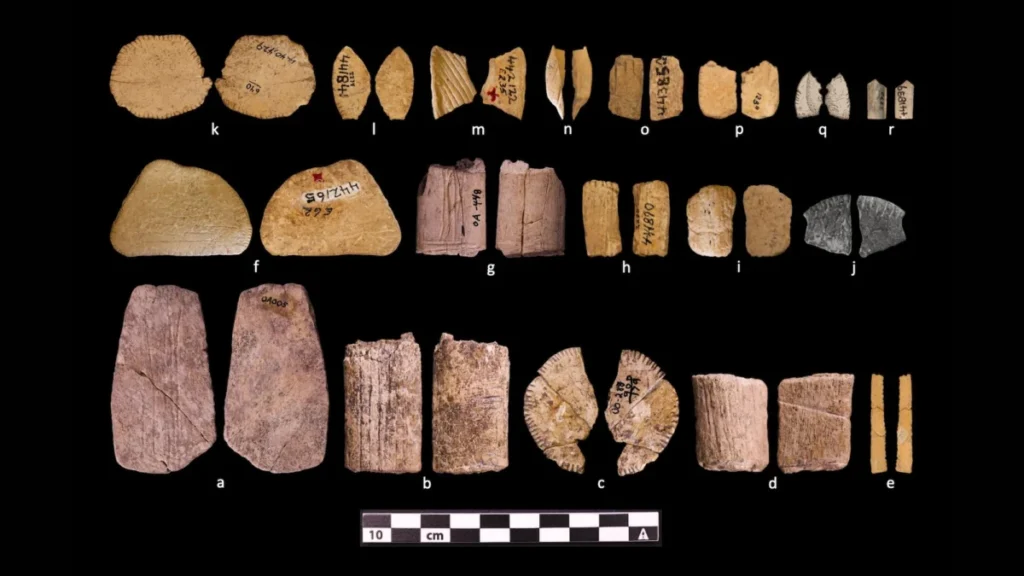
The long-held archaeological consensus regarding the origins of human gambling and the study of probability has been fundamentally challenged by new research published in the journal American Antiquity. For over a century, historians and scientists have largely maintained that the formal exploration of randomness and games of chance was a hallmark of the Bronze Age in the "Old World," originating roughly 5,500 years ago in the urbanizing societies of the Middle East, India, and Asia. However, a comprehensive analysis of artifacts from the western Great Plains of North America reveals that Indigenous hunter-gatherer communities were utilizing dice and other probability tools as early as 12,000 years ago, during the Late Pleistocene. This discovery pushes the timeline of probabilistic thinking back by more than 6,000 years, suggesting that the intellectual foundations of mathematical risk were being laid in the Americas while much of the globe was still emerging from the last Ice Age.
Challenging the Eurocentric Narrative of Innovation
The discovery, led by Colorado State University archaeologist Robert Madden and a team of researchers, indicates that the development of dice and games of chance was not an exclusive innovation of the sedentary civilizations of the Eastern Hemisphere. Historically, the presence of multisided dice at sites in the Indus Valley or ancient Mesopotamia was seen as a marker of advanced social complexity. These tools were often linked to the rise of statehood, trade, and organized religion, where they served dual purposes in both recreation and divination.
By re-examining North American artifacts with modern systematic analysis, Madden’s team has demonstrated that nomadic hunter-gatherers in the Americas possessed an equally sophisticated understanding of randomness. The research suggests that the ability to conceptualize and manipulate "odds" was a vital tool for survival and social cohesion in the harsh environments of the Late Pleistocene. This shift in perspective forces a re-evaluation of the cognitive and cultural capabilities of ancient Indigenous populations, who have often been excluded from the global history of mathematical and social innovation.
A Chronology of Chance: From the Ice Age to the Present
The timeline of dice usage in North America, as established by the new study, spans an incredible 12,000 years, providing a continuous record of gaming that survived through radical environmental and social shifts.
- The Late Pleistocene (12,800–12,200 years ago): The earliest evidence of dice tools emerges from sites in present-day Wyoming, New Mexico, and Colorado. These artifacts, known as binary lots, were used by Clovis and post-Clovis Paleo-Indian cultures.
- The Archaic Period (8,000–2,000 years ago): As the climate stabilized and populations grew, the use of dice expanded across the Great Plains and into the Great Basin. The tools became more varied in material, incorporating different types of bone and stone.
- The Pre-Contact Era (1,000 years ago to 1492): Gaming became deeply integrated into the social fabric of larger tribal confederacies. Dice games were often tied to seasonal gatherings and inter-tribal trade fairs.
- The Post-European Contact Period (16th Century–1907): Despite the devastating impact of colonization, Indigenous gaming traditions persisted. In 1907, ethnographer Stewart Culin documented nearly 300 sets of dice still in use or preserved within tribal communities, providing the data set that would eventually lead to the current breakthrough.
Methodology: Rediscovering Evidence Hidden in Plain Sight
The breakthrough did not come from a new excavation, but rather from a rigorous re-evaluation of existing museum collections and previously published archaeological reports. For decades, many of the items now identified as dice were categorized by archaeologists under the vague heading of "worked bone" or "gaming pieces" without a clear understanding of their specific function.
Madden and his colleagues utilized a newly designed systematic analysis to categorize 600 artifacts from 57 different sites across 12 U.S. states. The researchers focused on "binary lots"—flat, two-sided tools typically carved from small animal bones. Unlike the cubic dice common in modern casinos, these lots functioned through the tossing of multiple pieces at once.
To be classified as a probability tool, each artifact had to meet specific criteria:
- Intentional Modification: The bone had to show clear signs of carving, smoothing, or shaping that served no utilitarian purpose (such as for a needle or scraper).
- Distinctive Markings: One side of the lot was typically marked with incisions, notches, or dyes, while the other remained plain. This created a binary (yes/no or 1/0) outcome for each piece.
- Consistency in Form: The pieces were often found in sets, suggesting they were intended to be used together to create a range of probabilistic outcomes.
"In most cases, these objects had already been excavated and published," Robert Madden stated. "What was missing wasn’t the evidence, it was a clear, continent-wide standard for recognizing what we were looking at."
The Social Technology of Gambling
The implications of the study extend beyond mere entertainment. The researchers argue that these dice served as "social technologies." In the context of the Late Pleistocene, where groups were often small and mobile, interacting with "strangers" or neighboring bands carried significant risk.
Games of chance provided a neutral, rule-governed environment where different groups could interact without the immediate threat of conflict. Gambling acted as a mechanism for:
- Resource Distribution: Goods, tools, and food could be exchanged through games, serving as a primitive form of economic circulation.
- Information Exchange: While playing, groups shared vital information about migrating herds, weather patterns, and the location of high-quality lithic materials for tool-making.
- Alliance Building: High-stakes games created social bonds and obligations between individuals and families, strengthening the regional network of hunter-gatherer societies.
- Uncertainty Management: In a world governed by unpredictable environmental factors, the act of "playing with chance" may have served a psychological or ritualistic purpose, helping communities process the concept of luck and fate.
Gender Dynamics: The Role of Women in Ancient Innovation
One of the most striking findings of the study involves the demographic makeup of those who used these tools. By analyzing 131 historical and ethnographic accounts of Indigenous gaming, the researchers found a significant gender imbalance. According to the data, 81 percent of the recorded dice games were played exclusively by women. An additional 12 percent were played by both sexes, while only 7 percent were played by men alone.
This historical pattern suggests that women may have been the primary drivers of probabilistic thinking and social gaming in North American history. While men’s roles in Paleo-Indian societies are often associated with hunting and tool-making, women may have been the architects of the social and intellectual frameworks that governed community interaction.
"Additional research could shed light on whether this historical pattern extends into the prehistoric past," the study’s authors noted. If the gender distribution of the Pleistocene mirrored that of the historical period, it would mean that women were the leaders in the social and intellectual innovations associated with ancient Native American dice and gambling.
Analytical Implications: Mathematics and Cognition
The existence of dice 12,000 years ago suggests that the human brain’s capacity for complex mathematical reasoning—specifically the understanding of probability—is not a byproduct of "civilization" or agriculture. Instead, it appears to be a fundamental trait of the human species that emerges whenever social conditions require a way to manage risk and interaction.
From a mathematical perspective, the use of multiple binary lots (tossing several two-sided pieces) demonstrates an intuitive grasp of combinatorial probability. For example, tossing four binary lots results in various combinations (all marked, all plain, or mixtures thereof), each with different statistical likelihoods. The scoring systems used by Indigenous groups often reflected these odds, with rarer combinations yielding higher points—a clear indication of probabilistic logic.
Conclusion and Future Research
The work of Madden and his team serves as a corrective to the historical record, elevating the cultural and intellectual legacy of Indigenous North Americans. By identifying these "simple, elegant tools" as the precursors to modern probability theory, the study bridges the gap between the ancient past and contemporary science.
As archaeologists continue to apply these new systematic standards to other collections, it is likely that even more evidence of early gaming will emerge from across the Americas. This research not only changes our understanding of the Ice Age but also honors the sophisticated social lives of the people who navigated it. The dice found in the soil of Wyoming and Colorado are more than just artifacts; they are evidence of a 12,000-year-old human desire to understand, challenge, and play with the odds of existence.