


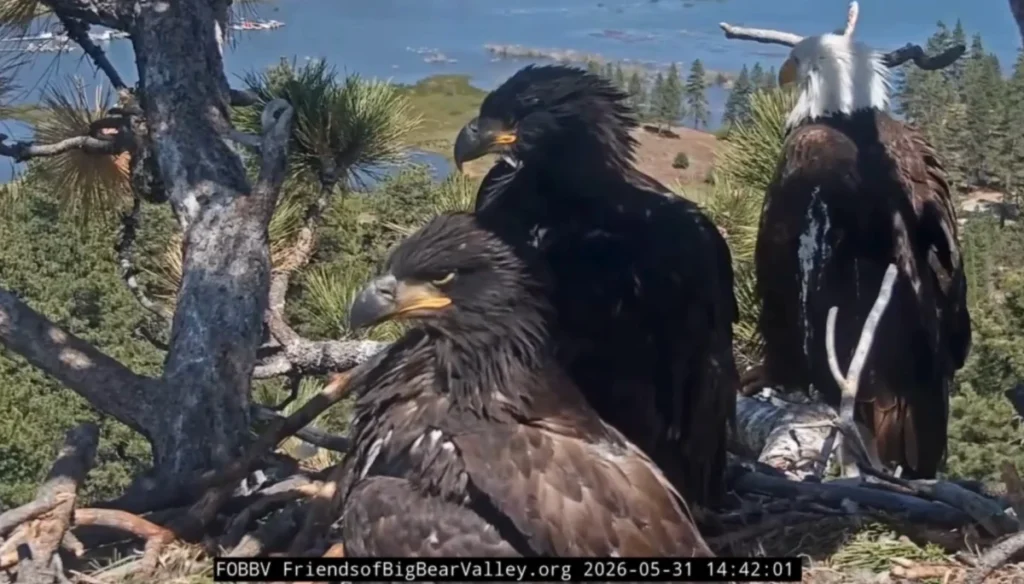
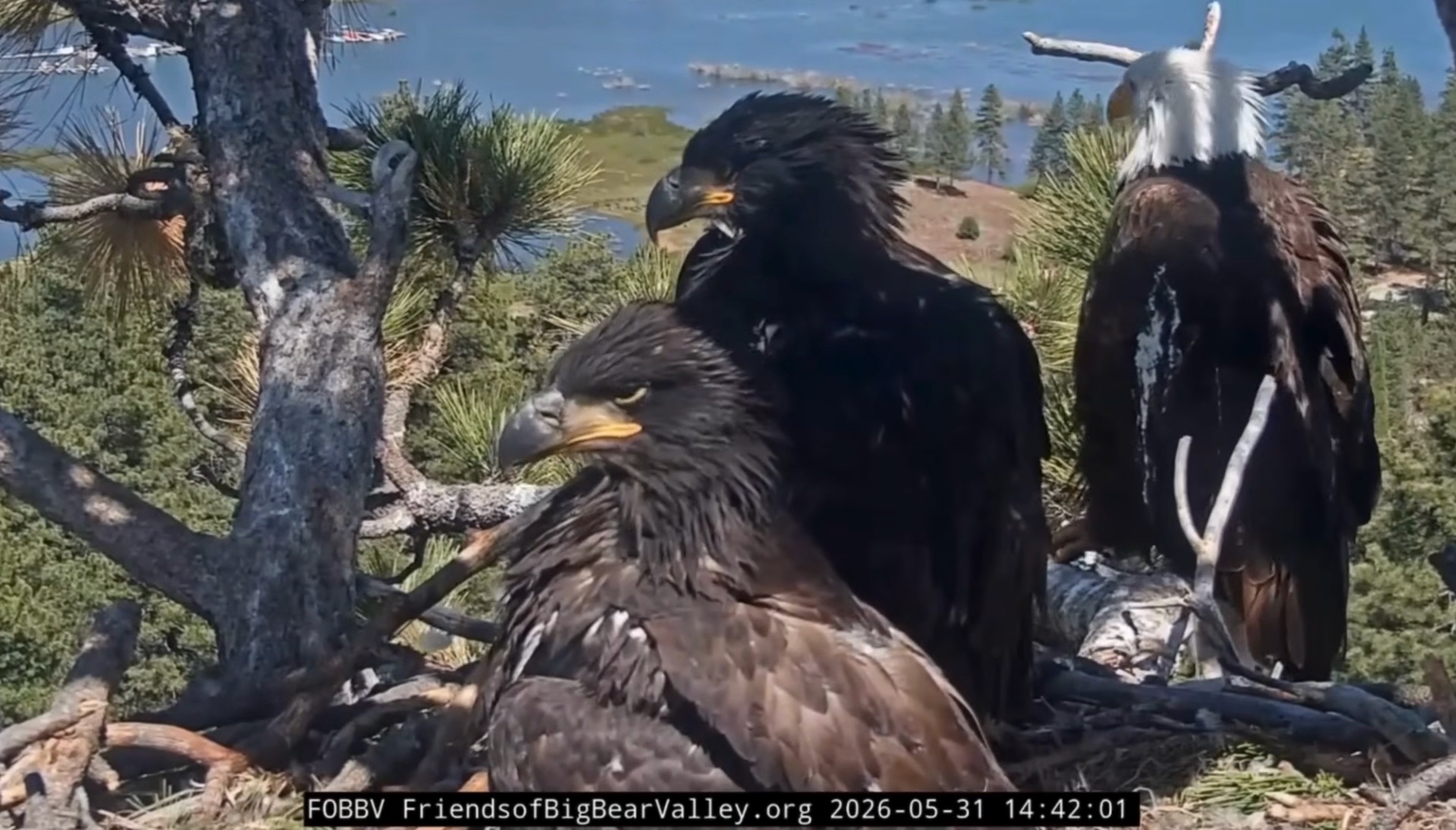
In the high-altitude canopy of the San Bernardino National Forest, a nocturnal confrontation recently highlighted the complex ecological dynamics of one of the world’s most-watched avian families. Jackie and Shadow, the internet-famous bald eagle pair of Big Bear Valley, have spent the 2026 breeding season under the watchful eyes of millions via a 24-hour livestream. While the primary focus remains on the development of their two newest eaglets, Sandy and Luna, a series of interactions between May 30 and May 31 underscored the constant vigilance required to maintain a nest in a high-biodiversity environment.
The nonprofit organization Friends of Big Bear Valley (FOBBV), which maintains the camera equipment and monitors the nest, reported that a local resident known as Fiona the squirrel made several unauthorized appearances at the nest site overnight. Fiona is a San Bernardino flying squirrel, a nocturnal subspecies that shares the ancient pine tree with the eagles. During one particular visit, Jackie, the female bald eagle, demonstrated that her maternal instincts extend well into the night. As the squirrel approached the sleeping family, Jackie responded with what observers described as a "dramatic slap" and vocalizations intended to drive the rodent away. This interaction, while seemingly minor, provides a rare glimpse into the interspecies competition and territorial management that occurs in the wild when the sun goes down.
A Chronology of the 2026 Nesting Season
The 2026 season has been characterized by a mixture of early tragedy and subsequent triumph. To understand the significance of Jackie’s defensive behavior, it is necessary to examine the timeline of events that led to the current state of the nest.
The season began in January 2026 with a significant setback. Jackie and Shadow had successfully produced their first two eggs of the year, but the nest was left momentarily unattended during a period of high predator activity. Common ravens (Corvus lax), known for their intelligence and opportunistic feeding habits, breached the nest and destroyed both eggs. This event sparked a wave of concern among the global community of "eagle-watchers," as the loss of a first clutch can often signal the end of a breeding year.
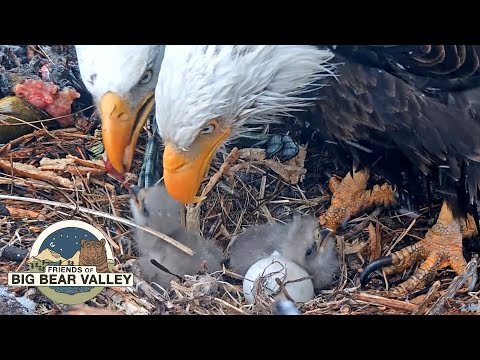
However, Jackie and Shadow demonstrated the resilience common to their species. Shortly after the loss, Jackie laid a second clutch of two eggs. The incubation period, which typically lasts around 35 days, was monitored with intense scrutiny. On April 4, 2026, at approximately 9:33 p.m. PDT, the first chick, later named Sandy, successfully hatched. The following morning, April 5, at 8:30 a.m., the second chick, Luna, emerged.
Since their hatching, the focus of the parents has shifted from incubation to protection and provisioning. The recent encounter with Fiona the squirrel is part of a broader pattern of nest defense. While ravens are the primary threat during the egg stage, the presence of nocturnal mammals and other birds of prey becomes a secondary concern as the chicks grow.
Biological Profile: The San Bernardino Flying Squirrel
The "intruder" in this scenario, the San Bernardino flying squirrel (Glaucomys sabrinus californicus), is a subspecies of the Humboldt’s flying squirrel. According to the United States Fish and Wildlife Service, these creatures are strictly nocturnal and are uniquely adapted to the coniferous forests of Southern California. Unlike "true" flight seen in birds, these squirrels utilize a specialized membrane called a patagium to glide between trees, covering distances of up to 300 feet in a single leap.
FOBBV researchers have identified at least two regular visitors to the eagle tree, nicknamed Fiona and Fast Freddie. While flying squirrels primarily subsist on a diet of truffles (fungi), conifer seeds, and lichens, they are also opportunistic scavengers. Volunteers for FOBBV have noted that these squirrels are frequently attracted to the eagle nest to forage for food scraps left behind by the raptors. This includes fish tails, coot feathers, eggshells, and even large beetles.
While flying squirrels do not typically pose a direct predatory threat to healthy eaglets of Sandy and Luna’s size, their presence is a nuisance. Jackie’s "slap" was a behavioral correction designed to maintain the sanctity of the nesting bowl. Following the interaction, the eaglets were observed practicing their own defensive maneuvers, including wing-flapping and "squirrel-shooing" postures, which are essential skills they must master before fledging.

Supporting Data: Survival Rates and Environmental Pressures
The survival of bald eagle eaglets is subject to a variety of statistical hurdles. Biological data suggests that only about 50 percent of bald eagle eggs successfully hatch in the wild. Jackie and Shadow’s ability to produce a second successful clutch after losing the first is a testament to their experience as a pair, having been together since 2018.
Once hatched, the challenges do not diminish. Eaglets remain in the nest for approximately 10 to 14 weeks. During this period, they are vulnerable to:
- Predation: Hawks, ravens, and owls are the primary threats.
- Weather: High-altitude environments like Big Bear Valley are prone to sudden, severe storms. In March 2025, a snowstorm depositing two feet of snow resulted in the death of one of the pair’s three chicks.
- Fledging Risks: The transition from the nest to independent flight is the most dangerous phase. Approximately 70 percent of eaglets survive their first year.
Data from the Audubon Society indicates that human-related factors also play a significant role. For young eagles that survive the initial flight, the greatest threats include collisions with vehicles while scavenging roadkill and lead poisoning from ingesting fragments in carcasses left by hunters.
Historical Context of the Jackie and Shadow Partnership
Jackie and Shadow have become an ecological phenomenon due to the longevity of their partnership and the transparency of their lives through technology. Since 2018, they have successfully fledged chicks in 2019 and 2022. However, they have also experienced significant fallow periods. Their eggs failed to hatch in both 2023 and 2024, leading to public discussions about the impacts of environmental stress and age on avian fertility.
The 2025 season was particularly poignant for the community. After all three eggs hatched in early March, a violent snowstorm battered the San Bernardino National Forest. Despite Jackie’s efforts to shield the chicks with her own body, one succumbed to the freezing temperatures. The two survivors, Sunny and Gizmo, eventually fledged, providing a narrative of hope that has carried over into the current 2026 season with Sandy and Luna.

Official Responses and Conservation Efforts
The Friends of Big Bear Valley have leveraged the popularity of the livestream to advocate for broader conservation measures. One of the most pressing issues is the preservation of the eagles’ foraging grounds. Bald eagles are highly dependent on the fish populations of Big Bear Lake and the surrounding meadows for hunting.
Environmental groups are currently engaged in a fundraising campaign to secure $10 million for the "Save Moon Camp" initiative. The goal is to protect a critical foraging area near the nest from residential and commercial development. Proponents argue that the presence of Jackie and Shadow serves as an "umbrella species" effect—by protecting the habitat required for the eagles, they inadvertently protect the entire ecosystem, including the very flying squirrels that Jackie occasionally has to slap away.
In a statement regarding the recent squirrel encounter, FOBBV emphasized the importance of observing these natural behaviors without human intervention. The organization maintains a strict policy of non-interference, allowing the "drama" of the nest to unfold as it would in a wilderness area untouched by cameras.
Broader Implications and Analysis
The interaction between a bald eagle and a flying squirrel is more than just a viral moment; it is a micro-study in niche partitioning and competition. Jackie and Shadow occupy the apex predator niche during the day, while Fiona and Fast Freddie occupy the scavenging niche at night. The nest serves as a focal point where these two worlds collide.
Furthermore, the 2026 season highlights the role of citizen science in modern conservation. The data collected by thousands of viewers—tracking feeding times, types of prey brought to the nest, and interspecies interactions—provides a wealth of information that would be impossible for a small team of biologists to gather alone. This "crowdsourced" monitoring has allowed for a more granular understanding of how bald eagles adapt to the presence of other species and how they manage the energy trade-offs between sleep and nest defense.
As Sandy and Luna approach the 10-week mark, the frequency of these interactions is expected to increase. The eaglets are becoming more mobile and curious, often peering over the edge of the nest to observe the world below. Their eventual departure from the nest will mark the end of another chapter in a saga that has captivated a global audience, serving as a reminder of the delicate balance required to sustain life in the wild.
The 2026 nesting season continues to be a success story for Jackie and Shadow. Despite the loss of their initial eggs and the nightly incursions of persistent squirrels, the pair has demonstrated the resilience of the Haliaeetus leucocephalus species. For now, the "Queen of Big Bear" remains in control, ensuring that her offspring have the best possible chance of reaching the skies.