


The modern enterprise is currently grappling with a paradox of implementation: while artificial intelligence investments are surging, the gap between tool deployment and operational proficiency remains stubbornly wide. For many organizations, the strategy for integrating AI has followed a traditional, top-down "cascade" model. A chief learning officer or executive team identifies a solution, mandates its rollout across business units, creates a standardized curriculum, and tracks progress via high-level dashboards. However, after 18 months of intensive focus, many firms report a stark divergence in results. While some teams have successfully woven AI into their workflows to achieve newfound speed and precision, others have relegated the technology to an unclicked tab, treating the initiative as a temporary mandate to be ignored until it fades.
This failure to achieve uniform adoption is rarely a matter of technological friction; rather, it is a failure of knowledge circulation. When an organization treats AI implementation as a purely technical hurdle to be cleared, it ignores the human-centered design necessary to foster trust, judgment, and psychological safety. In the current corporate environment, where capability requirements shift at the speed of leadership attention rather than academic curriculum cycles, the inability to move knowledge through the organization effectively acts as a bottleneck to competitive advantage.
The Anatomy of the Adoption Gap
The root cause of this stagnation lies in the cultural costs of experimentation. Employees who successfully integrate AI into their work often treat their discoveries as proprietary, failing to share their insights with peers. Conversely, teams that struggle to utilize the tool remain silent to avoid the appearance of professional incompetence. In a high-stakes corporate environment, admitting that one "doesn’t know what they are doing" with a new tool carries the risk of being labeled as behind the curve. Simultaneously, those who develop clever workarounds to overcome the tool’s limitations fear that surfacing their methods will be perceived as "going rogue."
This silence is systemic. By the time a formal refresher course is scheduled by the central learning and development (L&D) team, the underlying technology has typically evolved, rendering the previous curriculum obsolete. Because knowledge is not circulating horizontally among peers, and because the vertical feedback loop is either too slow or too punitive, the organization effectively loses the collective intelligence generated by its own workforce.
The Shift Toward Executive-Led AI Strategy
The urgency of this issue is reflected in the current global economic landscape. According to recent data from the Boston Consulting Group (BCG), 72 percent of CEOs are now personally directing AI strategy, signaling that artificial intelligence has moved from a back-office IT concern to a primary boardroom priority. Organizations are planning to roughly double their AI investment as a share of total revenue over the coming years.
Despite this heightened level of executive engagement, Deloitte’s Global Human Capital Trends report reveals a significant misalignment in strategy. While seven in 10 business leaders identify speed and organizational nimbleness as their top competitive priorities through 2029, nearly 60 percent of organizations still pursue a purely tech-focused approach to AI implementation. Data suggests that this technical-heavy focus is counterproductive: organizations that prioritize human-centered design alongside their technological infrastructure are 1.6 times more likely to achieve their projected return on investment than those that do not.
The Crisis of Managerial Readiness
The burden of this transition often falls on middle management, yet this is precisely where the system is weakest. The 2026 Global Learning and Skills Trends Report from Udemy highlights a profound disconnect between employee expectations and managerial capability. While 88 percent of employees surveyed consider effective leadership to be the critical factor in the success of AI initiatives, less than half—only 48 percent—believe their own managers possess the necessary proficiency to lead them through this transformation.
This creates a "reinforcement gap." L&D departments rely on managers to normalize the use of new tools and provide the psychological safety required for employees to experiment. If the manager is perceived as unprepared or unwilling to acknowledge their own limitations, the team is unlikely to engage authentically with the AI, choosing instead to pay lip service to the rollout.
From Single-Loop Cascades to Double-Loop Circulation
To solve the circulation problem, organizations must move away from the traditional "cascade" model—where information flows in one direction from the top down—and toward a system of "double-loop learning." In management theory, single-loop learning focuses on correcting errors within an existing framework. Double-loop learning, however, requires the organization to question the underlying assumptions that created the process in the first place.
A cascade is inherently a single-loop system. It can adjust output, but it cannot interrogate the logic beneath the workflow. A circulation model, by contrast, treats the frontline not as the final destination of a directive, but as a vital source of data. By establishing multidirectional feedback loops, leadership can transform the organization into a sensing system that detects when a tool is not meeting the needs of the business and adapts in real-time.

For these loops to function, they must be predicated on two conditions:
- Employees must believe that their feedback will lead to tangible changes.
- Employees must be certain that expressing difficulty or confusion will not result in negative performance repercussions.
The Role of Rapid-Cycle Inquiry
Leading organizations are finding success through "rapid-cycle inquiry," a methodology characterized by short, structured bursts of authentic listening. Rather than relying on annual engagement surveys, these companies utilize flash focus groups and brief, real-time workflow walk-throughs.
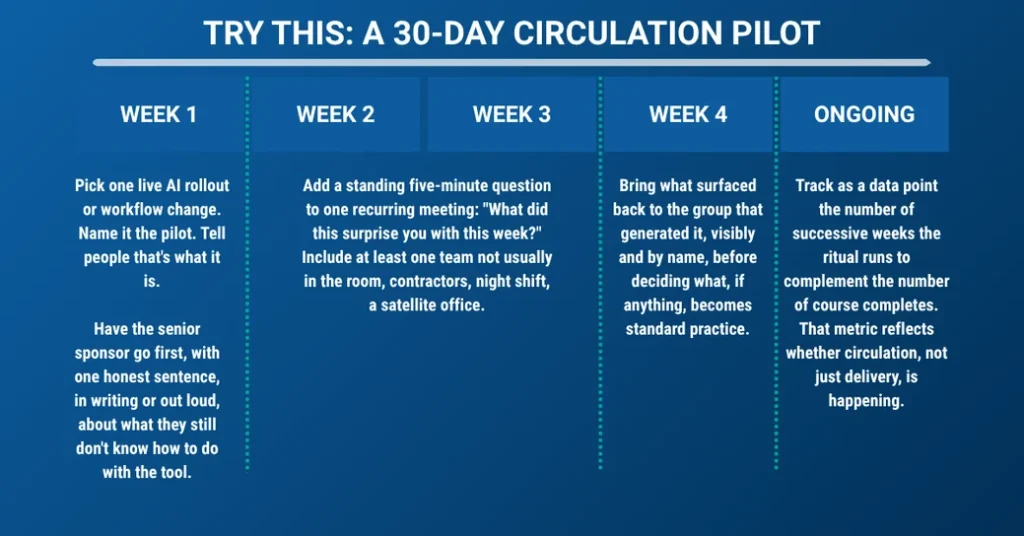
One effective strategy involves a simple, ritualized question posed in leadership meetings: "What are we assuming about this tool that we haven’t tested?" When a senior leader asks this of themselves first, they model an "inquiry mindset." This visibility of uncertainty removes the stigma of not knowing, allowing team members to feel secure enough to share their own struggles and discoveries. Within a few quarters, this practice can uncover innovative workarounds that might have otherwise remained hidden in the shadows of the organization.
Equitable Knowledge Distribution
A significant risk in building a circulatory model is the potential for power concentration. In many firms, the individuals most likely to be noticed for their AI experimentation are those already close to institutional power—those who are visible, well-connected, and fluent in corporate jargon. If the circulation of knowledge is left to chance, it will naturally gravitate toward those who are already at the table, leaving frontline and support staff further marginalized.
To avoid this, L&D leaders must intentionally build systems that incorporate input from across the entire organizational spectrum, including contract staff, night-shift workers, and teams in diverse geographic regions. This requires moving beyond the standard organizational chart and toward "trait-mapping," where specific human strengths—such as interpersonal sensitivity, critical analysis, or creative execution—are matched to active projects rather than static job descriptions.
AI as a Listening Partner
Paradoxically, the very technology that necessitates these cultural changes can also be used to facilitate them. "Agentic AI" systems are now capable of recognizing patterns in workflow, identifying when teams are diverging from standard procedures, and flagging these instances as potential areas for organizational learning.
When introduced transparently—as a tool for discovery rather than a tool for surveillance—AI can act as an early-warning system. It can detect that four different teams have independently developed unique use cases for a software package, allowing the L&D team to synthesize those lessons and share them across the enterprise. However, the success of this approach depends entirely on trust. The moment an employee feels the AI is being used to monitor their personal productivity or "catch" them falling behind, the candor required for the system to function will disappear.
Redefining the Curriculum: Judgment as the New Core
As AI becomes increasingly capable of drafting documents, building financial models, and generating code, the role of L&D is shifting. Organizations no longer need to spend significant resources teaching the "how" of technical procedures, as the AI itself is becoming the tutor. Instead, the "new curriculum" must focus on judgment.
Employees need to learn when to trust an AI-generated output, when to interrogate it, and how to identify when an answer is inaccurate or biased. These skills—often referred to as "soft skills" but increasingly understood as "load-bearing skills"—are essential for navigating ambiguity. The ability to sit with a machine-generated result and apply human context to it is now the primary competitive advantage in the workforce.
The Future of Organizational Learning
Ultimately, the transition from a cascade to a circulation model is a design challenge. Leaders must stop viewing their role as owners of a curriculum and start viewing it as architects of a learning environment. This involves shifting from a mindset of "change management"—which often implies forcing compliance—to one of "adaptive intelligence," where the organization collectively senses and responds to its environment in real-time.
The organizations that will thrive in the next decade are those that build the habit of continuous inspection. They are the companies where a senior leader can admit to fumbling a prompt in a town hall meeting, where "what surprised you this week?" is a standard agenda item, and where the knowledge of the frontline is treated as the company’s most valuable asset. By fostering an environment where it is safe to be wrong, to be curious, and to experiment, leaders can ensure that their AI implementation is not just a digital upgrade, but a catalyst for deep, enduring organizational growth. The portal for this learning has been opened by AI; it is now up to leadership to ensure the path through it is safe enough for everyone to walk.