

In a groundbreaking study published on June 4, 2026, in the prestigious journal Science, researchers from the University of Oulu, the University of Helsinki, and the University of Turku in Finland have revealed that bumblebees possess an extraordinary capacity for spontaneous problem-solving, a cognitive ability long believed to be exclusive to humans and other large-brained vertebrates. The findings challenge over a century of established scientific understanding regarding intelligence and the neural architecture required for complex thought, positioning insects, with their minuscule brains, squarely in the conversation about sophisticated animal cognition.
The study, which focused on the common buff-tailed bumblebee (Bombus terrestris), presented the insects with an entirely novel object manipulation task. Despite never having been explicitly trained for the specific solution, a significant number of bees independently devised and executed a multi-step strategy to access a previously unreachable reward. This remarkable display of ingenuity has sent ripples through the fields of animal cognition, neuroscience, and evolutionary biology.
The Ingenious Challenge: An Insectile "Box-and-Banana" Test
At the heart of the research was an experimental setup designed to emulate a classic test of insight, famously conducted with chimpanzees by psychologist Wolfgang Köhler more than a century ago. Köhler’s experiments demonstrated that chimpanzees, such as the celebrated Sultan, could suddenly solve unfamiliar problems by combining objects in new ways—for instance, stacking boxes to reach a banana suspended out of immediate grasp. These studies became quintessential examples of "insight learning" and spontaneous problem-solving in animals, cementing the belief that such complex cognitive leaps required substantial brain power.
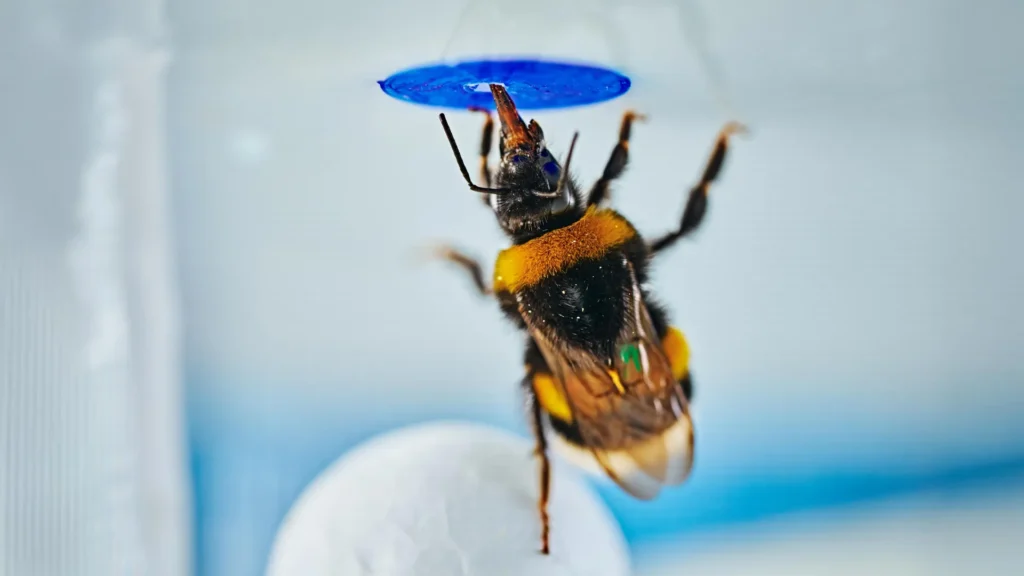
The Finnish research team crafted an equivalent challenge tailored for bumblebees. Initially, the bees were trained to associate a specific blue artificial flower with a sugar water reward. Once this association was firmly established, the experimental phase began. Researchers moved the blue flower, still containing the reward, to the ceiling of a transparent arena, placing it well beyond the bees’ direct flight path or reach. Crucially, a small, movable ball was also present on the floor of the arena.
To successfully retrieve the reward, the bees had to spontaneously generate a solution: they needed to roll the small ball directly beneath the elevated flower, then climb onto the ball, thereby gaining the necessary height to access the nectar. This sequence of actions – identifying the ball as a movable tool, repositioning it precisely, and then utilizing it as a platform – was something the bees had never been taught or observed before.
"This is essentially an insect version of the classic ‘box-and-banana’ problem," explained senior author Olli Loukola, Docent at the University of Oulu and currently a Senior Researcher at the University of Turku. "The animal must realize that an object can be repositioned and then used as a tool to reach an otherwise inaccessible goal. What stands out about the result is that this kind of spontaneous problem-solving is now demonstrated in an insect, blurring lines we once thought rigid."
Lead author Akshaye Bhambore from the University of Oulu further emphasized the unprecedented nature of the bees’ behavior. "What makes this behavior especially remarkable is that the bees had never been trained to roll the ball. This was a completely new challenge. Their behavior appeared goal-directed, with successful individuals showing more directed movement patterns rather than random exploration." This observation of goal-directedness is critical, differentiating the bees’ actions from mere accidental success or random trial-and-error.
Rigorous Controls: Ruling Out Simpler Explanations
Understanding the profound implications of such a discovery, the research team implemented an exceptionally stringent set of control experiments to meticulously rule out any simpler explanations for the bees’ success. The integrity of the findings hinged on demonstrating that the bees’ actions were indeed a result of spontaneous problem-solving and not, for example, accidental luck, associative learning, or simple stimulus-response mechanisms.
One of the primary concerns addressed was the bees’ prior experience. The experimental design ensured that the bees were "fully naive" regarding the specific solution. Before the critical test, they had only learned two isolated facts: that the blue flower offered a reward, and that the ball was a movable, harmless object within their environment. There was no training that linked the ball to the flower, nor any demonstration of using the ball as a tool.
"In many previous studies of insight-like problem-solving, the animals have had extensive experience with objects, test environments, or other problem-solving tasks," Loukola noted. "Here, the bees had never been trained to use the ball to reach the flower, and they had no previous experience with this kind of solution. We also designed the experiments to rule out simpler explanations such as accidental success, play behavior, trial-and-error learning, or direct visual guidance."
A particularly compelling set of control tests involved obscuring the target flower from the bees’ view as they manipulated the ball. In these more demanding conditions, the bees could not rely on direct visual guidance to steer the ball towards a visible target. Astonishingly, many bees still managed to roll the ball to the correct location beneath the hidden flower, indicating an internal representation of the goal and the necessary actions, rather than just reacting to external cues.
"By analyzing the bees’ behavior across unusually stringent control experiments, we could show that they were not simply reacting to visual stimuli or moving the ball randomly," Bhambore confirmed. This level of experimental rigor strengthens the conclusion that the bees were indeed engaging in a form of spontaneous, goal-directed problem-solving.
A Century of Insight: From Chimpanzees to Bumblebees
The historical context of this study traces back to the early 20th century. Wolfgang Köhler’s pioneering work with chimpanzees on the Canary Islands between 1913 and 1917 revolutionized the understanding of animal intelligence. His observations of chimps like Sultan, who would stack boxes or use sticks to obtain out-of-reach bananas, provided the first robust scientific evidence for "insight" in non-human animals – the sudden understanding of how to solve a problem without trial-and-error. These experiments were pivotal in challenging the prevailing behaviorist view that animal learning was purely a matter of conditioned responses.
For decades, the capacity for such insightful problem-solving was largely considered a hallmark of primates and other vertebrates with complex neural structures, particularly those capable of abstract thought and planning. The underlying assumption was that the sheer number of neurons and the intricate connectivity found in larger brains were prerequisites for these advanced cognitive functions. Human brains, with an estimated 86 billion neurons, and chimpanzee brains, with around 250 million neurons, seemed perfectly suited for such complex tasks.
Bumblebees, in stark contrast, possess brains that are orders of magnitude smaller, containing roughly one million neurons – a mere fraction of a vertebrate brain. Given this vast disparity in neural real estate, the discovery of comparable problem-solving abilities in Bombus terrestris represents a monumental shift in cognitive science. It forces a fundamental re-evaluation of the relationship between brain size, neural complexity, and the emergence of intelligence.
"For over a century, spontaneous object-based problem-solving has mostly been studied in vertebrates," Loukola reflected. "Our study suggests insects may belong in that conversation too." This statement encapsulates the profound challenge this research poses to long-held scientific dogmas.
The Marvel of Miniature Minds: Beyond Brain Size
The ability of bumblebees to perform such complex tasks with their tiny brains is nothing short of astonishing and underscores the remarkable efficiency of biological computation. While the human brain is a massive, energy-intensive organ, the bumblebee brain, weighing less than a milligram, can execute sophisticated computations necessary for navigation, communication, social interaction, and now, spontaneous problem-solving.
Co-author Ece Nur Akmeşe from the University of Helsinki vividly described the experience of witnessing these cognitive feats: "One moment the animal is exploring seemingly without direction, and the next it performs a highly efficient sequence of actions leading directly to the solution. Watching the bees solving the task was genuinely fascinating." This observation highlights the sudden, seemingly ‘aha!’ moment that characterizes insightful problem-solving, even in a creature as small as a bee.
The findings compel neuroscientists to reconsider what constitutes "intelligence" and how it might be implemented in different biological architectures. It suggests that perhaps the organization and efficiency of neural networks, rather than simply their volume, are key determinants of cognitive capacity. Evolution, it appears, has found diverse pathways to achieve complex problem-solving, even with significant constraints on brain size and energy consumption.
A Growing Body of Evidence: Other Bee Feats
This groundbreaking study is not an isolated incident but rather the latest addition to a steadily growing body of evidence showcasing the sophisticated cognitive abilities of bees. Over the past two decades, research has consistently revealed astonishing intellectual capacities in these insects, continually pushing the boundaries of what scientists believed was possible for animals with such small nervous systems.
Previous studies have demonstrated that bees can engage in social learning, for instance, by observing and imitating other bees to learn how to pull a string to access a reward. They can solve intricate puzzle-like tasks, navigating mazes and remembering complex routes. Their cooperative behaviors, essential for colony survival, involve intricate communication systems, most famously the waggle dance, which conveys precise information about food sources.
Beyond these, bees have shown abilities in abstract concept learning, such as distinguishing between "same" and "different" patterns. They can learn to count up to four or five objects and even grasp the concept of "zero." Their navigation systems are incredibly advanced, utilizing sun compasses, polarized light, and landmarks to forage across vast distances and return precisely to their hives. Some species have even shown rudimentary forms of facial recognition. This cumulative evidence paints a picture of bees as highly intelligent and adaptable creatures, far beyond the simplistic reflex-driven organisms they were once thought to be. The latest Science paper on spontaneous problem-solving thus provides a critical missing piece in this expanding understanding of bee cognition, elevating their intellectual standing further.
Broader Implications and Future Directions
The implications of the bumblebee study extend far beyond the realm of insect intelligence. It prompts a multi-faceted re-evaluation across several scientific and philosophical domains:
1. Evolutionary Biology: The findings suggest that complex cognitive abilities like spontaneous problem-solving may have evolved independently multiple times across the animal kingdom, a phenomenon known as convergent evolution. It challenges the assumption of a linear progression of intelligence tied directly to brain size, instead hinting at diverse evolutionary pressures selecting for cognitive flexibility in a variety of ecological niches. This could mean that the fundamental computational principles underlying intelligence are more universal than previously thought.
2. Neuroscience and AI: For neuroscientists, the study opens critical questions about neural efficiency. How do miniature brains achieve such feats? What are the minimal neural circuits required for complex cognition, planning, and insight? Understanding the bumblebee brain’s architecture and function could provide invaluable insights into the fundamental mechanisms of intelligence, potentially informing the design of more efficient and adaptable artificial intelligence systems and robots. Biomimicry, drawing inspiration from nature’s solutions, could lead to AI that can solve novel problems with limited computational resources, mimicking the bee’s remarkable efficiency.
3. Animal Welfare and Conservation: If insects possess such sophisticated cognitive capacities, it raises profound ethical questions about their treatment. The widespread use of pesticides, habitat destruction, and the impact of climate change on insect populations might have far greater implications than previously understood, affecting not just their numbers but also their complex cognitive worlds. A deeper appreciation for insect intelligence could foster greater empathy and bolster conservation efforts for these vital pollinators and ecosystem engineers.
4. Philosophical Reconsiderations: The study contributes to the ongoing philosophical debate about the definition of "intelligence" and "consciousness." By demonstrating complex problem-solving in creatures so phylogenetically distant from humans, it forces a re-examination of anthropocentric biases in understanding animal minds. While the researchers are cautious about attributing human-like consciousness or thought processes to bees, the sheer flexibility and goal-directedness of their behavior push the boundaries of what we consider non-conscious or purely instinctual.
Loukola emphasized this cautious interpretation: "We are not claiming that bees think like humans. But our findings show that miniature brains can generate flexible solutions to novel problems in ways we are only beginning to understand." This nuance is crucial; it acknowledges the impressive capabilities without anthropomorphizing the insects.
Future research will undoubtedly delve deeper into the neural underpinnings of these abilities, perhaps using advanced imaging techniques to observe brain activity during problem-solving. Genetic studies could identify genes associated with cognitive flexibility, and comparative studies with other insect species might reveal the evolutionary trajectory of these remarkable capacities. The discovery also highlights the vast, unexplored cognitive landscapes that may exist within the animal kingdom, particularly among invertebrates.
In conclusion, the study by Akshaye A. Bhambore, Ece N. Akmeşe, Emma Häkkinen, Milla K. Jussila, Juha-Heikki Kantola, and Olli J. Loukola, published on June 4, 2026, in Science, marks a pivotal moment in the study of animal cognition. It not only elevates the humble bumblebee to the ranks of insightful problem-solvers but also fundamentally challenges long-held assumptions about the relationship between brain size and intelligence, opening new avenues for understanding the diverse and remarkable capabilities of life on Earth. As Loukola aptly put it, "Our study suggests insects may belong in that conversation too," a conversation that now seems infinitely richer and more complex.