



Inside Cape Breton University’s Great Hall, the blue-and-white crossed flag of Nova Scotia is surrounded by dozens of other flags forming a vibrant quiltwork: China, Greece, Egypt, Liberia, Nepal, Turkey, Ghana, Switzerland, Italy, Lebanon, Mozambique, and Jordan. This striking display is more than just a decorative tapestry; it is a profound symbol of diversity and a testament to years of dedicated effort to recruit and integrate students from across the globe into the fabric of Cape Breton University and the surrounding community of Sydney, Nova Scotia. This celebration of global connection stands in stark contrast to the recent policy shifts that threaten to unravel the very success story it represents.
The influx of international students at Cape Breton University (CBU) has been nothing short of transformative. Between 2017 and the fall of 2023, the university experienced an astonishing tripling of its student population, growing from under 900 to nearly 7,000. This dramatic surge was predominantly driven by international learners, with eight out of every ten new students being international. This demographic shift was not merely an academic ambition; it was a critical strategy for the long-term sustainability of Cape Breton Island, an area grappling with an aging population. Islanders, on average, are a decade older than the Canadian national average, and like much of the Atlantic region, they face the daunting challenge of a declining youth demographic.
A Lifeline for an Aging Region
"We’re the oldest region in an aging country, and it is essential to our sustainability to welcome newcomers. And who better than international students?" stated Victor Tomiczek, CBU’s Director of International Recruitment and Global Partnerships. This sentiment encapsulates the strategic imperative behind CBU’s internationalization efforts.
The impact of these efforts on Cape Breton Island’s demographic trajectory has been significant. The island’s population, which had been in decline for years, began to show signs of growth in 2019, a reversal directly attributable to the enrolment and subsequent retention of international students at CBU. By the peak of international student enrolment in 2023, following a post-pandemic surge, these students were contributing an estimated $300 million annually to the local economy. Their presence permeated all levels of the local workforce, from small, independent businesses to national banks and public service roles. Beyond the quantifiable economic benefits, Tomiczek emphasized the "unquantifiable wealth of cultural diversity they bring to the Island."
The Federal Vision: International Students as Pillars of Growth
Cape Breton’s experience is a powerful microcosm of a broader national strategy. For decades, the federal government has recognized international students as a vital demographic for maintaining and expanding Canada’s labour force. The government’s own international education strategy for 2019-2024 identified this cohort as "exceptional candidates" for permanent residency. These students are typically young, possess fluency in at least one of Canada’s official languages, and crucially, have gained a Canadian educational experience. This was further bolstered by joint federal-provincial initiatives like the Atlantic Immigration Program, designed to connect newcomers and international graduates with in-demand jobs, leading to a remarkable retention rate of over 70% for international students graduating from universities in Atlantic Canada.
A Sudden Shift: The Shock of Policy Reforms
Against this backdrop of carefully cultivated success, the announcement of significant reforms to the international student program by former Minister of Immigration, Refugees and Citizenship, Marc Miller, in early 2024, sent shockwaves through the Canadian post-secondary education sector. The reforms introduced stringent requirements for international student entry and imposed caps on the number of approved visas.
For CBU, the consequences have been nothing short of catastrophic. In the 2023 academic year, the university’s undergraduate population stood at 7,148. By the following year, this figure had plummeted by nearly half to 3,849. This represents a staggering decrease of 3,299 students, with all but five of these being international students.
“We were achieving goals in our region – in terms of our population and the needs of our population – and then they just cut our throat,” lamented CBU President David Dingwall, articulating the profound sense of betrayal felt by many in smaller institutions.
Auditor General’s Scathing Report Confirms Concerns
A subsequent report by the Auditor General of Canada on the international student program reforms validated the concerns raised by President Dingwall and numerous other stakeholders in Canada’s smaller provinces. The report critically noted that Immigration, Refugees and Citizenship Canada (IRCC) had failed in its mandate to adequately consider the immigration and economic goals of regions impacted by the reforms. Furthermore, the Auditor General found that IRCC had not adjusted for the unintended negative consequences of its reforms, despite possessing data that clearly indicated an outsized detrimental impact on these regions.
The Auditor General’s report explicitly stated that IRCC "didn’t know why its approval rates were lower than projected" and did not assess whether its new measures were contributing to the reduction in applications submitted or to lower approval rates. This lack of foresight and data-driven adjustment has been a central point of criticism.
Flawed Allocation and Unexplained Projections
The Auditor General’s investigation identified critical flaws in the allocation model used by IRCC, which imposed compounding challenges on smaller provinces. Firstly, study permit spaces were distributed based on provincial population size, inherently leaving smaller provinces with fewer allocated spots. Secondly, IRCC initially projected a uniform 60% approval rate for study permit applications across all provinces, a figure it applied universally despite having access to data indicating significant variations and considerably lower approval rates in Atlantic Canada. This uniform, seemingly arbitrary projection has never been adequately explained.

Ava Czapalay, CEO of the Association of Atlantic Universities, highlighted the confusion and frustration this caused. "Provincial officials struggled to make sense of the reforms. Sometimes it felt like the people explaining it weren’t all that clear themselves on all of the changes," she noted.
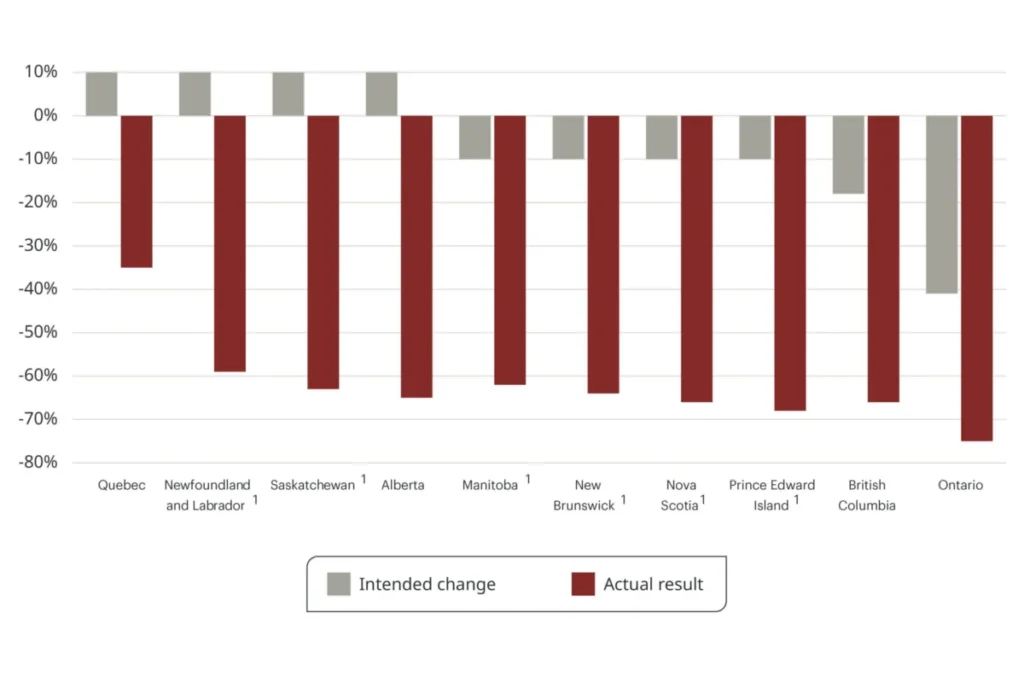
IRCC’s initial projections for approved study permits were starkly inaccurate. The department anticipated a decrease of 10% or less in Nova Scotia, PEI, New Brunswick, and Manitoba, with a projected 10% increase in Saskatchewan and Newfoundland and Labrador. In reality, all provinces experienced a drop of 56% or greater in approvals in 2024 compared to 2023.
Andrew Hakin, President and Vice-Chancellor of St. Francis Xavier University and Chair of the Council of Nova Scotia University Presidents, echoed this sentiment, stating, "It was clear that IRCC policies weren’t thinking about, to a great extent, the regional needs within Canada. There’s nothing there that suggests that there was a very good handle on where things were going to go."
The Global Repercussions: Canada’s Diminishing Appeal
The miscalculations and the opaque implementation of these reforms have had a seismic impact on Canada’s international reputation as a premier study destination. In 2024, IRCC projected approving 348,900 new study permits but only managed to approve 149,559 – a drastic 67% reduction from 2023 levels. The trend continued into 2025, with projections of 255,360 approved permits, but as of September 2025, only 50,370 had been granted.
Ms. Czapalay attributes the overall decrease in study permit applications to a growing perception among prospective students that Canada is no longer a welcoming destination. This view is widely shared across the university sector. Beyond stricter prerequisites, such as a doubling of the required proof of funds for students from $10,000 to $20,000, confusing and opaque rules, and increased bureaucracy have led to widespread bewilderment. Furthermore, IRCC made it more challenging for students to bring their families or partners, a factor that significantly influences study abroad decisions for many.
“You could imagine, if senior government officials were confused, how international students would have felt,” Ms. Czapalay remarked. “It’s like Canada just pulled the welcome mat right out from under their feet.”
Official Response and Shifting Tides
In response to inquiries from University Affairs, Julie Lafortune, Communications Advisor for IRCC, stated via email, "It’s important to note that the cap itself has not caused declines in international student numbers. In both 2024 and 2025, provinces and territories did not use all the spaces available to them." She added that "recent changes, such as higher financial requirements, have led to lower approval rates overall."
While IRCC maintains the cap itself is not the sole driver of decline, the data and the experiences of universities paint a different picture. Universities, many of which have become increasingly reliant on international student tuition fees to offset declining provincial funding, stagnant domestic enrolment, and government-imposed tuition freezes, are now grappling with the fallout from these policy shifts.
Universities Facing Financial Strain and Cutbacks
The repercussions are being felt acutely across the Canadian post-secondary landscape. Memorial University in Newfoundland and Labrador announced earlier this year its intention to sell off several properties. Acadia University in Wolfville, Nova Scotia, was forced to cut 31 positions last month, citing a 56% drop in international student enrolment. These layoffs included the entire team at the university’s international centre, the very unit responsible for assisting new students in their transition to life in Canada.
At Cape Breton University, the impact has triggered a cascade of cutbacks. By October 2025, CBU had eliminated over 100 positions and cancelled post-baccalaureate business programs that, according to President Dingwall, were specifically designed to address provincial labour market needs. These enrolment declines and program cancellations have resulted in an estimated $77 million in lost revenue. More recently, the university revised its overall enrolment target to approximately 3,500 and announced the elimination of an additional 50 positions. To mitigate further financial strain, tuition fees are set to increase by 3% for professional programs, 5% for undergraduate programs, and 5% for international student tuition fees, excluding Nova Scotia students.
President Dingwall emphasized that these difficult decisions are essential for the university’s survival. However, he pointed to the recent developments in New Brunswick as a stark warning of the broader dangers these policies pose to the Atlantic region. In April, global credit rating agency Moody’s downgraded New Brunswick’s fiscal outlook from stable to negative, citing "lower population growth due to stringent federal immigration policies." The province experienced a significant decline of 64% in approved international study permits.
A Plea for Continued Welcome
Despite the setbacks and the palpable damage to both academic institutions and regional economies, Victor Tomiczek remains resolute. He asserts that Atlantic provinces and other rural areas must continue to embrace international students, not only for the sake of institutions like CBU but for the very vitality of their communities. "We have come too far to turn back now," he stated, underscoring the critical need to reverse course and reinstate Canada’s position as a welcoming beacon for global talent. The path forward demands a re-evaluation of federal policies to ensure they support, rather than undermine, the essential contributions of international students to Canada’s demographic and economic future.