



The cybersecurity landscape is undergoing a profound structural transformation, driven by the rapid decentralization of enterprise infrastructure and the accelerating integration of machine learning into commercial operations. According to the Cloud Security Alliance’s (CSA) newly released Top Threats to Cloud Computing Survey Report 2026, identity and access management (IAM) has officially overtaken infrastructure misconfigurations as the primary security concern for organizations operating in the cloud. Furthermore, the survey highlighted the emergence of artificial intelligence-related vulnerabilities, which have broken into the elite threat rankings for the first time in the history of the organization’s longitudinal research series.
The findings, compiled by the CSA Top Threats Working Group, are based on comprehensive qualitative and quantitative data gathered from 507 qualified cybersecurity professionals worldwide. Survey participants were asked to evaluate and rank 23 distinct cloud security vectors, ultimately distilling the dataset down to a definitive Top 11 list. This year’s hierarchy is led prominently by identity vulnerabilities, artificial intelligence risks, third-party vendor resources, and application programming interfaces (APIs).

Published to guide organizational decision-makers, compliance officers, risk management specialists, and executive leadership, the 2026 report serves as a strategic blueprint for prioritizing cybersecurity spending, architectural governance, and risk mitigation. Each analyzed threat category within the report is accompanied by detailed breakdowns of technical and business impacts, key takeaways, real-world case studies, and mapped CSA security controls designed to fortify modern digital environments.
The Evolution of the Cloud Threat Landscape
The publication of the 2026 report marks a significant departure from historical cloud security paradigms. For years, the primary anxieties of chief information security officers (CISOs) and cloud architects centered on the foundational layers of technology stacks—specifically, how underlying infrastructure was provisioned, patched, and managed by cloud service providers (CSPs) or internal engineering teams. However, the latest survey data illustrates a decisive shift toward threats originating at the application layer, user interfaces, interconnected software supply chains, and cognitive automation systems.
Historically, structural errors such as unencrypted storage buckets, overly permissive network access groups, and poor change control protocols dominated the upper echelons of risk registers. While these misconfigurations remain dangerous, organizations have increasingly adopted automated posture management tools and Infrastructure as Code (IaC) templates to catch foundational errors before deployment. Consequently, threat actors have adapted by targeting human and machine identities, exploiting the gaps between integrated third-party services, and weaponizing emerging technologies like generative and analytical artificial intelligence.
This shifting baseline is underscored by the relegation of several legacy concerns. Traditional infrastructure-level vulnerabilities—such as denial-of-service (DoS) attacks, shared technology vulnerabilities inherent to multi-tenant environments, native CSP data loss events, unauthenticated resource sharing, and limited cloud visibility or observability—all scored outside the Top 11 threshold in the 2026 assessment. This indicates that while foundational hygiene remains necessary, it is no longer perceived as the primary vector of catastrophic enterprise compromise.
Comparative Chronology: The 2024 to 2026 Priority Shift
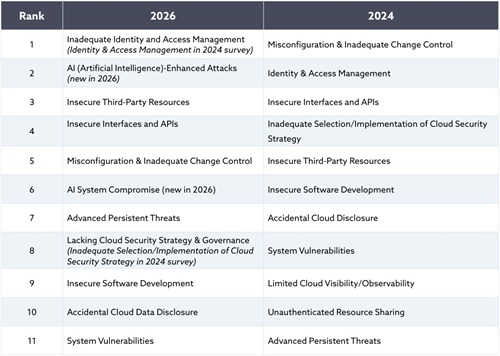
To understand the trajectory of modern digital risk, security analysts routinely examine the chronological progression between successive CSA survey cycles. Comparing the 2024 threat hierarchy with the newly minted 2026 rankings reveals a dramatic reshuffling of industry priorities, reflecting the speed at which enterprise technology stacks have evolved over a brief twenty-four-month window.
In the 2024 survey, identity and access management occupied the second position, trailing just behind misconfigurations and inadequate change control. By 2026, IAM vaulted into the top spot, a reflection of the perimeter-less enterprise where hybrid workforces, microservices architectures, and sprawling multi-cloud deployments render traditional network boundaries obsolete. Conversely, 2024’s reigning champion—misconfiguration and inadequate change control—slotted comfortably into the fifth position for 2026, demonstrating that while foundational errors are better managed today, they have not been entirely eradicated.

Other notable chronological movements include the upward trajectory of supply chain vulnerabilities. Insecure third-party resources climbed from the fifth position in 2024 to the third position in 2026, highlighting the cascading risks introduced by third-party software dependencies, vendor integrations, and open-source libraries. Advanced Persistent Threats (APTs) also experienced a notable surge, moving from the eleventh position up to seventh, signaling that state-sponsored and sophisticated cyber espionage groups are increasingly prioritizing persistent cloud access over traditional on-premises targets.
Most significantly, the 2026 survey cycle introduces artificial intelligence categories for the first time. The rapid commercial adoption of large language models (LLMs), automated decision engines, and AI-driven development tools has created an entirely new attack surface. CSA cautions that while direct cross-referencing between individual rows of the 2024 and 2026 charts is not a strict one-to-one mapping—due to the evolving definitions of individual threats—the macro-trend points undeniably away from infrastructure vulnerabilities and toward identity, integration, and intelligence risks.
Statistical Breakdown and Scoring Tightness
A notable characteristic of the 2026 survey results is the statistical compression among the top-ranked threats. Rather than exhibiting a steep drop-off between primary concerns and secondary issues, the aggregate risk scores assigned by the 507 surveyed professionals formed a tightly clustered continuum.

The top-ranked threat secured a composite score of 7.95 out of a standard risk index scale, while the eleventh threat on the list registered a score of 7.45. This narrow margin of half a point across the entire Top 11 spectrum indicates that modern security practitioners do not view these risks as isolated silos. Instead, they perceive them as an interrelated matrix of challenges where an identity failure can quickly cascade into an API exploit, an AI data leakage event, or a third-party supply chain compromise.
The survey methodology leveraged the collective expertise of seasoned practitioners across diverse industry verticals, including financial services, healthcare, government, retail, and technology. This broad cross-section ensures that the rankings reflect generalized enterprise realities rather than sector-specific anomalies.
Technical Analysis of the Leading Threats
Identity and Access Management as the New Perimeter
With the widespread adoption of cloud-native applications, traditional network firewalls have lost their efficacy as the primary line of defense. The ascension of identity and access management to the number one threat position underscores the reality that credentials—both human and non-human (such as service accounts, API keys, and machine identities)—are the keys to the modern digital kingdom. Weak multi-factor authentication (MFA) enforcement, excessive permission grants (violating the principle of least privilege), and the poor management of ephemeral credentials leave organizations vulnerable to credential stuffing, session hijacking, and lateral movement by attackers.

The Integration of Artificial Intelligence Risks
The debut of AI-related threats in the Top 11 reflects both the immense utility and the inherent insecurity of deploying machine learning models in production cloud environments. Organizations are rapidly integrating AI to automate workflows, process sensitive data, and write code, frequently without adequate guardrails. Key concerns highlighted by respondents include prompt injection attacks, training data poisoning, insecure model serialization, unauthorized data exfiltration via conversational interfaces, and the autonomous generation of vulnerable code by AI assistants. Because AI systems often require broad access to enterprise data repositories to function effectively, they represent a high-value target for threat actors seeking to harvest intellectual property or manipulate business logic.
Third-Party Resources and the Software Supply Chain
Ranking third in the 2026 report, insecure third-party resources reflect the systemic dependencies inherent in modern software development. Enterprises rarely build applications from scratch; instead, they rely on commercial SaaS products, managed service providers (MSPs), open-source libraries, and cloud marketplaces. A vulnerability or malicious backdoor introduced by a single upstream vendor can compromise thousands of downstream enterprise customers. The complexity of auditing these external dependencies has made supply chain attacks one of the most persistent vectors for ransomware deployment and corporate espionage.
Broader Business Implications and Strategic Guidance
The findings of the Cloud Security Alliance’s 2026 report carry profound implications for enterprise governance, regulatory compliance, and capital allocation. As regulatory bodies worldwide enforce stricter accountability for data protection and operational resilience—such as the European Union’s Digital Operational Resilience Act (DORA) and updated Securities and Exchange Commission (SEC) cybersecurity disclosure rules—boards of directors and executive leadership can no longer treat cloud security as a purely technical back-office function.

From a strategic perspective, mitigating the risks identified in the 2026 survey requires a fundamental shift in corporate culture and security architecture. Organizations must move beyond static perimeter defenses and adopt zero-trust frameworks that continuously verify every identity, device, and transaction. For identity management, this means implementing rigorous automated lifecycle management, enforcing phishing-resistant MFA, and continuously auditing privileged access pathways.
Regarding artificial intelligence, enterprises must establish dedicated governance committees to evaluate AI adoption, implement strict data loss prevention (DLP) controls around LLM prompts, and conduct rigorous security testing on machine learning pipelines before deployment. Similarly, software bill of materials (SBOM) management and continuous vendor risk assessments are no longer optional best practices; they are foundational requirements for securing interconnected cloud ecosystems.
Ultimately, the CSA’s 2026 Top Threats report provides a vital roadmap for navigating an increasingly complex digital frontier. By aligning security strategies with the empirical insights of hundreds of industry experts, organizations can better anticipate evolving vectors of compromise, protect critical assets, and maintain resilience in an era defined by rapid technological change.