

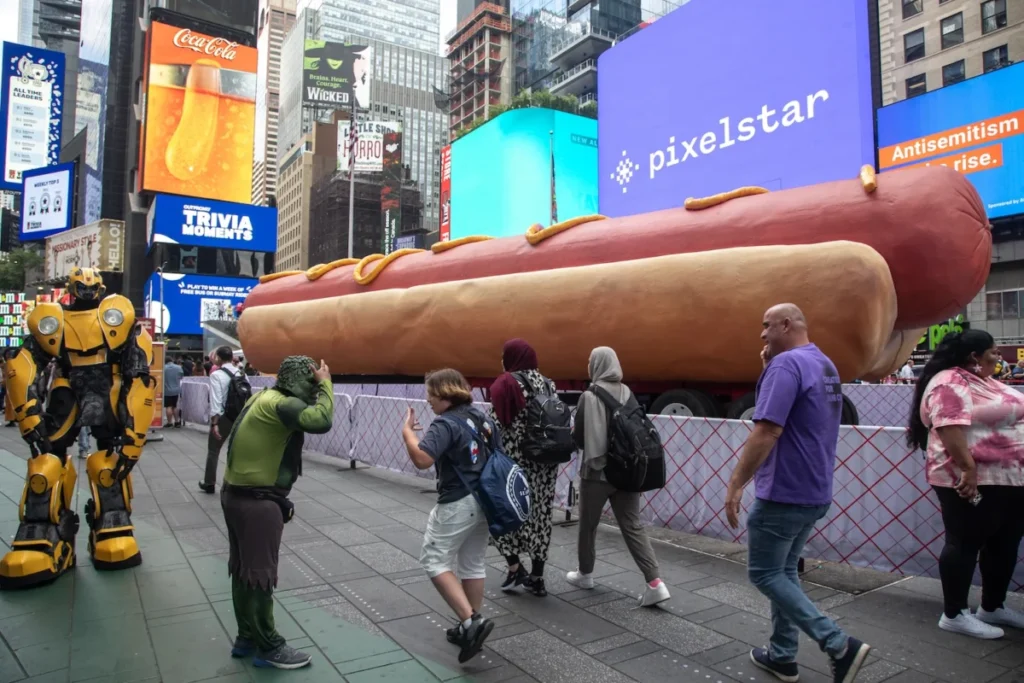
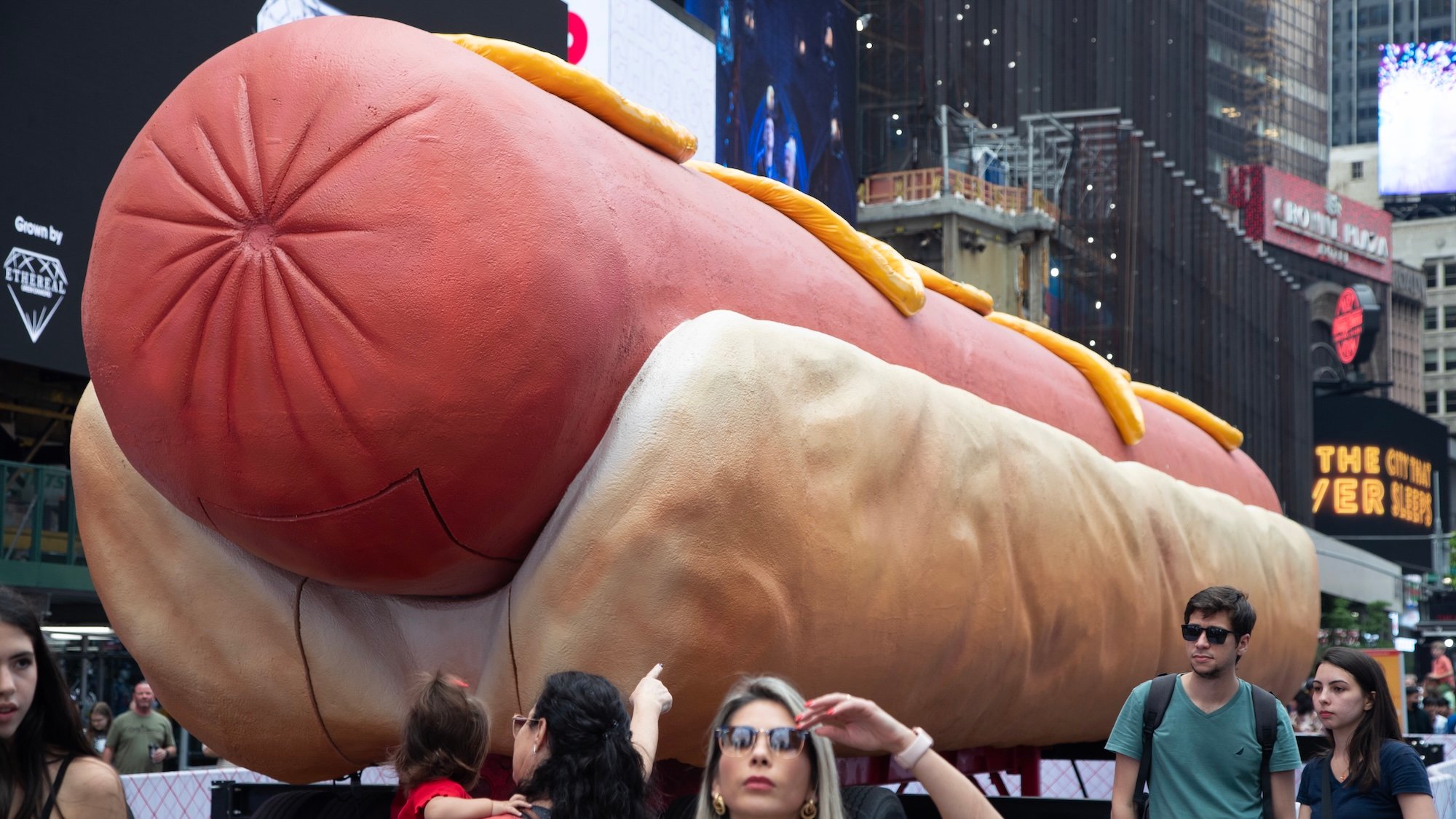
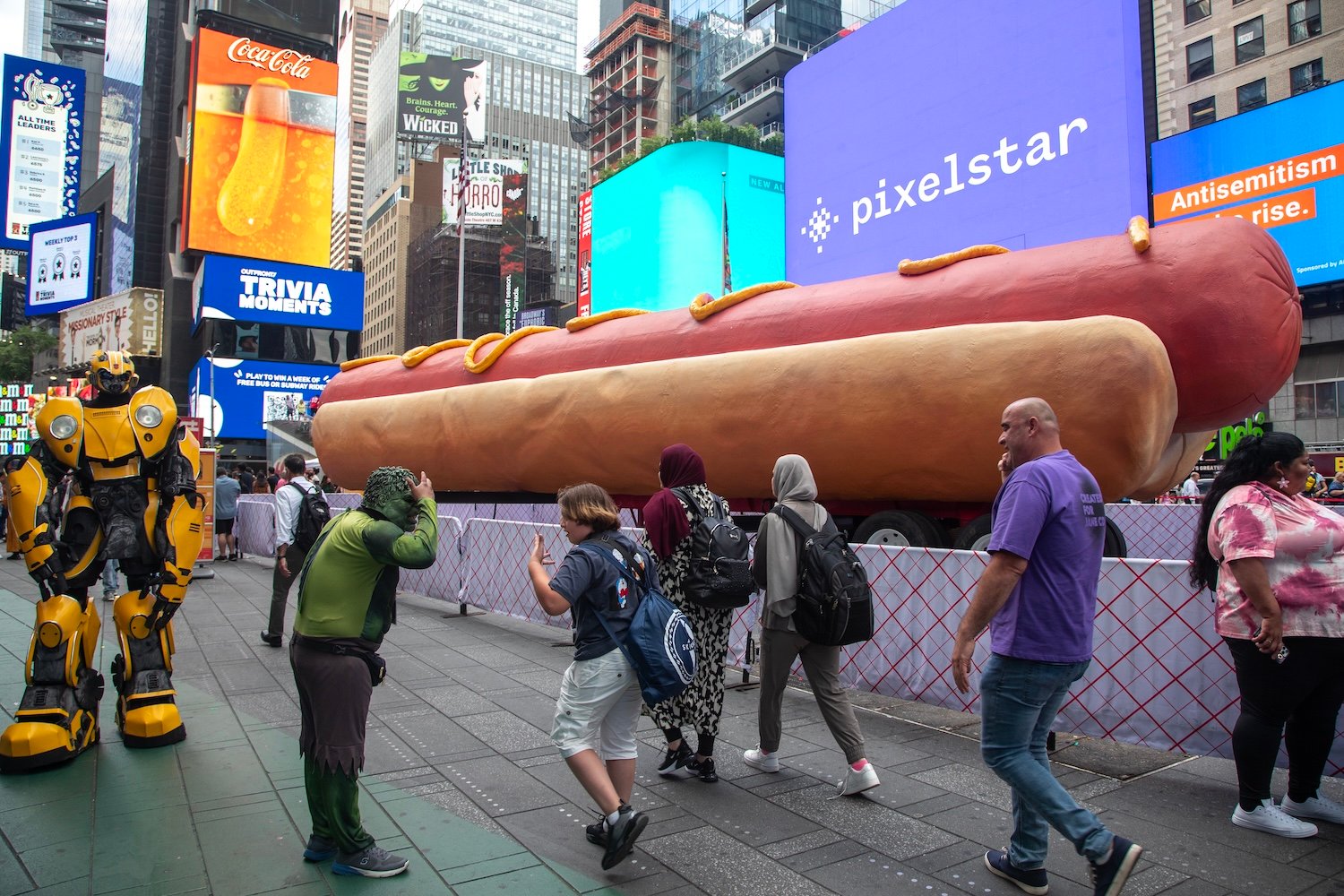
The massive 65-foot-long installation, officially titled Hot Dog: The Second Serving, has resumed its position in Duffy Square, marking a significant moment in the intersection of public art and cultural commentary. Created by conceptual artists Jen Catron and Paul Outlaw, the sculpture first captured international attention during its debut in 2024 and has now returned to the heart of Manhattan to coincide with the festivities surrounding the 250th anniversary of the United States. Positioned amidst the neon glow of Times Square, the oversized frankfurter serves as both a whimsical tourist attraction and a pointed critique of American industrialism, class structures, and the complexities of the American Dream.
The return of the sculpture, which has been colloquially dubbed the "World’s Largest Hot Dog," represents a coordinated effort between the artists and local cultural organizations to utilize public space for large-scale social observation. Standing at a length that rivals a standard bowling lane or a four-story building laid on its side, the installation dominates the pedestrian plaza, inviting passersby to contemplate one of the most ubiquitous symbols of American fast food.
Historical Context and the Evolution of the Installation
The project, originally titled Hot Dog in the City, was first unveiled in June 2024. Its initial residency was characterized by a series of high-energy public events designed to mimic the spectacle of American marketing and entertainment. During its first summer, the sculpture was the centerpiece for themed wrestling matches, educational Q&A sessions featuring food historians, and performances by local vendors. A signature feature of the installation is its internal mechanism: a built-in confetti cannon that fires daily, erupting from the "meat" of the sculpture in a shower of celebration that the artists suggest mirrors the explosive nature of hyper-capitalism.
The decision to bring the installation back for the 2026 season is deeply tied to the United States Semiquincentennial. As the nation reflects on two and a half centuries of history, Catron and Outlaw’s work offers a contemporary counterpoint to traditional monuments. While bronze statues of historical figures often dominate public squares, the giant hot dog elevates a humble, processed food item to the level of a national icon. According to the artists, the hot dog is a "vessel" for exploring the myths of American prosperity. It is an item that is simultaneously democratic—accessible to nearly everyone regardless of income—and a product of the industrial food complex that often prioritizes volume and profit over craftsmanship.
Technical Specifications and Mathematical Analysis
The sheer scale of the sculpture invites technical scrutiny regarding its dimensions and the hypothetical volume it occupies. Jen Catron and Paul Outlaw have confirmed that the interior of the 65-foot-long sculpture encompasses approximately 6,000 cubic feet. When converted into cubic inches, the internal capacity reaches a staggering 10,368,000 units.
To put this volume into perspective, analysts have calculated the "frankfurter capacity" of the sculpture. Using the standard dimensions of a popular retail hot dog, such as an Oscar Mayer frank—which typically measures six inches in length with a one-inch diameter—the volume of a single hot dog is roughly 4.7 cubic inches. A purely mathematical division of the sculpture’s total volume by the volume of a single hot dog suggests that 2.2 million franks could theoretically fit inside the structure.
However, a professional engineering perspective requires the consideration of "packing efficiency." Because hot dogs are cylindrical and cannot be compressed into a solid mass without losing their shape, there is a significant amount of interstitial space (air gaps) between the items. Assuming a packing efficiency of approximately 80 percent—a generous estimate for irregular cylindrical stacking—the realistic capacity of the sculpture is estimated at 1.75 million hot dogs.
From a sociological standpoint, this data highlights the scale of American consumption. Given that the average American consumes approximately 70 hot dogs per year, the 1.75 million franks contained within a single "Second Serving" sculpture would be enough to satisfy the annual hot dog intake of 25,000 people.
The Hot Dog as a Cultural and Economic Symbol
The choice of the hot dog as a subject is not incidental to its New York City setting. The hot dog is inextricably linked to the history of New York’s immigrant populations. Originally brought to the United States by German immigrants in the 19th century, the "dachshund sausage" became a staple of Coney Island and eventually the street corners of Manhattan. It represents the "grab-and-go" efficiency of the city’s workforce and remains one of the few food items that bridges the gap between different socioeconomic classes.
By placing this symbol in Times Square—a hub of global tourism and corporate advertising—Catron and Outlaw force a confrontation between the viewer and the reality of mass production. The sculpture’s polished, hyper-realistic finish mimics the aesthetic of "food porn" and high-end commercial photography, yet its subject is a mass-produced meat product often criticized for its mystery ingredients.
Industry experts suggest that public art installations of this magnitude have a measurable impact on local economies. Times Square, which sees upwards of 300,000 pedestrians daily, relies on "spectacle" to maintain its status as a premier global destination. The presence of the giant hot dog encourages "stationary time" among tourists, leading to increased foot traffic for surrounding businesses, from souvenir shops to actual hot dog vendors who benefit from the thematic synergy.
Public Reaction and Artistic Intent
While many visitors view the sculpture as a "selfie-worthy" backdrop, the artistic community has noted the subversive nature of the work. The "Second Serving" title implies a redundant consumption—a commentary on the American tendency toward "more" as a substitute for "better."
Reaction from the public has been largely positive, though it remains divided between those who appreciate the humor and those who find the critique of capitalism heavy-handed. Inferred statements from the Times Square Alliance and local arts councils suggest that the installation is viewed as a successful example of "placemaking," a multi-faceted approach to the planning, design, and management of public spaces that capitalizes on a local community’s assets to promote people’s health, happiness, and well-being.
"The hot dog is the ultimate equalizer," the artists have noted in previous discussions regarding the project’s philosophy. "It is a food of the people, yet it is also a product of a massive industrial machine. By blowing it up to this size, we are asking people to look at what they are consuming—not just the food, but the culture that surrounds it."
Broader Implications for Public Art in the 21st Century
The return of Hot Dog: The Second Serving signifies a shift in how cities approach public monuments. As the U.S. 250th anniversary approaches, there is an increasing move toward ephemeral, experiential art that engages with current social issues rather than just historical commemoration.
The installation also raises questions about the environmental and ethical implications of industrial food production. While the sculpture itself is made of synthetic materials, its subject matter points toward the massive carbon footprint of the livestock industry and the labor issues often associated with meatpacking plants. By using a celebratory tone (complete with confetti cannons) to highlight a symbol of industrial output, Catron and Outlaw utilize irony to spark a deeper conversation about sustainability and the future of the American food system.
As the sculpture remains on display through the summer season, it will continue to serve as a focal point for debate, photography, and public gathering. Whether viewed as a giant joke or a serious piece of social commentary, the 65-foot hot dog stands as a testament to the power of public art to reflect the complexities of national identity. In the heart of the world’s most famous intersection, the "Second Serving" reminds us that in America, the spectacle is often just as important as the substance.