



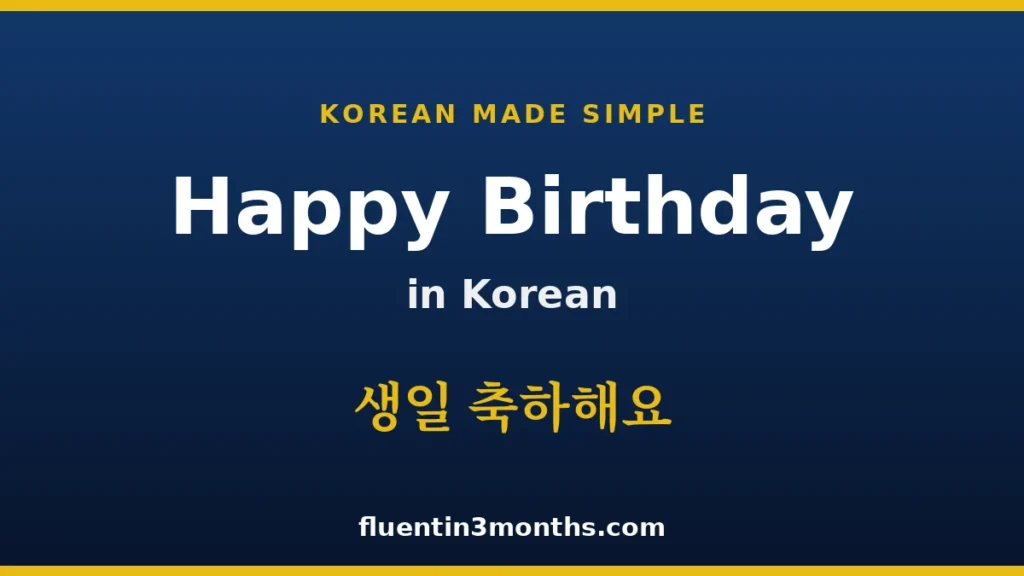
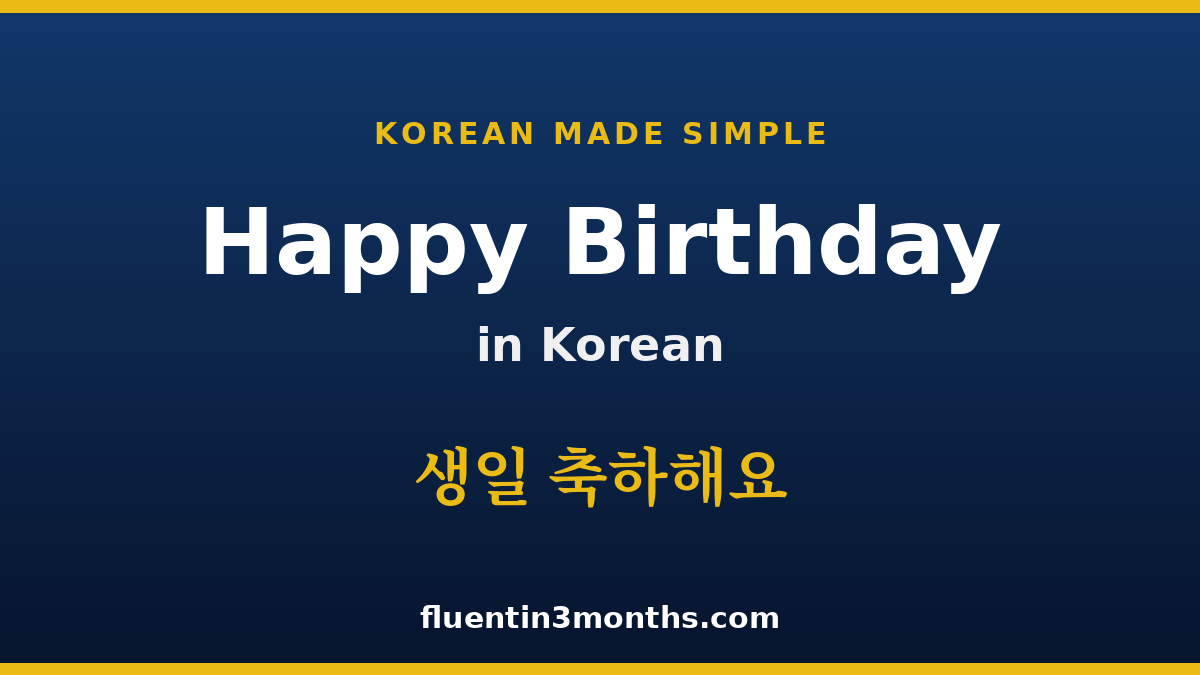
The most widely accepted method for wishing someone a happy birthday in Korean is through the phrase "saengil chukhahaeyo" (생일 축하해요). While this phrase serves as the linguistic standard for everyday social interaction, the Korean language—deeply rooted in Confucian values—requires a nuanced approach to social hierarchy, honorifics, and interpersonal relationships. Understanding how to navigate these greetings requires more than rote memorization; it requires an appreciation for the cultural framework that governs communication in South Korea.
The Linguistic Architecture of Korean Birthday Greetings
In Korean, birthday greetings are not static; they are dynamic expressions that shift based on the age, social status, and professional proximity of the participants. The base phrase, "saengil chukhahaeyo," combines the noun "saengil" (birthday) with the verb "chukha-hada" (to congratulate). By adding the polite suffix "-yo," the speaker ensures a level of respect that is appropriate for colleagues, acquaintances, or people with whom one is not yet on intimate terms.
However, moving beyond this baseline involves understanding the distinction between standard politeness and formal deference. For instance, when addressing a superior, an elder, or an individual held in high esteem, the vocabulary itself undergoes a transformation. The word "saengil" is replaced by "saengsin," the honorific equivalent. Similarly, the verb "hada" (to do) is replaced by "deurida," a humble verb signifying the act of offering or giving something of value. Thus, the formal construction "saengsin chukhadeurimnida" represents a profound shift from a casual well-wish to a statement of formal respect.
Chronology and Evolution of Korean Customs
Korean birthday traditions are steeped in centuries of history, yet they continue to adapt to modern societal changes. Historically, the celebration of life was tied to the lunar calendar, and the concept of "age" was calculated differently than in Western nations. For decades, the traditional "seneun nai" (counting age) system was the norm, where an infant was considered one year old at birth, and everyone collectively turned a year older on New Year’s Day.
This cultural phenomenon often resulted in individuals being "two years older" in Korea than they would be by international standards. This changed significantly in June 2023, when the South Korean government enacted legislation to mandate the use of the "man nai" (international age) system for all administrative and civil matters. This transition was designed to streamline international business, legal, and social interactions, effectively ending years of confusion regarding age-based hierarchical requirements. Despite this legal shift, social habits remain deeply ingrained, and many Koreans continue to use the traditional "seneun nai" in casual social settings, illustrating the tension between modernization and cultural preservation.
Cultural Traditions: From Seaweed Soup to Milestone Celebrations
A quintessential element of the Korean birthday experience is the consumption of miyeokguk, or seaweed soup. This dish is not merely a meal; it is a symbolic gesture of gratitude toward the mother. Because miyeokguk is traditionally consumed by women recovering from childbirth, eating it on one’s birthday serves as a recurring reminder of the physical toll of birth and the maternal care received during infancy.
Furthermore, the doljanchi, or first-birthday celebration, remains one of the most significant milestones in a Korean child’s life. Historically, high infant mortality rates meant that surviving the first year was a monumental achievement worthy of celebration. A central component of this event is the doljabi ceremony. During this ritual, the child is placed before an array of items—such as thread, money, or writing implements—and encouraged to grasp one. Each item serves as a symbolic prediction of the child’s future: thread signifies longevity, money suggests wealth, and books or pens represent academic or professional success. While modern iterations of this ceremony are often lighthearted, they remain a vital link to traditional beliefs about fate and prosperity.
Statistical Context and Social Implications
The importance of these customs is reflected in the consumer behavior and social investment surrounding these events. Data from the South Korean Ministry of Interior and Safety suggests that the preservation of such cultural rituals acts as a social stabilizer in an increasingly digitized society. When birthdays are observed with traditional markers like miyeokguk or formal honorifics, it reinforces the collective social cohesion that defines Korean interpersonal dynamics.
Sociologists note that the strict adherence to speech levels—ranging from banmal (casual speech) to honorifics—is not merely about politeness; it is a mechanism for maintaining order. Because age is a primary determinant of one’s position in the social hierarchy, knowing when to switch from a casual greeting to a formal one is a critical social skill. Misusing these levels can be perceived as an affront or, at the very least, a lack of social awareness.
Navigating Pronunciation and Linguistic Nuance
While Romanized guides like "saengil chukhahaeyo" provide a functional starting point for learners, they fail to capture the subtle phonetic shifts inherent in the Korean language. For instance, the pronunciation of "g" sounds and the aspiration of consonants are rarely rendered accurately by the Latin alphabet.
To achieve natural fluency, one must look toward the Hangul writing system, created by King Sejong the Great in 1443. Hangul is unique because its consonant shapes are based on the anatomy of the mouth and throat used to produce each sound. Mastering these letters is the only way to move beyond the "rough approximations" provided by Romanization. As one begins to integrate these phrases into daily life, it is recommended that learners utilize audio-based resources, such as language acquisition platforms, to internalize the correct intonation and cadence.
Broader Impact: The Globalization of Korean Culture
The rising interest in Korean culture, often termed the "Hallyu" or "Korean Wave," has brought increased international attention to these social customs. As more individuals engage with Korean media, language, and business, the demand for cultural literacy has surged. Understanding the difference between a simple birthday wish and an honorific expression is now a necessary skill for professionals working with Korean partners.
The implications of this cultural exchange are profound. By adopting local customs—such as using the appropriate birthday greeting—foreigners demonstrate a respect for Korean values that transcends mere linguistic ability. Whether one is attending a doljanchi or simply sending a text message to a colleague, the choice of words serves as a bridge between cultures.
Final Considerations for the Learner
For those beginning their journey into the Korean language, the best advice remains to prioritize context. Start with the versatile "saengil chukhahaeyo" for general use. As relationships deepen and one gains a better understanding of the individuals involved, transition to more specific, honorific, or casual forms as the situation dictates.
Ultimately, the goal of learning these expressions is to participate authentically in the culture. Whether it is through the singing of the "Happy Birthday" song—which, in Korea, maintains the familiar Western tune but is sung with an underlying formality—or the careful selection of a gift for an elder, every interaction is an opportunity to practice the values of respect and community that lie at the heart of Korean society. As the nation continues to balance its rapid technological advancement with its deep-seated historical roots, these birthday traditions will undoubtedly remain a cornerstone of its social fabric, providing a sense of continuity in a rapidly changing world.