


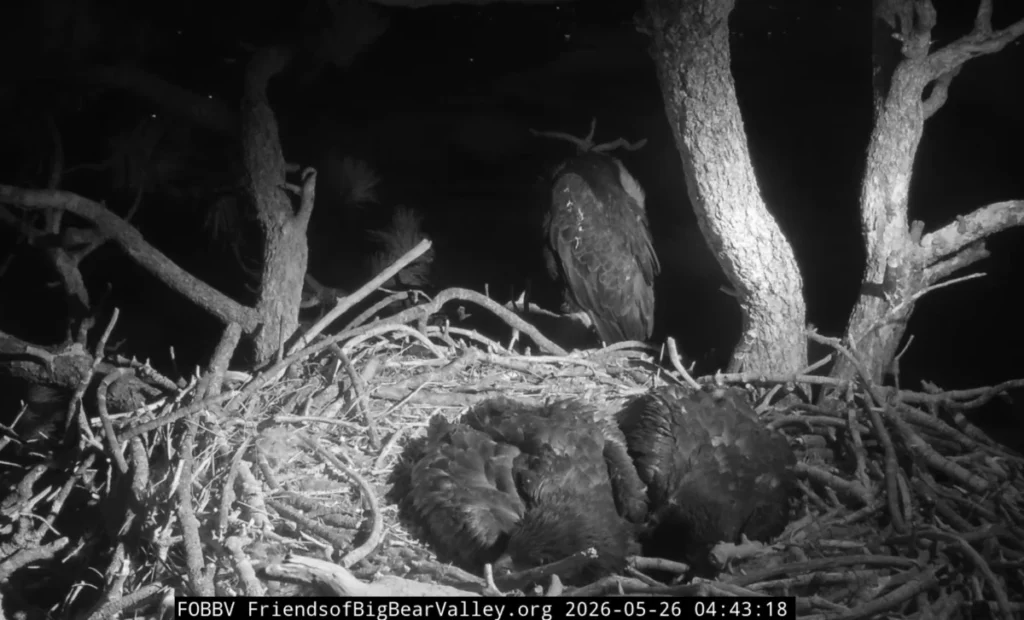
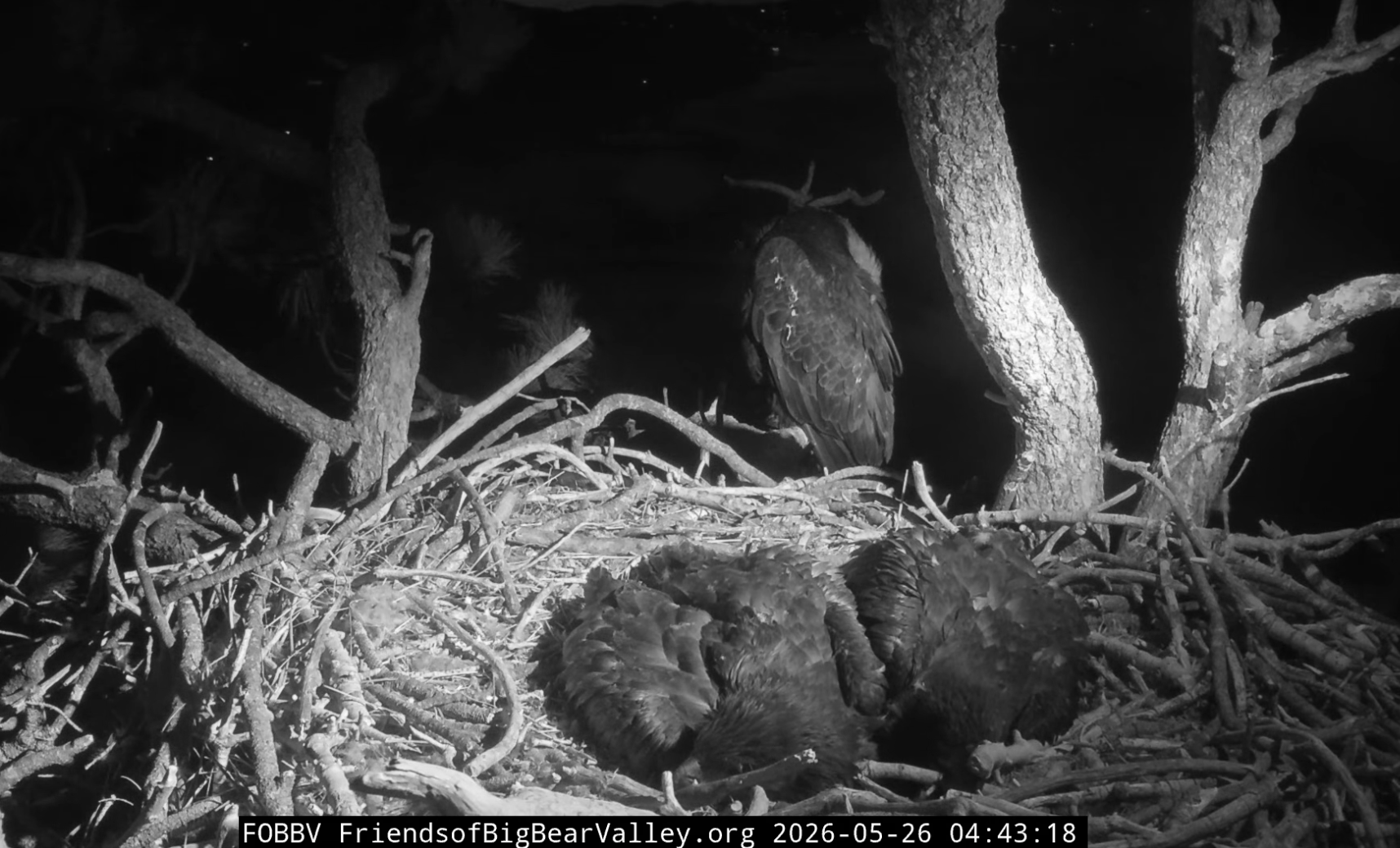
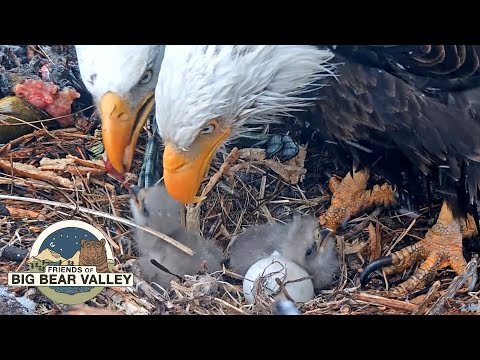
The domestic dynamics within the world’s most watched bald eagle nest have shifted significantly as the 2026 nesting season enters a critical phase of development. Jackie and Shadow, the resident bald eagle pair of Big Bear Valley in the San Bernardino National Forest, have officially transitioned their nocturnal habits to accommodate the rapid growth of their two offspring, Sandy and Luna. Observations from the 24/7 livestream, managed by the nonprofit organization Friends of Big Bear Valley (FOBBV), confirm that the adult eagles have begun roosting on nearby branches rather than within the nest bowl itself. This behavioral shift, while appearing to be a parental "move out," is a documented biological necessity driven by the physical maturation of the eaglets and the structural limitations of the nest.
As of late May 2026, Sandy and Luna have reached approximately 80 to 90 percent of their adult size. At six to seven weeks of age, bald eagle chicks undergo a period of intense muscular development and feather growth, requiring more physical space to stretch, wing-tuck, and exercise. The transition of the parents to the "front porch"—a sturdy branch adjacent to the nest—is a strategic move to prevent accidental injury and manage the limited real estate of the nest bowl.
The Science of Roosting and Avian Space Management
The decision for Mama Jackie to sleep on a branch while her chicks occupy the nest is rooted in practical avian biology. According to FOBBV, the primary driver is space management. A bald eagle’s wingspan can reach up to seven feet, and as Sandy and Luna begin to "wingsize"—the act of flapping and strengthening their flight muscles—the nest bowl becomes a hazardous environment for multiple occupants. The risk of being struck by a flailing wing or a sharp talon is high during the night when the eaglets may shift or startle.
Furthermore, adult eagles possess a specialized anatomical feature known as a tendon locking mechanism, or a "ratcheting" mechanism in their feet. When an eagle lands on a branch and its weight settles, the tendons in its legs automatically pull the talons closed. A series of tiny ridges on the tendons lock into place, allowing the bird to maintain a vice-like grip on a perch without any conscious muscle exertion. This evolutionary adaptation allows Jackie and Shadow to sleep soundly while standing upright, conserving vital metabolic energy that would otherwise be spent on muscle contraction. This mechanism is so efficient that eagles have been known to remain perched even in high winds or during deep sleep.
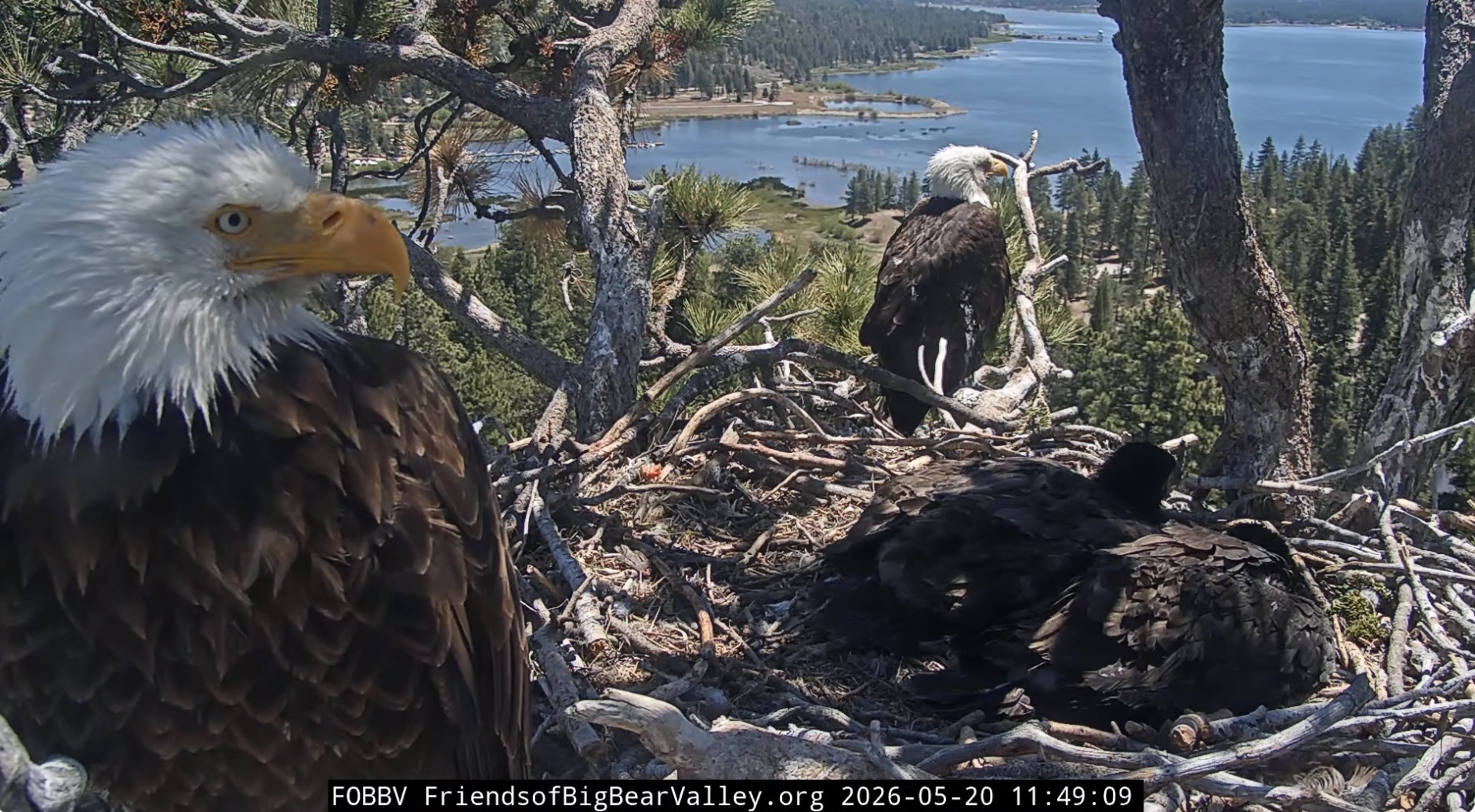
While Jackie no longer shares the immediate nest bowl at night, her proximity remains a vital component of the eaglets’ safety. By roosting on a nearby branch, she maintains a clear line of sight to the nest, ready to defend against nocturnal predators such as Great Horned Owls or to shield the young from sudden environmental shifts.
Chronology of the 2026 Nesting Season
The 2026 season has been characterized by resilience following an initially devastating start. The timeline of events highlights the tenacity of the Big Bear pair:
- January 2026: Jackie and Shadow produced an initial clutch of two eggs. However, in a moment of vulnerability, the nest was breached by ravens, which destroyed both eggs. This event sparked widespread concern among the global "Eagle Peep" community that monitors the stream.
- February 2026: Defying the odds of a typical nesting cycle, Jackie laid a second clutch of two eggs. This "replacement clutch" is common in raptors if the first attempt fails early enough in the season.
- April 4, 2026: Chick 1, later named Sandy, hatched at 9:33 p.m. PDT. The hatching was captured in high definition, showing the chick’s first "pip" through the shell.
- April 5, 2026: Chick 2, later named Luna, hatched at 8:30 a.m. PDT, less than 12 hours after its sibling.
- May 1, 2026: Following a public naming contest that drew tens of thousands of submissions, FOBBV officially announced the names Sandy and Luna, reflecting the natural elements of the Big Bear landscape.
- Late May 2026: The eaglets began "branching" behaviors and significant wing-flapping exercises, leading to the parents’ transition to nocturnal branch roosting.
Environmental Pressures and Survival Statistics
The survival of bald eagle eaglets is a precarious journey, with data suggesting that only about 70 percent of fledglings survive their first year. Sandy and Luna face a gauntlet of challenges before they can be considered self-sufficient.
Predation remains a constant threat. While bald eagles are apex predators, their young are vulnerable to other large raptors and corvids. Additionally, the geography of Big Bear Valley presents unique weather-related risks. In the 2025 season, a severe March snowstorm resulted in the loss of one of Jackie and Shadow’s three chicks, highlighting how even minor shifts in temperature and precipitation can have lethal consequences for unfeathered young.
Human-wildlife interaction also poses a significant risk. As the eaglets prepare to fledge—likely between mid-June and mid-July 2026—they will take their first flights. This period is the most dangerous stage of their lives. Fledglings often land on the ground or low-lying structures as they refine their landing skills. In the Big Bear area, vehicle strikes are a leading cause of mortality for young eagles who may attempt to scavenge roadkill near local highways.
Historical Context of the Big Bear Nest
Jackie and Shadow have become international celebrities, providing scientists and the public with a rare, intimate look at the life cycle of the Haliaeetus leucocephalus. The pair first established their bond in 2018. Since then, their reproductive success has been a subject of intense study.
Prior to the 2026 season, the pair successfully raised chicks in 2019 and 2022. However, they faced consecutive "empty nest" years in 2023 and 2024 when their eggs failed to hatch due to environmental factors or infertility. The success of the 2026 brood is particularly significant given the statistics; only 50 percent of bald eagle eggs successfully reach the hatching stage.
The memory of the 2025 brood, Sunny and Gizmo, also looms large in the community’s mind. That year saw the rare occurrence of a three-egg clutch, though only two survived the harsh winter storms. The continued success of Jackie and Shadow is often cited by conservationists as a testament to the recovery of the species, which was removed from the endangered species list in 2007.
Conservation Efforts and the "Save Moon Camp" Initiative
The popularity of the Big Bear livestream has transcended entertainment, fueling a massive conservation movement. Currently, environmental groups and FOBBV are engaged in a high-stakes fundraising effort to secure the future of the eagles’ habitat.
The "Save Moon Camp" initiative aims to raise $10 million to purchase and protect a critical 62-acre parcel of land known as Moon Camp. This area serves as a primary foraging and perching ground for Jackie, Shadow, and their offspring. The land is currently slated for residential development, which conservationists argue would introduce noise pollution, light pollution, and physical barriers that could drive the eagles away from the valley.
Protecting this foraging area is considered essential for the long-term viability of the nest. As the eaglets fledge, they require undisturbed areas to practice hunting and to find food without human interference. The success of this fundraising effort will likely determine whether future generations of eagles can continue to thrive in the San Bernardino National Forest.
Future Implications: The Fledging and Beyond
In the coming weeks, viewers can expect to see Sandy and Luna become increasingly active. "Branching"—the act of hopping from the nest bowl to adjacent limbs—is the final step before the first flight. During this time, the adult eagles will often withhold food slightly, encouraging the chicks to leave the nest to meet them for a meal, a form of "tough love" designed to trigger the fledging instinct.
Once Sandy and Luna take flight, they will remain dependent on Jackie and Shadow for several weeks as they learn the complex art of fishing and scavenging. Eventually, the young eagles will disperse. Data from previous Southern California fledglings show a wide range of migration; some have been tracked as far north as British Columbia and as far south as Baja California.
Because FOBBV does not physically tag or GPS-collar the birds to avoid human interference, the specific journeys of Sandy and Luna will remain a mystery once they leave the Big Bear Valley. However, their contribution to the local population and the wealth of data provided by their 24/7 observation will continue to inform eagle conservation efforts for years to come. For now, the sight of Jackie and Shadow watching over their nearly-grown chicks from the "front porch" remains a symbol of biological success and the enduring appeal of the natural world.