


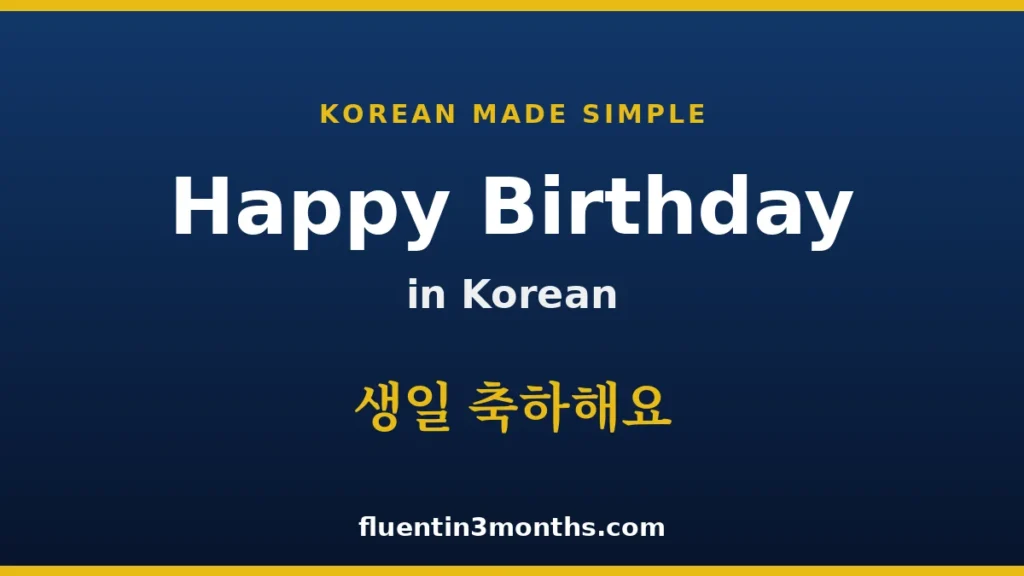
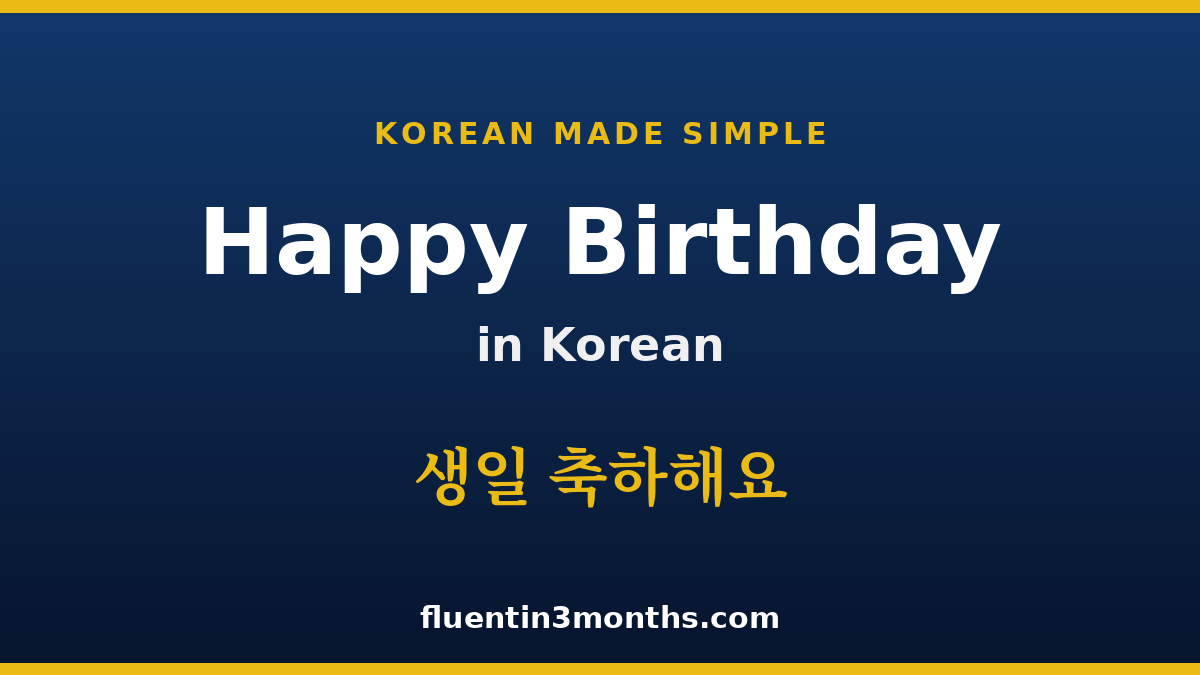
The most common and versatile way to express "happy birthday" in the Korean language is saengil chukhahaeyo (생일 축하해요). While this phrase serves as a reliable default for social interactions, the nuances of the Korean language—governed by complex social hierarchies, honorifics, and context-dependent speech styles—require a deeper understanding to ensure appropriate delivery. Mastery of these greetings involves more than simple vocabulary; it requires an awareness of the social dynamics that define one of the world’s most etiquette-conscious cultures.
Linguistic Foundations and Hierarchy
In the Korean language, the method of addressing someone is fundamentally tied to the speaker’s relationship with the recipient. Unlike many Western languages where a single phrase suffices for all social strata, Korean necessitates a shift in verb endings and nouns based on age, social standing, and intimacy.
The standard polite form, saengil chukhahaeyo, utilizes the polite speech level known as haeyoche. This is appropriate for acquaintances, colleagues, or individuals with whom one does not share a deeply intimate, casual bond. To understand the structure, one must analyze the components: saengil (birthday) and chukhahaeyo (to congratulate). Korean culture approaches birthdays as a communal milestone of life, thus the linguistic focus is placed on the act of offering congratulations rather than simply stating the event.
For those in an established, close relationship, such as peers or individuals who have mutually agreed to forgo formal constraints, banmal (casual speech) is employed. In this context, the phrase is shortened to saengil chukhahae (생일 축하해). Conversely, when addressing elders or individuals held in high esteem, one must shift to the honorific form: saengsin chukhadeurimnida (생신 축하드립니다). This transition involves changing the noun saengil to its honorific counterpart, saengsin, and utilizing the humble verb deurida to demonstrate deference.
Chronology and Evolution of Traditions
Korean birthday customs are rooted in deep-seated historical practices, most notably the celebration of the first birthday, known as doljanchi. Historically, given high infant mortality rates in pre-modern Korea, surviving to the first anniversary was a significant achievement, warranting a formal celebration to ensure the child’s future health and prosperity.
A central element of this celebration is doljabi, a ritual in which a child is presented with an array of objects—each symbolizing a different path in life. Historically, these included thread (representing longevity), money (wealth), and writing tools (scholarly success). While contemporary urban families may modernize the objects, the fundamental purpose of the doljabi remains a cornerstone of the traditional Korean lifecycle.
Another essential cultural marker is the consumption of miyeokguk, or seaweed soup. This dish is inextricably linked to the maternal experience, traditionally served to women post-childbirth due to its high iodine and mineral content. By consuming this soup on their birthday, Koreans acknowledge the labor and care of their mothers, linking the individual’s milestone to their biological origins.
The Impact of Legislative Changes on Age Counting
A significant shift occurred in South Korean social and legal structures in June 2023, when the government officially moved to standardize the international age system. Historically, South Korea operated under seneun nai, or "Korean age," where an individual was considered one year old at birth, with everyone collectively aging one year on the first day of the lunar year.
This traditional system often created discrepancies of one or two years compared to the international standard (man nai). The 2023 legislative reform sought to harmonize administrative, civil, and legal procedures with international norms to reduce social confusion. While man nai is now the mandatory standard for government documents and legal contracts, the older generation and colloquial social habits remain influenced by the traditional system. Observers note that while the law has shifted, the cultural transition—particularly in how people perceive and announce their age—will likely be a gradual process.
Analytical Perspective on Social Etiquette
Sociolinguistic analysis of Korean birthday greetings reveals that the language acts as a mirror for social values. The necessity of choosing between saengil and saengsin highlights the importance of seniority and hierarchy. Failure to use the appropriate honorifics can be perceived as disrespectful or socially tone-deaf, regardless of the speaker’s intention.
The "birthday song," while set to the internationally recognized melody, also underscores this cultural priority. Even in informal settings, the lyrics often default to a more formal structure, reflecting a collective social consensus that birthday celebrations are moments of respect that transcend the typical casual nature of a peer-to-peer conversation.
Practical Application for Non-Native Speakers
For those navigating these linguistic waters, the following hierarchy of usage is recommended:
- General/Professional: Saengil chukhahaeyo is the safest and most broadly accepted phrase for workplace or acquaintance-based settings.
- Casual/Intimate: Saengil chukhahae should be reserved strictly for close friends or family members who have explicitly moved into a casual relationship dynamic.
- Formal/Respectful: Saengsin chukhadeurimnida is mandatory when addressing grandparents, parents, or seniors in a formal environment.
The pronunciation of these phrases requires attention to the specific phonetic structure of the Korean alphabet, or Hangul. Developed under King Sejong the Great in the 15th century, Hangul was designed to reflect the physiological production of sound. For instance, consonants were shaped to mimic the position of the tongue and throat. Learners are encouraged to move beyond romanized approximations—which often fail to capture the subtle aspiration and tension of Korean consonants—and instead utilize audio-based resources to perfect the necessary intonation.
Conclusion and Broader Implications
The act of wishing someone a "happy birthday" in Korean is a window into a culture that prioritizes social harmony, respect for seniority, and historical continuity. By integrating the appropriate linguistic markers and acknowledging the significance of traditions like miyeokguk and doljanchi, a speaker demonstrates more than just language proficiency; they show a genuine engagement with the cultural fabric of South Korea.
As the country continues to modernize its legal frameworks regarding age and identity, the underlying traditions of the birthday celebration remain steadfast. Whether through the formal precision of saengsin chukhadeurimnida or the casual intimacy of saengil chukhahae, the act of congratulating another on their life’s milestone remains one of the most vital threads in the tapestry of Korean interpersonal relationships. For those aiming to build meaningful connections within the culture, treating these greetings with the appropriate gravity and respect is a foundational step in effective communication.