




As enterprises increasingly transition from experimental artificial intelligence deployments to production-grade agentic workflows, IT infrastructure providers are under mounting pressure to deliver robust management, security, and governance frameworks. Addressing this evolving market demand, Nutanix has announced a sweeping set of updates to the Nutanix Cloud Platform (NCP). Headlining the release is the general availability of Nutanix Enterprise AI (NAI) 2.8 alongside the upcoming release of the Nutanix Kubernetes Platform (NKP) 2.19. These strategic platform enhancements are specifically engineered to allow organizations to run complex AI workloads concurrently with their existing virtualized and containerized legacy applications, applying unified governance, operations, and security policies across all environments.
Announced on August 26, the latest updates reinforce Nutanix’s signature "dual-native" architectural philosophy, which treats virtual machines and containers as first-class infrastructure citizens. This approach aims to eliminate the operational silos that traditionally plague enterprise IT departments when adopting emerging technologies. Rather than forcing organizations to migrate data-heavy workloads into isolated, specialized silos or entirely rebuild core business systems, Nutanix aims to bring artificial intelligence capabilities directly to where data already resides.
The Evolution of Dual-Native Infrastructure and Enterprise Strategy
The modern corporate data center is a complex ecosystem where traditional enterprise resource planning systems, relational databases, web applications, and modern cloud-native microservices must coexist. The introduction of generative AI and autonomous agentic systems—AI agents capable of planning, executing multi-step workflows, and interacting with external application programming interfaces—has strained legacy infrastructure. Companies frequently encounter severe bottlenecks when attempting to provision high-performance computing resources, manage large language models, and enforce strict regulatory compliance across fragmented platforms.
Nutanix’s strategy centers on bridging this operational divide. By positioning virtual machines and containers on an equal footing within a single, integrated platform, the company seeks to streamline the deployment lifecycle for machine learning pipelines and autonomous agents.

"Enterprise AI should not require customers to rebuild the systems that already run their business," stated Thomas Cornely, executive vice president of product management at Nutanix, emphasizing the core philosophy driving the platform’s continuous development.
This ethos has shaped the rapid sequence of product announcements and technical releases leading up to the late-August rollout of NAI 2.8 and NKP 2.19.
Chronology of Releases and Technical Milestones
The path toward comprehensive production agentic AI governance has unfolded through a deliberate sequence of software releases and architectural milestones throughout the year:
- August 10: Nutanix open-sourced its Model Context Protocol (MCP) server for NCP. Designed to bridge AI systems with foundational platform operations, this software utilizes the Nutanix Prism v4 API to allow developer tools and autonomous agents to securely interact with the infrastructure. Early compatibility was established with prominent developer assistants, including GitHub Copilot, Claude Code, and Cursor. The Prism v4 API Gateway acts as the central gatekeeper, managing execution, role-based access control, throttling, metering, and auditing.
- August 26: Nutanix officially announced the expansion of the Nutanix Cloud Platform, highlighting the immediate general availability of Nutanix Enterprise AI 2.8 and the impending release of the Nutanix Kubernetes Platform 2.19. Additionally, the company announced the general availability of Service Provider Central (SP Central), a multi-tenant control plane designed to unify the management of infrastructure, applications, cloud-native services, and artificial intelligence workloads across distributed environments.
This calculated timeline underscores the accelerated pace at which enterprise infrastructure providers must iterate to keep pace with rapid advancements in artificial intelligence and application development frameworks.
Deep Dive: Nutanix Enterprise AI 2.8 and MCP Governance
As developers increasingly deploy agentic systems capable of executing automated tasks, governance and security have emerged as primary concerns for Chief Information Security Officers. Unmonitored AI agents interacting with sensitive corporate data repositories present severe vulnerabilities. To mitigate these risks, Nutanix Enterprise AI 2.8 introduces generally available Model Context Protocol server management natively within the Nutanix Agent Gateway.
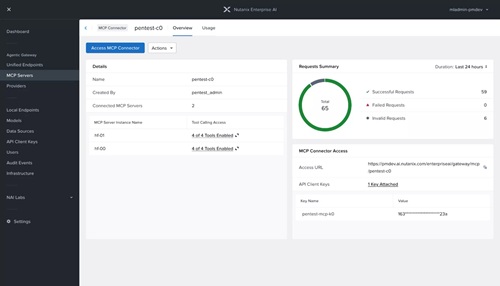
The Agent Gateway functions as a centralized routing and connection point bridging autonomous AI agents with various MCP servers, whether those servers are hosted locally inside the Nutanix Enterprise AI environment or managed remotely. Through this gateway, system administrators can exercise granular control by assigning specific tool permissions to designated users or individual API keys. Furthermore, locally deployed MCP servers within the NAI environment benefit from automated rolling updates, ensuring that security patches and feature enhancements can be applied without incurring system downtime.
Beyond governance, NAI 2.8 extends the capabilities of Nutanix Private Inference. The platform now supports fine-tuning for foundational models containing fewer than 8 billion parameters, enabling organizations to customize smaller, highly efficient models tailored to specific internal use cases without leaking proprietary data to public cloud providers. Additionally, the release provides robust support for deploying NVIDIA NIM microservices within fully air-gapped network environments, satisfying the stringent security requirements of government agencies, financial institutions, and healthcare providers.
To support massive enterprise-scale deployments, Nutanix has introduced several features currently designated as technical previews:
- Multi-node and multi-GPU inference: Engineered to support colossal frontier models containing more than 100 billion parameters, allowing distributed computing resources to handle intensive reasoning tasks.
- KV cache offloading: Transferring Key-Value cache memory from expensive GPU VRAM to standard CPU host memory, optimizing hardware utilization and reducing overall operational costs.
Nutanix has issued standard technical advisories clarifying that features released under tech preview status are intended strictly for evaluation and testing purposes and should not be deployed within mission-critical production environments.
The architectural separation between the NCP MCP server released in early August and the Agent Gateway in NAI 2.8 provides a dual-layer approach to security. While the NCP MCP server exposes native Nutanix infrastructure operations to developer-facing AI assistants, the Agent Gateway provides centralized oversight over how autonomous agents access external tools, APIs, and underlying enterprise data stores.

Expanding Container and Bare-Metal Capabilities with NKP 2.19
Complementing the software-level intelligence introduced in NAI 2.8, the forthcoming Nutanix Kubernetes Platform 2.19 focuses heavily on modernizing container orchestration across diverse physical and virtualized infrastructure footprints. Scheduled for general availability soon, NKP 2.19 bridges the gap between traditional enterprise virtualization and modern cloud-native architectures.
A key highlight of the NKP 2.19 release is the expansion of NKP Metal, a capability designed to extend the streamlined Nutanix operating model directly onto bare-metal physical servers. By leveraging integrated Nutanix Foundation and Lifecycle Manager technologies, NKP Metal automates complex administrative tasks such as initial node provisioning, operating system deployment, and firmware lifecycle management. This capability is particularly beneficial for high-performance computing workloads that demand direct, uncompromised access to underlying hardware components without the abstraction layer of a hypervisor.
Concurrently, NKP running on the AHV hypervisor can be integrated directly with Nutanix Flow. This integration enables sophisticated network-level micro-segmentation and isolation of AI agents, preventing unauthorized lateral movement across the network in the event of a security compromise.
To accelerate time-to-value for machine learning engineers, NKP 2.19 introduces a curated AI Applications Catalog. This catalog provides pre-validated, easily deployable packages for popular open-source artificial intelligence and data engineering software. Among the notable applications included in the catalog are Kubeflow for orchestrating machine learning workflows, Milvus for high-performance vector database operations, and Slurm for managing cluster workloads and job scheduling.
Reinforcing its commitment to open standards and industry interoperability, Nutanix announced that the Nutanix Kubernetes Platform has successfully earned CNCF Kubernetes AI Conformant Platform certification. This credential guarantees that workloads developed on NKP adhere strictly to Cloud Native Computing Foundation standards, ensuring portability and avoiding vendor lock-in.

Market Implications and Strategic Analysis
The convergence of artificial intelligence, virtualization, and container management represents a profound shift in enterprise IT spending and architectural design. For years, organizations pursued artificial intelligence initiatives through isolated data science projects, often operating in parallel or completely detached from core IT infrastructure management. As these proof-of-concept projects mature into production-level agentic workflows—where software agents actively read databases, execute transactions, and orchestrate automated business processes—the limitations of siloed approaches have become glaringly apparent.
By embedding AI capabilities directly into the fabric of the Nutanix Cloud Platform, the company is positioning itself as a comprehensive infrastructure layer for the enterprise AI era. The integration of advanced governance tools like MCP server management and the Agent Gateway directly addresses enterprise anxieties regarding safety, auditing, and regulatory compliance. Organizations can no longer afford to treat AI as an experimental peripheral; it must be managed with the same rigorous governance applied to traditional financial databases and customer relationship management systems.
Furthermore, the introduction of SP Central addresses the operational complexity faced by managed service providers and large enterprises managing multi-tenant environments. By providing a unified control plane capable of simultaneously overseeing infrastructure, native applications, cloud-native services, and AI pipelines, Nutanix significantly reduces administrative overhead.
The broader industry implication is clear: infrastructure vendors that fail to provide a cohesive, dual-native model capable of supporting both virtual machines and modern containers—while simultaneously offering native hooks for AI governance and model inference—risk becoming marginalized. Enterprises demand architectural flexibility that allows them to leverage private infrastructure for data privacy and security while retaining the agility required to rapidly deploy cutting-edge artificial intelligence models.
As Nutanix rolls out NAI 2.8 and prepares for the general availability of NKP 2.19, the company is providing a structured pathway for enterprises striving to operationalize agentic AI safely and at scale. By harmonizing infrastructure management with advanced AI governance, Nutanix aims to ensure that the next generation of enterprise automation is built upon a secure, manageable, and highly resilient foundation.