





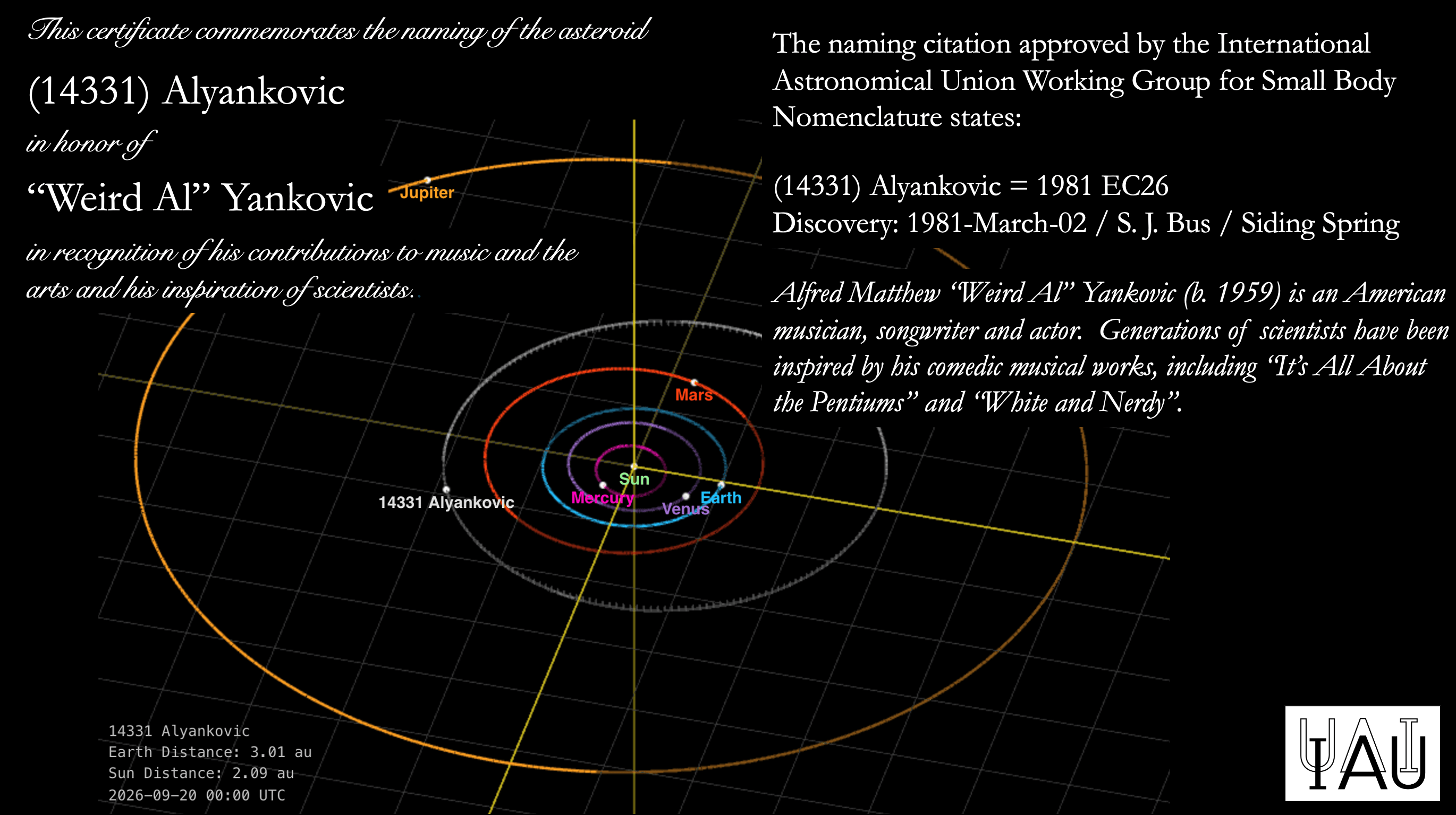
The celestial landscape has officially expanded to include a piece of comedy royalty. The International Astronomical Union (IAU) has formally approved the designation of asteroid (14331) Alyankovic, permanently anchoring the legacy of the legendary musician, parodist, and satirist within our solar system. The naming citation, which recognizes Yankovic’s profound and enduring cultural influence across generations of scientists, engineers, and educators, was formally published in the WGSBN Bulletin, the Minor Planet Center, and the Jet Propulsion Laboratory’s Small Bodies Search.
This rare celestial tribute places the iconic entertainer among an elite group of cultural figures whose impact transcends traditional artistic boundaries. While asteroid naming conventions have historically been reserved for pioneering researchers, astronomers, and foundational educators, the scientific community occasionally grants this distinction to individuals outside of formal STEM fields whose work instills a deep, lifelong passion for learning, inquiry, and critical thinking.
The Discovery and Characteristics of Asteroid (14331) Alyankovic
Asteroid (14331) Alyankovic is not a fleeting cosmic visitor, but a permanent resident of the solar system. Originally discovered on March 2, 1981, by astronomer Stephen J. Bus at the historic Siding Spring Observatory in Coonabarabran, New South Wales, Australia, the celestial body has been carefully tracked for decades by observatories worldwide.
Orbiting the Sun within the Main Asteroid Belt—the vast circumstellar disk situated between the orbits of Mars and Jupiter—the asteroid measures an estimated 1 to 1.25 miles in diameter. It completes one full revolution around the Sun approximately every 1,378 Earth days, or just under 3.77 years.

Astronomically, (14331) Alyankovic is classified as a silicate, or S-type, asteroid. According to data compiled by NASA, S-type asteroids are primarily composed of iron and magnesium-silicates. While these rocky bodies dominate the inner regions of the Main Asteroid Belt, they account for roughly 17 percent of all known asteroids in the solar system, making them a significant subject of study for planetary scientists seeking to understand the primordial composition of the early solar system.
A Legacy of Inspiring the Scientific Community
The decision by the IAU to honor Yankovic stems from his unique position in modern popular culture as an artist who made intelligence, technical proficiency, and intellectual curiosity not only acceptable, but undeniably cool. For decades, the musician’s catalog has resonated deeply within scientific and academic circles.
Tracks such as "It’s All About the Pentiums," "White and Nerdy," and "Word Crimes" celebrated computer literacy, linguistic precision, and the archetypal "nerd" culture long before mainstream media embraced those themes. Furthermore, his 2009 immersive short film, Al’s Brain: A 3-D Journey Through the Human Brain, utilized humor and accessible storytelling to engage audiences with neuroscience.
Dr. Allison McGraw, a planetary scientist at the Lunar and Planetary Institute in Houston, Texas, emphasized the profound cultural footprint Yankovic left on the scientific community.
"The asteroid science community believes Weird Al’s influence extends far beyond music," Dr. McGraw said. "Many of us grew up listening to Weird Al’s music while learning about computers, science, mathematics, and technology. For countless scientists, engineers, programmers, educators, and students, his work helped create an environment where being enthusiastic about learning was something worth celebrating. His work has inspired curiosity, creativity, lifelong learning, and a sense of joy in discovering how the world works. That is precisely why we felt he belonged among the stars."
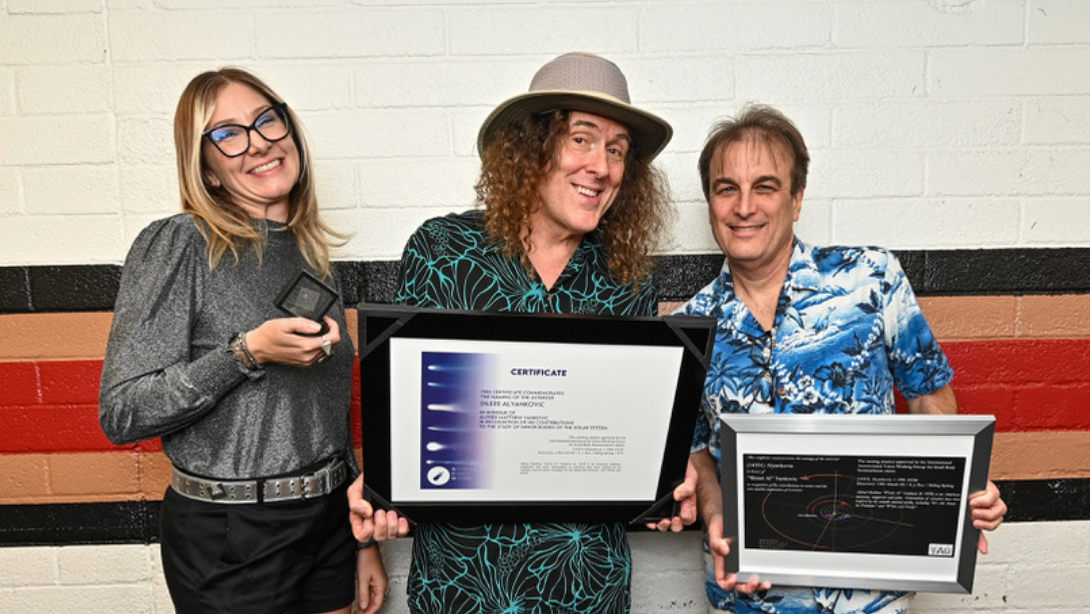
The formal presentation of the asteroid’s certificate brought together planetary scientists, including Dr. Steve Desch and Dr. Allison McGraw, alongside the musician himself, cementing a bridge between empirical scientific research and the arts. Responding to the astronomical honor with his trademark wit, Yankovic remarked, "This is perhaps the greatest honor I’ve ever received. I just hope this isn’t the asteroid that winds up destroying the Earth."
Historical Precedents: Celebrities and Public Figures in the Cosmos
The naming of an asteroid after a comedic musician is part of a broader, deliberate tradition within astronomy to acknowledge cultural touchstones. While the IAU maintains rigorous standards for celestial nomenclature—prohibiting commercial naming schemes and requiring that names of living individuals possess demonstrable, long-term historical or societal significance—exceptions are made for those who shape human intellectual history.
Similarly, the scientific and taxonomic communities have frequently looked to entertainment and literature to name newly discovered flora, fauna, and geological formations. Notable examples include Aegrotocatellus jaggeri, a prehistoric trilobite named after Rolling Stones frontman Mick Jagger; Scaptia beyonceae, a species of horsefly named for pop icon Beyoncé; and Mesohippus kermiti, an ancient proto-amphibian named in honor of Jim Henson’s beloved creation, Kermit the Frog.
However, stellar and asteroid designations carry a distinct gravity. Unlike terrestrial species classifications that may face ecological shifts, objects in the Main Asteroid Belt persist on astronomical timescales, ensuring that the namesake will endure for billions of years.
A Milestone in a Storied Career
This celestial recognition adds to an extraordinary five-decade career that has continually shattered expectations for what a comedy musician can achieve. Yankovic holds the historic distinction of being the first comedy artist to debut an album at the number one spot on the Billboard Top 200 chart. His trophy cabinet boasts five Grammy Awards and a Primetime Emmy Award, complemented by a star on the Hollywood Walk of Fame.
Despite reaching stellar heights both literally and figuratively, the artist maintains a rigorous schedule. As the astronomical community celebrates the formal cataloging of asteroid (14331) Alyankovic, the musician remains actively engaged in his craft, currently maintaining a demanding live touring schedule through October 17.
Broader Implications and Sociological Impact
The permanent inclusion of Yankovic’s name in the solar system highlights a vital shift in how society perceives the intersection of science and popular culture. Historically, media tropes often isolated intellectual pursuits from mainstream entertainment, frequently casting academics and enthusiasts as social outsiders.
By championing intellectualism, grammar, technology, and scientific inquiry through universally accessible parody, artists like Yankovic played a subtle yet powerful role in shifting cultural attitudes. Sociologists and educators note that destigmatizing curiosity is a foundational step in encouraging youth participation in STEM (Science, Technology, Engineering, and Mathematics) fields. By honoring this contribution, the IAU acknowledges that cultural architects who foster a love of learning are just as vital to scientific progress as the researchers working in the laboratory.
As asteroid (14331) Alyankovic continues its silent, steady transit through the void between Mars and Jupiter, it serves as a permanent testament to the enduring power of humor, education, and the joyful pursuit of knowledge.