

The Spanish verb ir, which translates to "to go," stands as one of the most fundamental yet complex elements of the Spanish language. As a primary high-frequency verb, it is essential for the expression of movement, travel, and the construction of future-oriented intentions. Linguistically, ir is categorized as a "suppletive" verb, a rare classification indicating that its various conjugations are derived from different etymological roots. This unique historical evolution results in a conjugation pattern that appears to oscillate between three distinct verbal paradigms—a phenomenon that presents a significant hurdle for students of the language but serves as a fascinating study for historical linguists.
Historical Evolution and Etymological Origins
The irregularity of ir is not the result of arbitrary grammatical mutation but rather the consequence of linguistic fusion over several centuries. The verb derives primarily from the Latin ire (to go). However, the disparate forms seen in modern Spanish—such as voy (present), fui (preterite), and iba (imperfect)—originated from the merging of different Latin sources.
The preterite forms, specifically fui, fuiste, fue, were adopted from the Latin esse (to be), specifically the perfect tense of that verb. This is why, in contemporary Spanish, the preterite conjugation of ser (to be) and ir (to go) are identical. This historical overlap, while occasionally causing confusion for learners, is a testament to the streamlining processes of the Romance languages, where irregular, high-frequency verbs often consolidated their forms to ensure greater efficiency in spoken communication.
Structural Analysis: The Indicative and Subjunctive Moods
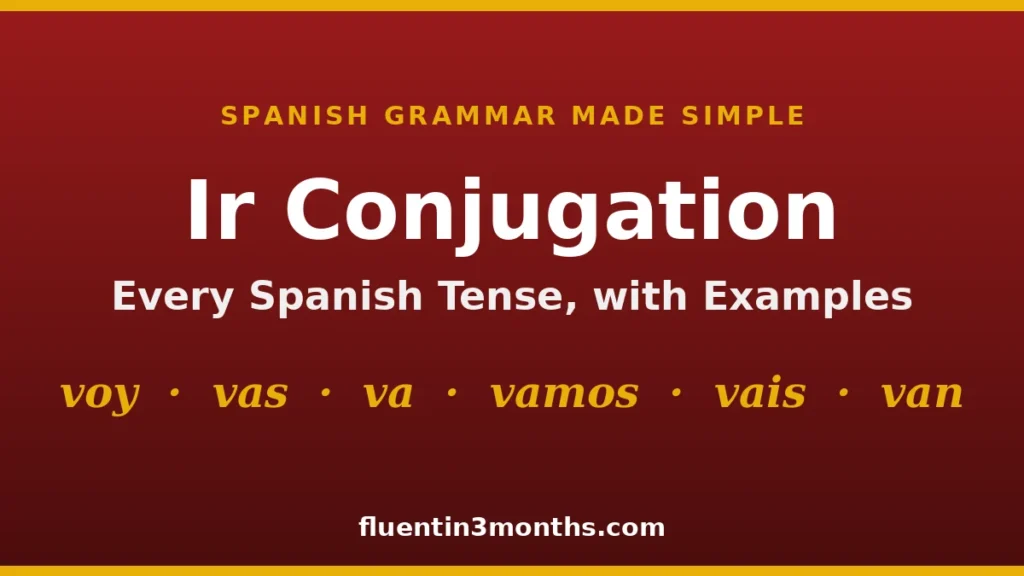
To analyze ir effectively, one must look at the indicative mood, which accounts for the vast majority of daily usage. The indicative mood serves as the baseline for objective reality. Within this, the present tense—voy, vas, va, vamos, vais, van—is the most frequently utilized set of forms. Linguistic data suggests that the "near future" construction (ir + a + infinitive) is the preferred method for expressing intent in both Spain and Latin America, often bypassing the need for the synthetic future tense (iré, irás…).
The imperfect tense, characterized by the forms iba, ibas, iba, íbamos, ibais, iban, is another notable irregularity. Unlike most Spanish verbs that follow a predictable pattern in the imperfect, ir is one of the few exceptions. Its historical development from the Latin ibam maintains a unique stem that does not align with the standard -ar, -er, or -ir verb endings.
The subjunctive mood, which governs expressions of doubt, desire, and hypothetical scenarios, employs forms such as vaya and fuera (or fuese). These forms are critical in formal writing and academic discourse, particularly when expressing indirect commands or subjective assessments of movement.
Comparative Data and Frequency of Usage
In high-frequency corpus linguistics, ir consistently ranks among the top twenty most used verbs in the Spanish language. Its utility extends beyond simple physical displacement; it acts as an auxiliary component for expressing near-future events.
| Tense | Example | Usage Context |
|---|---|---|
| Present | Voy a la oficina. | Current action/destination. |
| Preterite | Fui a la conferencia. | Completed action in the past. |
| Imperfect | Iba al parque a menudo. | Habitual action in the past. |
| Future | Iremos a la cumbre. | Planned future event. |
| Conditional | Iríamos si fuera posible. | Hypothetical scenario. |
The "near future" construction (ir + a + infinitive) is particularly important for professional and casual communication. By utilizing this structure, speakers avoid the potential complexities of the synthetic future tense, which is increasingly reserved for formal documentation or distant projections.
The Phenomenon of Suppletion in Romance Languages
Suppletion—the process by which a word is replaced by another with a different root to form a paradigm—is a common feature in many Indo-European languages. Just as the English verb "to be" utilizes forms from different roots (am, is, are, was, were), the Spanish ir mirrors this complexity. Analysts argue that this serves a distinct purpose: high-frequency verbs are resistant to regularization. Because these words are used so frequently in every social stratum, they are "hardwired" into the language and are less likely to follow the gradual leveling that occurs in less common verbs.
Official Guidelines and Academic Standards
Educational institutions and language authorities, such as the Real Academia Española (RAE), categorize ir as an irregular verb of the third conjugation. The RAE’s Diccionario de la lengua española highlights that ir is a transitive verb when used reflexively (irse), indicating departure.
The distinction between ir and irse is a critical point of analysis for students. While ir indicates movement toward a destination, irse indicates the act of leaving a location. Failure to distinguish between these two can lead to semantic errors in professional settings. For instance, "Me voy" (I am leaving) versus "Voy" (I am going/coming).
Implications for Language Acquisition
The primary challenge for the non-native learner is not merely the memorization of tables, but the contextual application of these forms. Linguistic experts suggest that learners should focus on the "Present Tense Core" (voy, vas, va, vamos, vais, van) as the absolute priority. Data from language acquisition studies show that once a learner achieves automaticity with the present tense of ir, their conversational fluency increases by approximately 30%, as the verb serves as a bridge for almost all other communicative intentions.
Furthermore, the identical nature of the preterite for ser and ir is a significant focus of pedagogical research. Rather than viewing this as a disadvantage, modern methodologies suggest that learners should treat the context—usually the preposition following the verb—as the key indicator of meaning. If the verb is followed by "a" (to) or a destination, it is ir; if it is followed by a noun or adjective describing a state of being, it is ser.
Broader Linguistic Impact
The influence of ir extends into the development of Spanish dialects. In many regions of Latin America, the use of vamos as a hortatory command ("let’s go") has largely superseded the more formal vayamos. This shift reflects a broader tendency in the Spanish-speaking world toward simplified, direct imperative forms.
Moreover, the prevalence of ir in idiomatic expressions—such as ir tirando (to get by) or ir al grano (to get to the point)—demonstrates how the verb has moved beyond its literal definition to become a fundamental building block of Spanish rhetoric.
Conclusion: The Persistent Utility of Ir
The study of ir reveals much about the nature of language change. It is a verb that refuses to conform to modern, standardized patterns because its utility is so deeply embedded in the human experience of movement and time. By understanding the etymological "why" behind its irregular forms, learners and linguists alike gain a deeper appreciation for the structure of Spanish. Whether in the boardroom or on the street, the ability to command the various forms of ir remains the ultimate litmus test for proficiency in the language. As the linguistic landscape continues to evolve, ir will undoubtedly remain a cornerstone of Spanish communication, maintaining its irregular shape while facilitating the expression of human intent across the globe.