


Microsoft has unveiled a comprehensive suite of initiatives and technological advancements designed to integrate generative artificial intelligence into the global education ecosystem, headlined by the launch of the Microsoft Elevate for Educators program. Announced ahead of the Bett UK 2026 conference, this strategic rollout represents a significant expansion of the company’s fifty-year commitment to education, aiming to address the critical challenges of teacher workload, personalized student learning, and the digital skills gap in the burgeoning AI era. The initiative combines high-level professional development with education-specific software tools, including a new "Teach" assistant within Microsoft 365 Copilot and the "Study and Learn Agent" for students, while providing higher education students with free access to premium productivity and career-building platforms.
The centerpiece of the announcement, Microsoft Elevate for Educators, is designed as a bridge between traditional pedagogy and modern technological demands. The program offers educators access to one of the world’s largest peer-to-peer networks, providing a space for collaborative learning and the sharing of best practices regarding AI implementation. By offering free professional development resources and in-demand credentials, Microsoft seeks to build institutional capacity, ensuring that school leaders and classroom teachers are not merely passive users of AI but active architects of its role in the classroom. This initiative is a core component of Microsoft’s broader "Elevate" commitment, which aims to provide 20 million people worldwide with AI skilling credentials over the next two years.
A Chronology of AI Integration in the Classroom
The path to this announcement has been marked by a rapid evolution in how educational institutions perceive and utilize automated technologies. In late 2022 and throughout 2023, the sudden ubiquity of large language models prompted a period of apprehension within the education sector, primarily focused on academic integrity and the potential for plagiarism. However, by 2024, the narrative shifted toward "AI Literacy" as school districts recognized that students would enter a workforce where AI proficiency is a prerequisite.
Microsoft’s involvement in this transition has been iterative. Following the initial integration of Copilot across its enterprise software, the company began tailoring these tools for the specific compliance and privacy needs of schools. The 2025 release of the IDC White Paper, "A Blueprint for AI-Ready Schools," served as a foundational document, highlighting early success stories from districts such as Broward County Schools in the United States and the Coquitlam School District in Canada. These case studies demonstrated that when AI is used to handle administrative burdens—such as grading rubrics and lesson planning—teachers can reclaim significant portions of their day for direct student engagement. The current 2026 announcement represents the culmination of these pilot programs into a standardized, global offering.

Enhancing Educator Productivity Through the "Teach" Assistant
One of the most immediate practical applications of this rollout is the "Teach" feature within the Microsoft 365 Copilot app. Designed to function as a specialized instructional assistant, Teach addresses the perennial issue of administrative burnout. According to internal research and industry data, educators spend an average of 10 to 15 hours per week on lesson preparation and administrative tasks. Teach aims to reduce this time by generating lesson plans that are automatically aligned with regional and national educational standards.
The tool’s capabilities extend beyond simple content generation. It allows educators to instantly adapt reading materials to different grade levels, ensuring that a single primary source can be accessible to a diverse classroom of learners with varying literacy skills. Furthermore, the assistant can generate quizzes and rubrics based on the specific content of a lesson, providing a cohesive link between instruction and assessment. Because these tools are available at no additional cost for existing Microsoft 365 Education customers, the barrier to entry for resource-strapped districts is significantly lowered.
Hardware-Software Synergy: The Microsoft Learning Zone
The announcement also emphasizes the role of specialized hardware in the educational experience. The Microsoft Learning Zone, a new AI-powered Windows application, has been optimized specifically for Copilot+ PCs. These devices, equipped with advanced neural processing units (NPUs), allow for on-device AI processing, which enhances privacy and reduces latency compared to cloud-only solutions.
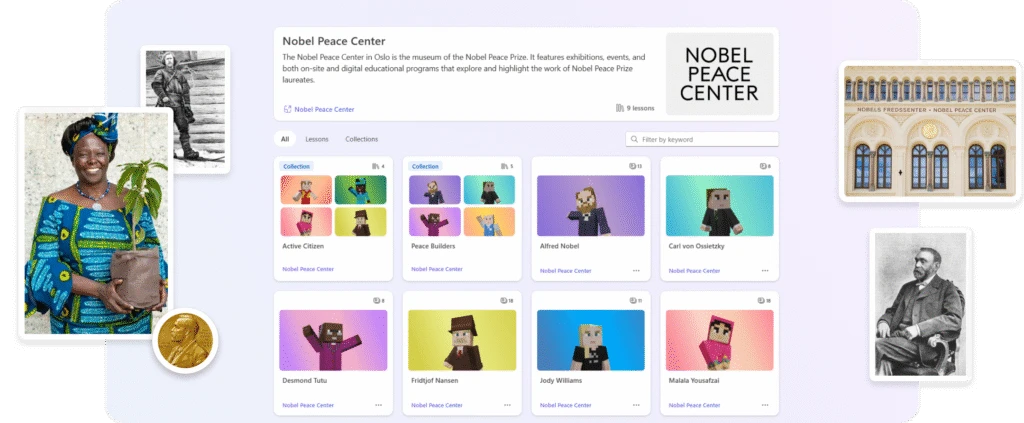
The Learning Zone app has received the ISTE Seal of Alignment, recognizing its adherence to research-backed teaching practices. It leverages content from prestigious partners, including NASA, the Nobel Peace Center, and the World Wildlife Fund, to provide interactive, high-fidelity learning experiences. For instance, the Nobel Peace Center collection allows students to explore human rights through the lives of Malala Yousafzai and Wangari Maathai, complemented by immersive activities within Minecraft Education. Educators can track student progress through these modules and share content via Microsoft Teams, with full integration into third-party Learning Management Systems (LMS) slated for late 2026.
Student-Centered AI: The Study and Learn Agent
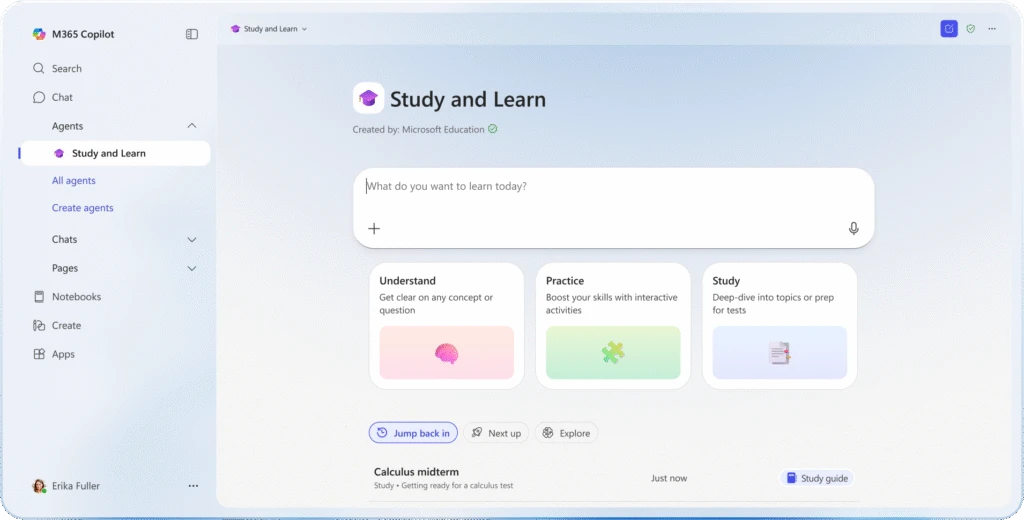
While much of the focus is on educator support, Microsoft is also introducing tools aimed directly at student growth. The "Study and Learn Agent" is an AI-powered companion designed for students aged 13 and older. Unlike general-purpose AI that might provide direct answers to homework questions, the Study and Learn Agent is built on learning science principles to foster critical thinking.
The agent guides students through adaptive exercises, using flashcards, matching games, and guided study sessions to help them master complex concepts independently. By acting as a tutor rather than a ghostwriter, the tool addresses long-standing concerns regarding the erosion of student effort in the age of generative AI. The goal is to nurture "metacognition"—the ability of students to understand and regulate their own learning processes.
Supporting Higher Education and Career Readiness
Recognizing the economic pressures on university students and the shifting demands of the global job market, Microsoft has announced a limited-time offer for higher education students. Eligible individuals can receive 12 months of free access to Microsoft 365 Premium and LinkedIn Premium Career.
This package is designed to support the "student-to-professional" pipeline. While Microsoft 365 Premium assists with academic research, organization, and presentation, LinkedIn Premium Career provides students with insights into hiring trends, access to LinkedIn Learning’s vast library of professional courses, and the ability to see how they compare to other applicants for internships and entry-level positions. This dual-platform approach acknowledges that academic success and career readiness are increasingly viewed as a single, continuous journey by both students and educational institutions.
Data Security and the IDC Blueprint for AI-Ready Schools
As schools integrate more sophisticated technology, the risks associated with cybersecurity and data privacy have become paramount. To mitigate these risks, Microsoft has introduced the Education Security Toolkit. This resource provides a structured framework for institutional leaders to evaluate their cybersecurity posture, offering guidance on compliance with international data protection standards and real-world scenarios for threat mitigation.
The IDC White Paper sponsored by Microsoft, "A Blueprint for AI-Ready Schools," further reinforces this focus on responsible adoption. The research indicates that successful AI integration is not merely a matter of purchasing software but requires a cultural shift within the school system. Key findings from the paper suggest that districts which prioritize "human-in-the-loop" AI—where AI augments rather than replaces human judgment—see higher levels of teacher satisfaction and better student outcomes. The paper outlines a multi-stage strategy for schools, beginning with "AI Exploration" and moving toward "AI Maturity," where technology is seamlessly woven into the pedagogical fabric of the institution.
Broader Impact and Industry Implications
The implications of Microsoft’s latest educational push extend beyond the classroom. By embedding its AI ecosystem in schools, Microsoft is positioning its technology as the standard for the next generation of workers. This move intensifies the competition with other tech giants, notably Google and Apple, who have long vied for dominance in the education sector.
Industry analysts suggest that the success of these programs will be measured by their ability to close the "digital divide." While affluent districts may easily adopt Copilot+ PCs and premium AI tools, the challenge for Microsoft will be ensuring that these innovations reach underserved populations. The company’s commitment to providing many of these tools at no extra cost to existing education customers is a strategic step toward democratizing access to high-end AI.
Furthermore, the focus on "skilling" 20 million people reflects an awareness of the global labor shortage in technical fields. By providing educators with the tools to teach AI responsibility, Microsoft is essentially outsourcing the massive task of global workforce retraining to the world’s existing educational infrastructure.
Looking Ahead to Bett UK 2026
The full scope of these innovations will be on display at Bett UK 2026, held in London from January 21–23. As one of the world’s largest education technology exhibitions, Bett serves as the primary stage for Microsoft to demonstrate the real-world applications of the Learning Zone and the Teach assistant to an international audience of ministers, school leaders, and practitioners.
As the age of AI continues to redefine the boundaries of what is possible in a classroom, Microsoft’s Elevate for Educators program and its associated tools signal a shift toward a more integrated, intelligent, and teacher-centric approach to education. By focusing on reclaiming time for educators and fostering independence in students, the company aims to ensure that the transition to AI-enhanced learning is both productive and secure, ultimately preparing the next generation for the complexities of a technology-driven future.