


The global education sector is currently navigating a pivotal transition as artificial intelligence moves from experimental pilot programs to integrated institutional infrastructure. In response to this shift, Microsoft has released a comprehensive update to its Education AI Toolkit, providing primary schools, universities, and regional districts with a formalized framework for scaling AI implementations. The revised toolkit is designed to address the growing demand for practical resources, planning support, and governance models as educational leaders seek to move beyond individual use cases toward systemic adoption. By streamlining the toolkit’s layout and introducing new sections focused on team-level innovation and autonomous agents, Microsoft aims to provide a roadmap for sustainable, secure, and student-centered digital transformation.
The updated toolkit reflects a broader trend in the education technology market, where the focus has shifted from the mere availability of generative AI tools to the strategic management of these technologies. According to recent industry reports, nearly 60% of educators are now using AI in some capacity, yet many institutions still lack a cohesive strategy for data privacy, faculty training, and long-term integration. The Microsoft Education AI Toolkit addresses these gaps by organizing its resources around three primary themes: student success, institutional innovation, and the simplification of IT security.
Evolution of AI Integration in Educational Frameworks
The release of this updated toolkit marks a significant milestone in the chronology of AI’s arrival in the classroom. When generative AI first gained mainstream prominence in late 2022, many educational institutions reacted with caution, focusing primarily on academic integrity and the potential for misuse. Throughout 2023 and 2024, this narrative evolved as districts began piloting small-scale projects, such as AI-powered tutoring assistants and lesson-planning tools for teachers.

By 2025, the conversation has matured into a focus on "institutional capacity." The updated Microsoft toolkit is a direct result of feedback gathered from these early adopters, who indicated a need for guidance on how to manage AI at scale. The transition from the "Hour of Code" to the "Hour of AI" highlights this shift, moving the focus from basic digital literacy to a deeper understanding of how autonomous systems function and how they can be governed within a public or private institution.
Core Pillars of the Updated Microsoft Education AI Toolkit
The toolkit is structured into five distinct sections—Overview, AI Navigators, Plan, Implement, and Research—all of which have been optimized for a landscape orientation to facilitate easier navigation during collaborative planning sessions. The organizational strategy is built upon three foundational pillars that dictate how an institution should view the impact of AI.
The first pillar, Student Success, emphasizes the use of AI-powered tools to support personalized learning. This includes tutoring-style support, automated assessments, and timely feedback loops that allow educators to intervene more effectively. Beyond immediate classroom support, this pillar focuses on preparing students for an AI-augmented workforce through skills-based pathways and industry-recognized certifications.
The second pillar, Institutional Innovation, targets the operational side of education. By leveraging AI-powered insights and automation, schools can modernize their infrastructure to improve faculty and staff productivity. This involves moving administrative workflows into more efficient, data-driven systems that reduce the time spent on repetitive tasks.

The third pillar, Simplify and Secure IT, addresses the critical need for data protection and governance. As schools handle sensitive student information, the toolkit provides guidance on using tools like Microsoft Security Copilot for threat detection. It emphasizes that a successful AI program must be built on a foundation of trusted adoption, where data privacy and security practices are applied rigorously across all platforms.
Scaling from Individual Snapshots to Institutional Sparks
One of the most significant additions to the toolkit is the "AI Sparks" section, which represents a shift from individual practice to collective institutional progress. Previously, the toolkit utilized "AI Snapshots" to highlight how a single practitioner might use a tool—for example, an educator using Microsoft 365 Copilot Chat to create accessible content for a diverse classroom.
In contrast, the new AI Sparks focus on team-level and department-level implementations. An example provided in the toolkit describes a district-wide literacy team using Learning Accelerators, such as Reading Coach and Reading Progress, to accelerate early literacy across all K-3 classrooms. In a higher education context, a Spark might involve an IT department using Microsoft Copilot Studio analytics to identify common helpdesk issues and proactively update resources. This move from isolated experiments to coordinated, campus-wide transformation is intended to create lasting change that survives beyond the tenure of a single innovative teacher or administrator.
The Rise of Agentic AI and Autonomous Workflows
The updated toolkit introduces the concept of "Agentic AI," a significant advancement over standard chat-based assistants. While traditional AI assistants require constant human prompting to perform tasks, agentic AI has the potential to support institutional operations by automating multi-step processes with a higher degree of autonomy. These tools can route complex administrative questions or manage multi-departmental workflows based on the specific governance and design parameters set by the institution.

Microsoft highlights two distinct paths for implementing these agents: Microsoft Copilot Studio for rapid, no-code creation, and Microsoft Azure AI Foundry for more sophisticated, custom-coded solutions. The toolkit points to the University of Leicester as a primary example of this technology in action. By implementing an AI-powered digital coach, the university successfully reduced staff workload while providing students with 24/7 access to essential information. This case study serves as a blueprint for other institutions looking to balance the need for high-quality student services with the reality of constrained human resources.
Action-Ready Frameworks and Stakeholder Alignment
To bridge the gap between theoretical planning and actual implementation, Microsoft has added a series of action-ready checklists. These checklists are designed to turn broad guidance into clear, assignable tasks for various stakeholders, including IT directors, curriculum leads, and school boards.
The implementation roadmap provided by these checklists ensures that institutions do not skip fundamental steps, such as establishing an AI leadership committee or conducting a thorough data privacy assessment. By providing a systematic framework for moving from assessment to action, the toolkit helps ensure that AI adoption is not only fast but also sustainable and aligned with the institution’s core educational mission.
Community Building and Global Research Foundations
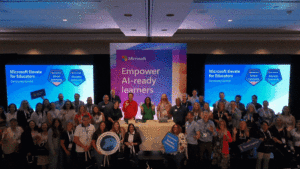
Recognizing that AI implementation is a social as well as a technical challenge, the toolkit emphasizes the "Microsoft Elevate for Educators" framework. This initiative combines the Microsoft Showcase Schools and the Microsoft Innovative Educator Expert (MIEE) programs into a unified community. The goal is to create a global network where leaders can share their experiences, troubleshoot common problems, and earn recognition for their innovation.

Furthermore, the toolkit includes a strengthened Research section. This area is curated to help teams find evidence-based content that validates their implementation approaches. By grounding their strategies in current research, school leaders can build stakeholder confidence and address concerns from faculty or parents regarding the efficacy and ethics of AI in the classroom. This section is particularly useful for administrators who must present their AI roadmaps to governing boards or public committees, providing them with the data necessary to justify investments in new technology.
Analysis of Broader Impact and Future Implications
The update to the Microsoft Education AI Toolkit reflects a broader maturation of the EdTech industry. Analysts suggest that as AI becomes a standard component of institutional infrastructure, the competitive landscape for schools and universities will increasingly be defined by their ability to leverage data effectively. Institutions that successfully move from "adoption" to "transformation" will likely see improvements in student retention, faculty satisfaction, and operational efficiency.
However, the shift toward agentic AI and systemic automation also brings new challenges. Questions regarding the "human-in-the-loop" requirement and the long-term impact on the educator’s role remain central to the discourse. The toolkit’s emphasis on "responsible AI" and "governance" suggests that Microsoft is aware of these tensions, positioning its tools not as replacements for educators, but as force multipliers that handle the "drudgery" of administration to allow for more meaningful human interaction.
As the Fall 2025 academic cycle approaches, the toolkit serves as a vital resource for institutions looking to move beyond the hype of generative AI. By providing a structured, evidence-based approach to scaling technology, Microsoft is attempting to standardize the way the world’s educational systems interact with artificial intelligence. The success of these updates will ultimately be measured by how well schools can bridge the digital divide, ensuring that AI-driven student success is accessible to all learners, regardless of their location or socioeconomic status.