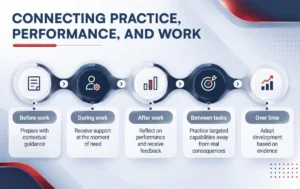




In the contemporary corporate landscape, the high completion rate of a training video is frequently mistaken for a successful learning intervention. Organizations across manufacturing, healthcare, and finance routinely report that 90 percent of their workforce completes digital training modules within weeks of deployment. Yet, internal audits, incident reports, and performance reviews often reveal that these metrics are decoupled from actual job performance. Months after a successful "launch," operational errors persist, suggesting that while employees may have watched the content, they have not internalized the necessary behavioral changes.
Industry experts and instructional designers are increasingly shifting their focus from passive viewership metrics to performance-based outcomes. This pivot requires a fundamental reassessment of how corporate media is produced, moving away from explanatory content—which describes topics—toward performance-oriented content, which demonstrates specific, actionable tasks.
The Evolution of Corporate Learning Metrics
The current crisis in corporate training efficacy can be traced to an over-reliance on Learning Management System (LMS) data. For decades, the standard for measuring the success of a video-based training initiative has been "completion percentage" and "average watch time." However, research from the Massachusetts Institute of Technology (MIT) and other academic institutions has shown that digital engagement does not inherently correlate with retention or skill transfer.
Historically, the training video model was derived from the broadcast television era: a narrator presents information, the audience watches, and a multiple-choice quiz confirms attendance. While this format is cost-effective to scale, it fails to account for the cognitive load required to translate visual information into manual or interpersonal action. Recent studies indicate that the most effective training interventions now treat video not as a medium for information delivery, but as a scaffold for cognitive rehearsal and practical application.
Defining Observable Behavior: The Pre-Production Imperative
The root cause of training failure is often identified during the pre-production phase. When a department requests a video—whether for a new expense reporting system or a warehouse safety protocol—the request is almost always framed as a topic rather than a behavioral objective.
To bridge this gap, modern Learning and Development (L&D) teams are adopting a "behavior-first" methodology. This involves a rigorous discovery process before a single frame is filmed. Stakeholders, including subject matter experts (SMEs) and frontline managers, are asked to define success through three specific lenses:
- The Context: Under what specific conditions does the task occur?
- The Standard: What is the exact physical or interpersonal output required?
- The Penalty of Failure: What is the specific error, and what is its operational or financial consequence?
For instance, rather than producing a generic "Warehouse Safety" video, successful firms now produce content that focuses on a singular, critical behavior: "When a conveyor belt stops unexpectedly, the employee must perform a lockout-tagout (LOTO) procedure before making physical contact with the machinery." This shift transforms the video from a passive overview into a procedural guide that can be directly mapped to observational checklists used by supervisors.
Data-Driven Design and Cognitive Science
The transition toward performance-based training is supported by a growing body of psychological research. A seminal meta-analysis published in the Journal of Applied Psychology by Paul Taylor, Darlene Russ-Eft, and Daniel Chan reviewed 117 studies regarding training interventions. The research concluded that passive knowledge acquisition diminishes rapidly over time, whereas skills demonstrated and practiced by the learner show high durability.
The data suggests that the "Show, Then Practice" model is the most effective approach to skill transfer. In this model, the video acts as a catalyst for active learning rather than an end-to-end instruction manual.
- Segmented Learning: Research by Szpunar, Khan, and Schacter at Harvard University demonstrated that breaking training content into short, five-to-seven-minute segments—interspersed with active decision-making quizzes—significantly reduces mind-wandering. Students who were tested between segments showed a marked improvement in final retention compared to those who watched continuous, uninterrupted footage.
- The Role of Negative Examples: High-performing training modules frequently include "anti-patterns"—footage showing how not to perform a task. By contrasting correct and incorrect procedures, learners develop a higher level of situational awareness, allowing them to identify potential hazards or process deviations in real time.
The Learning-Transfer Evaluation Model (LTEM)
As organizations look to move beyond basic completion rates, many are adopting Will Thalheimer’s Learning-Transfer Evaluation Model (LTEM). This framework forces a departure from vanity metrics by evaluating training at multiple tiers:
- Comprehension: Assessing if the learner understands the decision-making process required in a specific scenario.
- Task Competence: Evaluating whether the employee can perform the task under simulated or supervised conditions immediately following the video.
- Job Application: Measuring the persistence of the behavior at 30, 60, and 90 days post-training.
By focusing on these metrics, organizations can determine if a failure to implement a procedure is due to a lack of knowledge (a training failure) or a lack of support (a process or infrastructure failure). If an employee knows how to perform the task but is prevented by a clunky software interface or lack of necessary tools, no amount of video training will solve the problem. In such cases, the training department provides value by uncovering systemic operational flaws that would otherwise remain hidden behind high completion rates.
The Manager’s Role as the Final Link
A common finding in recent L&D audits is that training effectiveness is heavily dependent on the manager’s involvement. The most sophisticated video in the world cannot compensate for a manager who does not know how to observe or reinforce the desired behavior.
Industry leaders now include a "Manager’s Guide" with every training deployment. This document provides supervisors with the specific checklists and observation criteria needed to evaluate their direct reports. When managers are trained to look for specific behaviors—such as how an employee initiates a difficult feedback conversation or how they interact with a digital tool—the "transfer" of the training into the workplace becomes a structured, collaborative process rather than a hope-based one.
Strategic Implications for Future Production
The implications for corporate communications and L&D departments are significant. The move toward performance-based video requires more time, more cross-departmental coordination, and a greater emphasis on project management. However, the cost of "bad training" is increasingly recognized as a hidden operational tax. Every minute an employee spends watching a video that does not lead to improved performance is a minute of lost productivity.
Before commissioning a video in the future, organizations should adopt a standard set of diagnostic questions:
- What is the specific, observable behavior we expect to see on the floor 30 days from now?
- What is the current "pain point" or performance gap that this video is intended to close?
- How will the direct manager verify that the trainee has successfully mastered the task?
- Is this content better suited for a video, or should it be a quick-reference PDF or a hands-on simulation?
- What is the "business metric" (e.g., error rate, cycle time, safety incident frequency) that we expect this video to impact?
By treating video as a tool for behavioral change rather than a medium for content delivery, corporations can finally close the loop between the training room and the production floor. The era of the "90 percent completion" success story is fading; it is being replaced by an era where the effectiveness of a training investment is measured not by how many people watched the content, but by how much the content changed the way work gets done. As the competitive landscape intensifies, those organizations that prioritize observable, measurable performance over passive engagement will possess a significant, sustainable advantage in human capital development.